Tuesday, July 15, 2025

Insurgency: Justice Served

The NPA has unearthed more NPA arms caches.  This time in Iloilo. 


https://mb.com.ph/2025/07/10/army-unearths-npa-firearms-in-iloilo
The Philippine Army unearthed firearms left by New People’s Army (NPA) rebels in Igbaras town, Iloilo province.
Troops from the 61st Infantry Battalion located the firearms in Barangay Bagay following information from former NPA rebels.
Recovered  were two M16 rifles, two long M16 magazines, ammunition, two bandoliers, and  communist paraphernalia.
The 3rd Infantry Division  lauded the 61st IB under Lt. Col. Arturo Balgos Jr. for their accomplishment.
 Major Gen. Michael Samson, 3rd ID chief, thanked the two former rebels for their assistance.
“I also attribute the successful capture of the arms cache with high-powered firearms to our former rebels. Their willingness to share vital information is a strong indication that they are no longer bound by the false promises of the NPA,” added Samson.

Two former rebels helped find these weapons. There is no word on how long they waited after surrendering to submit this information. Surely it's not important. 

In Butuan weapons were seized after a clash with the rebels. 

https://www.pna.gov.ph/articles/1253774

Twin encounters Monday morning in the hinterlands of Barangay Pianing, Butuan City, resulted in the death of an unidentified New People’s Army (NPA) rebel and the recovery of two high-powered firearms.

In a statement Tuesday, the Philippine Army’s 4th Infantry Division (4ID) said troops from the 29th Infantry Battalion (29IB), under the operational control of the 901st Infantry Brigade, were dispatched early Monday to respond to civilian reports of NPA insurgents in the area.

The first armed confrontation occurred at approximately 5:20 a.m. and lasted over two minutes before the rebels abandoned their position. The second encounter happened around 7:30 a.m. during the pursuit operation, lasting more than five minutes and resulted in the death of an NPA member and the recovery of one M16 rifle and an R4 rifle.

“The civilian reports indicated that the rebels were conducting extortion and recruitment activities in the area,” said 291B commander Lt. Col. Mark Tabon.

He also recognized the timely and accurate information provided by the residents and lauded their steadfast support for the government’s peace and security efforts, particularly in ending the local communist armed conflict.

Meanwhile, the 4ID also reported Tuesday the surrender of five NPA rebels in Surigao del Sur on July 4 and 6.

Tabon said the surrenderers include a team leader, a squad leader, a medic and two Milisya ng Bayan members operating in the San Miguel town areas. They also handed over seven high-powered firearms to the government -- five AK-47 rifles, one M14 rifle and an RPK light machine gun.

“This latest success highlights our relentless pursuit of peace and security in Caraga. Every neutralized enemy and captured firearm diminishes the NPA's capacity to conduct armed violence,” Maj. Gen. Michele Anayron Jr., 4ID commander, said in a separate statement.

Civilian reports say the NPA was conducting extortion and recruitment activities. But we have heard from the AFP that the NPA is unable to recruit because they have no leadership. Seems that is a wrong analysis. Meanwhile 5 rebels surrendered in Surigao del Sur. One of these surrenders was a team leader and another a squad leader.  That is two leaders. 

In Caraga an NPA commander was killed during a clash. Local Indigenous People leaders call it justice.  

https://www.pna.gov.ph/articles/1253910

Indigenous People (IP) leaders in the Caraga Region view the recent death of communist New People’s Army (NPA) commander Roel Tremidal Neniel as justice for the many IPs executed under his command.

Neniel, commanding officer of the NPA’s North Eastern Mindanao Regional Committee (NEMRC), was killed Monday in an encounter with troops from the Philippine Army’s 901st Infantry Brigade (901Bde) in the hinterlands of Barangay Pianing here.

“Neniel has been sowing terror in the remote IP villages in Surigao del Sur and parts of Agusan del Norte and Surigao del Norte for years,” Datu Rico Maca, the IP Mandatory Representative (IPMR) of San Miguel, Surigao del Sur, said in a Wednesday interview.

Maca recounted that Neniel’s group abducted his cousin, Ariel Boy Maca, and five other IPs in 2020. Their bodies were later found in the fringes of Sitio Gacub in Carmen, Surigao del Sur.

“It was Neniel who did that, former rebels who witnessed the incident told me later,” Maca asserted.

An IP youth leader from Agusan del Norte, who requested anonymity for security reasons, said Neniel's group was widely feared among IP communities, particularly in the most remote areas.

“In my final college years, I found Jacob’s group roaming and scaring the neighborhood. They suspected me of being a government agent, but my uncle intervened and explained I was a student who rarely goes home,” the youth leader said.

The incident caused him shock and a nervous breakdown, leading him to stay away from his community for over a year.

In a statement Wednesday, the 901Bde said Neniel was wanted for multiple crimes, including civilian and IP murders, arson, and kidnappings in Surigao del Norte, Agusan del Norte, and Surigao del Sur.

“His group was also responsible for multiple acts of arson targeting government projects and private properties in Claver, Gigaquit, Bacuag, and Placer, all in Surigao del Norte; Carrascal in Surigao del Sur, and parts of Agusan del Norte,” the 901Bde stated.

Brig. Gen. Arsenio Sadural, commanding officer of the 901Bde, noted that neutralizing Neniel marks a significant step towards achieving justice for all victims, whose families and loved ones have long awaited it.

“Our forces will relentlessly pursue the remaining NPA terrorists to serve justice, protect communities, and ensure a peaceful environment for all,” he said.

He won't be missed but is there another leader to replace him? That is the more important question. 

A suspected rebel was killed during a clash in Camarines Sur. 

https://newsinfo.inquirer.net/2080210/suspected-rebel-slain-in-camarines-sur-clash

A suspected New People’s Army (NPA) rebel was killed on Tuesday following an encounter with  government forces in Lupi, Camarines Sur, authorities said Wednesday.

Col. Virgilio Olalia Jr., chief of the Camarines Sur police, said in a report that while a platoon of the Philippine Army was conducting a combat clearing operation, they had a 10-minute firefight with the alleged members of the NPA in Barangay Belwang at 11:43 a.m.

Authorities recovered one body and a high-powered firearm after the firefight.

They conducted checkpoint and choke point operations at possible exit points of fleeing suspected rebels.

No one was hurt on the government side

Suspected rebels? Alleged rebels? Is there nothing to let the AFP know they were actual rebels? 

In Bulacan an ex-NPA rebel surrendered. He brought his gun along. 

https://www.pna.gov.ph/articles/1253906

A former member of the Communist Terrorist Group (CTG) voluntarily surrendered to authorities in Barangay Sampaloc, San Rafael on Tuesday, carrying an unlicensed firearm.

In a statement on Wednesday, Lt. Col. Ronnie Albino, commander of the 2nd Provincial Mobile Force Company (PMFC), identified the surrenderer as alias “Ka Rey,” 47, a construction worker and resident of Doña Remedios Trinidad (DRT), Bulacan.

"Ka Rey was a former member of KLG Sierra Madre-Squad Uno, who was included in the Periodical Status Report (PSR) list in 2001," Albino said.

According to Ka Rey, he was recruited in 1997 under the leadership of alias “Jimmy” and was forced to join the movement due to extreme poverty. He admitted participating in armed encounters in Sapang Munti and Bulakan, Bulacan, and served as a collector of the so-called “revolutionary tax.” He permanently quit the movement in 2002 to start his own family.

As a demonstration of his sincerity, he surrendered his .38 caliber revolver without a serial number, which was immediately subjected to proper documentation.

The surrender was accomplished with the help of combined forces from the 2nd PMFC Bulacan, PIT Bulacan East, Regional Intelligence Unit 3, 24th Special Action Company, 2nd Special Action Battalion, PNP Special Action Force, Regional Intelligence Division 3, Police Intelligence Unit Bulacan, DRT Municipal Police Station, and 301st Regional Mobile Force Battalion 3.

Col. Angel Garcillano, acting provincial director of the Bulacan PPO, underscored the importance of former rebels' conversion as a step toward true peace.

“Every surrendered member of the movement is a win for our community. We continue to welcome and give new hope to those who want to change their lives,” Garcillano said.

This guy left the NPA in 2002 and is only now formerly surrendering? Does someone like that qualify for all the E-CLIP benefits? He has clearly been living his best life for two decades. Why did he bring a gun? This seems like pageantry. 

In Maguindanao 11 BIFF extremists have surrendered. 

https://www.pna.gov.ph/articles/1253957

Eleven members of the lawless Bangsamoro Islamic Freedom Fighters (BIFF) voluntarily surrendered to military authorities in Maguindanao del Sur on Wednesday, an Army official said.

Lt. Col. Michael Allah Eugenio, commander of the Army's 90th Infantry Battalion (90IB), stated that the surrenderers, exhausted from evading the relentless operations of the 90IB, laid down their guns and accepted reconciliation.

“They turned in 12 assorted high-powered firearms as evidence of their determination to end violent extremists that, they realized now, led them nowhere,” Eugenio said. The BIFF members yielded at the 90IB headquarters in Datu Saudi Ampatuan town.

He added that the surrender resulted from the increased community engagement by 90IB troopers, who convinced the extremists that peace is the best option.

The surrenderers will be enrolled in the Enhanced Local Armed Conflict program and the “Tulong ng Gobyernong Nagmamalasakit (TUGON)” program of the Bangsamoro Autonomous Region in Muslim Mindanao.

Eugenio called on other extremists still in the field to follow suit and take advantage of the government’s peace offer.

They realized their causes "led them nowhere." That is not true. It has led them into the arms of two bountiful government programs which will give them cash, food, job training, and housing assistance. 

Monday, July 14, 2025

Chinese Nationals Elected to High Office In The Philippines

The situation regarding Alice Guo is indicative of a much larger problem. To refresh, Guo is a Chinese national who moved to the Philippines at a young age. Somehow she fraudulently obtained a Philippine birth certificate and was able to avail of all the benefits of Philippine citizenship. That included running for and winning the office of Mayor of Bamban. Senator Sherwin Gatchalian says the nation's civil registry system must be overhauled to prevent this from ever happening again. 

https://www.pna.gov.ph/articles/1253786

Senator Sherwin Gatchalian is seeking to overhaul the country’s civil registration system to prevent foreign nationals from fraudulently acquiring Philippine citizenship, following the controversial case of former Bamban mayor Alice Guo, also known as Guo Hua Ping.

We want a new CRVS system so there won’t be another Alice Guo — someone pretending to be Filipino just to enter government and deceive people," Gatchalian said in a news release Tuesday.

The lawmaker filed the proposed Philippine Civil Registration and Vital Statistics Act, which seeks to establish a modern and streamlined registration system to accurately determine an individual’s identity for administrative and legal purposes.

The measure raises penalties for forging civil registry documents, providing false information during registration, and aiding the production of fraudulent records.

Gatchalian cited data from the Philippine Statistics Authority indicating that, as of November 2024, at least 1,627 suspicious birth certificates tied to foreign nationals have been flagged, with 18 cases endorsed to the Office of the Solicitor General for cancellation.

A recent court ruling found Guo to be “undoubtedly Chinese,” reinforcing concerns over gaps in the country’s identity verification systems.

The bill is part of a broader effort to protect national security and uphold the integrity of public service, Gatchalian said.

“We must ensure that only legitimate Filipinos have access to public office and government benefits,” he said.

The civil registry system is very prone to abuse with 1,627 suspicious birth certificates tied to foreign nationals being flagged. Another problem is the lack of birth certificates by legitimate citizens. Many Filipinos are not registered at birth. The whole CRVS system is definitely in need of being overhauled. 

Unsurprisingly it turns out the situation with Alice Guo is not singular. Joseph Chua Cua ran for mayor of Virac, Catanduanes in the 2025 elections and was recently disqualified due to questions over his citizenship. He is a former governor of  a former governor of Catanduanes and a former mayor of San Andres.

https://www.pna.gov.ph/articles/1254161

The Commission on Elections (Comelec) 1st Division has disqualified Joseph Chua Cua from the May 2025 midterm elections due to unresolved issues surrounding his citizenship, even though he lost in the race for mayor of Virac, Catanduanes.

In a 10-page decision promulgated on Friday and released to the media on Saturday, the Comelec granted the petition for disqualification filed by reelectionist Sinforoso Sarmiento, who alleged that Cua is not a Filipino citizen but a Chinese national, rendering him ineligible to run for public office.

Cua, a former governor of Catanduanes, lost to Sarmiento.

“Accordingly, the Petition for Disqualification is granted. Respondent Joseph Chua Cua is hereby disqualified as a candidate for municipal mayor of the municipality of Virac, Catanduanes,” the ruling stated.

The poll body noted that Cua failed to correct or clarify his citizenship status in official documents. His Philippine Statistics Authority (PSA) birth certificate shows he was born in San Andres, Catanduanes, on Oct. 16, 1962, but his prolonged absence from the country and inconsistent residency claims cast doubt on his qualifications.

“Upon calculation, and assuming that Respondent was a resident of the Philippines since birth, he should have been a resident herein for 62 years and six months on the day before the 12 May 2025 NLE (National and Local Elections). However, as it appears, Respondent has been conspicuously absent for one year in the Philippines, something which he failed to explain. This gap in Respondent's residency casts doubt on his compliance with the residence requirement of his derivative naturalization,” the Division said.

It further cited discrepancies in Cua’s residency declarations. While claiming to have lived in Virac for more than 61 years, Cua previously served as mayor of his birthplace, San Andres, from 2001 to 2004.

“It would be mathematically impossible for him to reside in Virac for 61 years and six months while serving as mayor of another municipality,” the Comelec stated.

“This raises even more serious questions regarding the respondent's eligibility to run for any local elective position.”

The poll body pointed out that possessing an identification certificate or being recognized by certain agencies as a Filipino does not conclusively establish citizenship.

“Exercising rights exclusive to Filipinos does not automatically make one a citizen,” it added, stressing that further credible evidence was lacking.

Where was the examination of Cua's citizenship during those previous elections? Perhaps there were no warning signs that would prompt anyone to look. The Comelec needs a complaint in order to investigate a candidate. 

The dismissal of Guo and Cua due to being Chinese nationals raises troubling questions. How many more Chinese nationals occupy high office in the Philippines? Why is this happening? Is this a coordinated effort by the Chinese Communist Party to undermine the Philippines? If that is the case then much more than revamping the CRVS system needs to be done. 

Sunday, July 13, 2025

The God Culture: Misinterpreting Mendoza - Lechios Is Not Luzon

Timothy Jay Schwab who is The God Culture has been producing a series of videos about how the Lequios Islands are the Philippines. That subject has been dealt with in great detail on this blog because the videos are all based on Tim's The Smoking Quill series of articles and I have demonstrated how those articles are filled with half-truths and outright lies. In the third video of this series Tim discusses the work of Juan Gonzalez de Mendoza. This is based on an article I did not examine so let's take a look at it. 

https://thegodculturephilippines.com/spanish-government-document-98-confirmed-lequios-is-the-philippines/

🎓 Mendoza Confirms It All 

In a separate document, Juan Gonzales de Mendoza writes: 

[From Java] "...and the kingdom of the Lechios: and in equal distance, are the Japones." 

He clearly places the Lechios halfway between Java and Japan — i.e., the Philippines. Not Japan. Not Ryukyu. Again, this matches the same progression: 

Java ➔ Luzon ➔ Japan, Equal distance from Java to Lequios and then, Lequios to Japan, manifests Lequios as about half way in the journey.  

Not: 

Java ➔ Ryukyu ➔ Japan [That would distort the map completely.]

🔨 END OF DEBATE!  

An Amazing Visual. The Final Nail 

Mendoza defines Lequios as approximately halfway between Java and Japan. That’s definitive. 

This confirms Lequios is Luzon—recognized not just by Mendoza, but also Mafra, Spanish Document #98, Barbosa, Pinto, Pigafetta, Magellan, and every credible source of the era.

There are two things to note here. 

1. Tim does not give the source for the quote in this article or in his video. He also does not give the title of the book in the article or the video. The title is The History of the Great and Mighty Kingdom of China.

2. Tim cites only a brief portion of a much longer section. In the video he cites a longer section starting with the word betwixt but he still ignores the context of Mendoza's book. 


https://archive.org/details/historyofgreatmi14151gonz/page/6/mode/2up

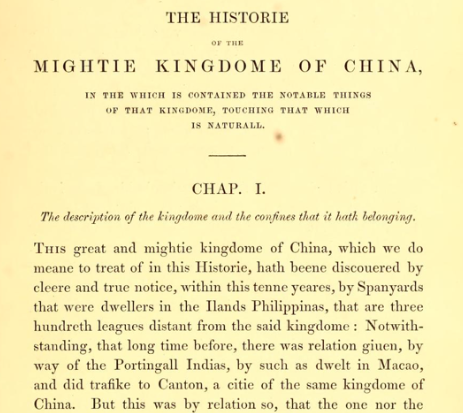
This great and miglitie kingdome of China, which we do meane to treat of in this Historie, hath beene discouered by cleere and true notice, within this tenne yeares, by Spanyards that were dwellers in the Hands Philippinas, that are three hundreth leagues distant from the said kingdome : Notwithstanding, that long time before, there was relation giuen, by way of the Portingall Indias, by such as dwelt in Macao, and did traiike to Canton, a citie of the same kingdome of China. But this was by relation so, that the one nor the other could satisfie, for that there was founde varietie in that which was true, till the yeere of 1577. Frier Martin de Gorrada, prouincial of the Augustine friers, who were the first discouerers of the said Ilands Philippinas, and ministred first the holy baptisme amongst them, with his companions, frier Hieronimo Martin, Pedro Sarmiento, and Myghell de Loarcha, cheefe officers of the citie of Marrila in the said Ilands, by the order and commandement of Guido de Labassares, gouernour thereof, did enter into the saide kingdome of China, led and gouerned by a captaine belonging to the king of the said kingdome, called Omoncon.

Of the comming of this Omoncon vnto the Ilands Philippinas, and of his hardines to carrie the aforesaid vnto the firme land, he being commanded to the contrarie vpon paine of death, and how he was receiued, and great courtesie shewed, and of other things verie curious, you shall finde in the second part of this historic, where as is the substance and whole relation of all that was brought vnto the king of Spaine.

You shall vnderstande that this mightie kingdome is the Orientalest part of all Asia, and his next neighbour towards the Ponent is the kingdome of Quachinchina, whereas they doo obserue in whole all the customes and rites of China. The greatest part of this kingdome is watred with the great Orientall Ocean sea, beginning at the Iland Aynan, which is hard by Quachinchina, which is 19 degrees towards the North, and compassing towards the South, whereas their course is northeast. And beyond Quachinchina towards the North, the Bragmanes do confine, which are much people, and verie rich, of golde, siluer, and pretious stones, but in especiall, rubies : for there are infinit. They are proude and hawtie men, of great corage, wel made, but of browne colour : they haue had (but few times) warre with them of China, in respect for that betwixt both the kingdomes, there are great and mightie mountaines and rockes that doth disturbe them. And harde vnto this nation ioyneth the Patanes and Mogore which is a great kingdome, and warlike people, whose head is the Gran Saniarzan : They are the true Scythas or Massagetas, of whom it is affirmed that they were neuer ouercome by any other nation : they are a people well proportioned and white : by reason they dwel in a cold countrie. Betwixt the West and the South is the Trapobana, or Samatra, a kingdome very rich of gold, pretious stones, & pearles : and more towards the South, are the two lauas, the great and the lesse, and the kingdome of the Lechios  and in equall distance, are the lapones 

pgs. 7-9 

In this full section Mendoza mentions the discovery of the Philippines. Then he mentions the nations surrounding China which include Sumatra, Java, Lechios, and Japan. If the Lechios is Luzon as Tim contends why does Mendoza refer to it by two different names? In volume 2 of his book Mendoza does not mention the kingdom of the Lechios but he mentions Luzon many times. Again, if they are the same place why is he not consistent with the names he uses?

The answer is because Lechios and Luzon are not the same. Let's look closely at the relevant portion of the sentence. 

and more towards the South, are the two lauas, the great and the lesse, and the kingdome of the Lechios and in equall distance, are the lapones 

Remember, Mendoza is naming all the nations surrounding China. So, to the south means south of China. Mendoza says Java is to the south of China. Then he mentions the kingdome of the Lechios. Is that supposed to be in the south? Luzon is southeast of China so it could be. But don't forget Mendoza has already mentioned the discovery of the Philippines. The Philippines would be part of the kingdom of Spain. That rules out Luzon as being Lechios. What about "in equal distance?" That is "in equal distance" from China. China is the measure of all these places. Lechios and Japan are both equidistant from China. That means Lechios is what we know today as the Ryukyu Islands. It's not hard to figure out if one reads the entire context of the book instead of seizing on part of a sentence as Tim does. 

Lechios is mentioned three times in Mendoza's book. This raises a problem. Either Tim did not bother to look at those references or he did and simply ignored them because they were too problematic. The fact is none of the three references to Lechios point to Luzon. Let's look at the remaining two.

Then the king perceiuing the request and petition of his kingdome and subiects, and being fully satisfied that this perswasion was requisite to be put in execution : he straight wayes set it a worke, and commanded vpon great penalties, that al his subiects and vassals naturall that were in any strange countries, that in a time limited, they should returne home to their owne country and houses : and likewise to the gouernours of the same countries, that they should in his name abandon and leaue the dominion and possession that he had of them : excepting such as would of their owne good will acknowledge vassalage, and giue him tribute, and remaine friends, as vnto this day the Lechios and other nations do.

pg. 93-94

This passage says unambiguously that the Lechios pay tribute and acknowledge vassalage to the king of China. That is not a description of the Philippines. Luzon was never a Chinese vassal state. But the Ryukyu Islands were. 

In the spring of 1609, the Ryukyu kingdom 琉球王国 was defeated by an invasion by the Satsuma domain of Japan, ruled by the Shimazu 島津 family. King Shō Nei 尚寧 and major Ryukyuan officials were marched off to Satsuma as prisoners of war. In response to the daimyo’s report on the invasion, the Tokugawa bakufu recognized Satsuma’s control over Ryukyu. The Tokugawa authorities, thus, brought Ryukyu, a kingdom that had maintained tributary relations with Ming China since the latter half of the fourteenth century, within the political orbit of Tokugawa Japan. From then until 1879, when the Meiji government abolished the kingdom and annexed Ryukyu into Japan as Okinawa Prefecture, the Ryukyu kingdom accepted both Chinese and Japanese claims of suzerainty.

 The Tokugawa World, pg. 420

Here is the third and final mention of Lechios that disproves Tim's claim it is Luzon.

It is not from our purpose (now after that we haue told you of the gouernement of this mightie kingdome) to giue you to vnderstand how that there be great and famous philosophers, as well naturall as morall, and other things of great pollicie and curiosity : to tel you now of their characters, and the manner they haue in writing, and then of the colledges and schooles. Now vnto the first. You shall finde verie fewe in this kingdome but can both write and reade, yet haue they not the alphabet of letters as we haue, but all that they doe write is by figures, and they are long in learning of it, and with great difiicultie, for that almost every word hath his character. They do signifie the heauen, which they do call Guant, by one character alone, which is this (Chinese character) the king, whom they doo call Bontay, by this (Chinese character), and by consequent the earth, the sea, and the rest of the elements. They do vse more than sixe thousand characters , different the one from the other, and they doo write them verie swiftly (as it hath beene scene many times at the Philippinas, by manie Chinos that are there, and come thither daily) ; it is a kinde of language that is better vnderstood in writing then in speaking (as the Hebrue toonge), by reason of the certaine distinction of points that is in euery character differing one from the other, which in speaking cannot be distinguished so easilie. Their order of writing is cleane contrarie vnto ours, for that they doo beginne their lines from aboue downewards, but in verie good order : likewise they begin their lines at the right hande and write towards tlie left, contrarie vnto vs. They keepe the verie same order in their printing, as you shall vnderstande, and as may he seene this day at Rome in the librarie of the sacred pallace. And likewise in that which King Philip hath caused to be erected in the monasterie of Saint Laurence the royall, and also in other places ; in this order as I haue saide, and of their characters to the which I referre me, it is an admirable thing to consider how that in that kingdome they doo speake manie languages, the one differing from the other : yet generallie in writing they doo vnderstand one the other, and in speaking not. The occasion is, for y one figure or character vnto them all doth signifie one thing, although in the pronouncing there is difference in the vowels. The character that doth signifie a citie is this (Chinese character) and in their language some doo call it Leombi, and others Fu, yet both the one and the other doo vnderstande it to bee citie; the like is in all other names. And in this order doo communicate with them the Japones, Lechios, those of Samatra, and those of the kingdome of Quachinchina and other borderers vnto them : whereas in their speech or language, there is no more vnderstanding then is betwixt Greekes and Tuskanes.

pgs. 120-122

In this section Mendoza discusses the written Chinese language. He says the language is seen being used by Chinese who visit the Philippines. Then he says this written language is how the Chinese communicate with the Lechios. Why is that? Because they were a tributary of China unlike Luzon. By distinguishing between Chinese visiting the Philippines and Chinese communicating with the Lechios Mendoza again treats the Lechios as separate from the Philippines.

With these two sections, Tim's assertion that the kingdom of the Lechios is Luzon is revealed to be a total lie. Again, Tim's disregard of these two passages which overturn his theory reveal he is either an ignorant and poor researcher or he is being duplicitous. Neither of which is a good look for Tim. Remember, Tim has said to even suggest he is not familiar with the sources he cites is to be untruthful.

One claiming we do not even read these sources, and did not even try to prove, when we quote and explain them in a massive number of pages, is clearly not one representing the truth.

https://thegodculturephilippines.blogspot.com/2025/03/the-god-culture-thegodculturephilippine.html

That being the case I say with full confidence that Tim is a mendacious, duplicitous, liar. He is familiar with Mendoza's book, or at least with the three places Lechios is mentioned, and has willfully twisted it to say what it does not. 

There is one other thing in the video that is worth mentioning. Apparently Tim has been meeting with Phds and other academics to discuss his theories. He claims he has gotten no pushback. 

9:50 In this age, a spotlight will be placed on this mindset exposing it and many academics will likely buck the system. We are not finding anyone so far, not a single one, who has pushed back to that degree. They have been willing to listen and they are enthralled with the information that is just plain not being taught in academia today. But it should be and they agree.

Lequios is Luzon: Bishop Mendoza Confirms It All! Return of the Lequios 3

It would be interesting to know exactly who Tim is speaking with and how he is presenting his information. What exactly are their qualifications? Have they read his books? Are they saying they will look at the information thoroughly and to get back to them after they have had time to examine Tim's claims? Because there is no way anyone who has meticulously examined Tim's claims will find them to be truthful. The lies jump off every single page he writes and appear in every single video he produces. The above lie about Mendoza is just one example of hundreds. It sounds good but when put under a microscope it falls apart.

If Tim had bothered to read the context of Mendoza's book he would have found that Lechios as Luzon does not hold up. The kingdom of Lechios was a tributary state and vassal of China unlike Luzon. But Tim is quite fond of half-truths, half-quotes, footnotes, and anything else he can twist to fit his pseudo-historical project of proving the Lequios islands are Luzon. That is the method of Timothy Jay Schwab who is The God Culture. 

Saturday, July 12, 2025

The God Culture: Timothy Jay Schwab's Footnote Fetish

Even after learning the truth of a matter Timothy Jay Schwab who is The God Culture cannot bring himself to deal with it. Case in point is what he has to say about Barbosa's book noting that the Lequios Islands are 175 leagues to the east of China. That information is something Tim found in a footnote to a translation of Barbosa's book. He wrote an article about it claiming it changes everything. On closer inspection I myself found the text to which the footnote referred and noted that it is a singular variant within a multitude of editions of Barbosa's book. It is only found in an older Spanish translation and not in any original Portuguese text.

Tim has a new video about the 175 leagues and he completely ignores that fact. 


175 Leagues to Truth: The Real Lequios Was Never Ryukyu. Return of the Lequios Part 2

Description: What if the real Lequios wasn’t Ryukyu… but Luzon all along? In this eye-opening deep dive, we expose the long-buried truth behind Duarte Barbosa’s “175 leagues to the east”—a footnote that leads straight to the Philippines. 

0:16  Today, we uncover a truth footnoted into silence. A mystery erased by empire. 

18:58 The truth was never buried. It was footnoted.

Tim does show the footnote very briefly at 18:58. 


It's easy to miss because the image is not static, Tim does not highlight it, and the version he is using is quite odd. It's not a PDF of the book. Here is a proper screenshot of this footnote from a PDF.

https://archive.org/details/in.ernet.dli.2015.189299/page/n257/mode/2up

The rest of the video is mostly AI slop with images that have nothing do with the topic. This is not only bad research it's a steep decline in the quality of Tim's videos which used to be meticulously put together with many supporting documents and references. This video has none of that. In fact, all of his most recent videos are nothing but AI slop. It seems Tim has lost his mojo. 

As I mentioned above, I wrote a lengthy article about this footnote and did the work Tim was too lazy to do. The footnote Tim cites is a reference to an existing Spanish text. Here is Lord Stanley's translation of the section on the Lequeos from the Spanish version.

https://archive.org/details/descriptionofcoa00barbrich/page/206/mode/2up

LEQUEOS.

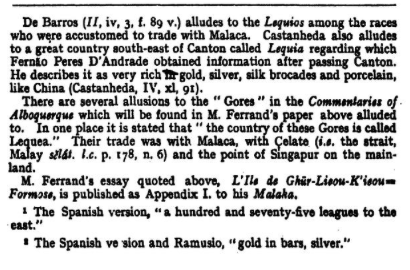
Opposite this country of China there are many islands in the sea, and beyond them at a hundred and seventy-five leagues to the east there is one very large which they say is the mainland, from whence there come each year to Malaca three or four ships like those of the Chinese, of white people whom they describe as great and wealthy merchants. They bring much gold in bars, silver, silk and many very rich silk stuffs, much very good wheat, beautiful porcelain and other merchandise. And they ship pepper and other things which they carry away. These islands are called Lequeos, the people of Malaca say that they are better men, and greater and wealthier merchants, and better dressed and adorned, and more honourable than the Chinese. There is not much information about these people up to the present time, because they have not come to India since the King of Portugal possesses it.

Oh, look. It's not a marginal annotation. "175 leagues to the east" is embedded in the text. Tim is wrong again. What a shock. 

Lord Stanley has a note on this passage regarding the identity of the Lequeos. 

The Liu Kiu Islands. Lequio major and minor, Y Fermosa, and Reix magas, form a group in Ortelius : in Homannus Formosa is in its proper place, and the group is called Lequeyo or Riukiu Islands.

I know Tim reads this blog which means he knows about Stanley's English translation and the Spanish translation which both contain the 175 leagues distance. So, why did Tim not use it? Why did he bring up a footnote? It's because he is attempting to prove the Lequios Islands are the Philippines and he needs the conspiratorial narrative that the true location of the Lequios Islands were covered up. But it hasn't been covered up. It hasn't been "footnoted." Stanley's translation and the Spanish translation are available to people who are able to to conduct real research. I found both of those texts with no trouble. Tim's omission of Stanley's text in favor of a footnote shows he is not interested in actual history but in pushing his conspiratorial narrative which is completely false as I have proven in many articles on this blog. 

This is not the first time Tim has declined to use primary sources in his books, articles, and videos. Tim regularly uses news reports, summaries, editorials, and Wikipedia as proofs for his claims. It is safe to say Timothy Jay Schwab who is The God Culture has a footnote fetish. 

Friday, July 11, 2025

Retards in the Government 425

 It's your weekly compendium of foolishness and corruption in the Philippine government.


https://mb.com.ph/2025/07/06/cop-probed-for-pouring-rugby-on-2-street-kids

The Tacloban City Police Office is investigating the viral video of a police officer who allegedly poured rugby and solvent on two street children here. 
Police Major Shenna Layog, TCPO Station 2 chief, condemned and said they are taking immediate action to address the incident. 
“The Tacloban City Police Office-Police Station 2 strongly condemns any form of misconduct by its personnel, particularly violations of human rights involving minors.” 
She added that the police personnel involved has been restricted to the premises of the station pending the outcome of the investigation. 
Layog conducted a Personnel Information and Continuing Education (PICE) session on Sunday, July 6. 
“The session emphasized the importance of maximum tolerance among PNP personnel in the performance of their duties, particularly in handling cases involving Children in Conflict with the Law (CICL).”

A PNP officer is being investigated for pouring rugby on two street children. 

https://newsinfo.inquirer.net/2079062/ca-upholds-dismissal-of-bi-official-in-pastillas-scheme

The Court of Appeals (CA) has denied the appeal of a former immigration officer, tagged as one of the group chat administrators of the notorious “pastillas” scheme, who had sought to overturn a 2022 grave misconduct charge.

In a 15-page decision dated June 30, the CA’s 17th Division found Gabriel Ernest Estacio guilty of grave misconduct and conduct prejudicial to the best interest of the service when he “played a significant part” in conspiring with other immigration officers to solicit and receive money from Chinese nationals so they could enter the country even without the required documentation.

“Considering that Estacio was found guilty of grave misconduct and conduct prejudicial to the best interest of the service, and grave misconduct being the most serious charge, the penalty of dismissal imposed by the Ombudsman was correct,” the appellate court said in the decision penned by Associate Justice Marietta Brawner-Cualing.

The CA effectively denied his appeal and upheld the 2022 consolidated decision of the Office of the Ombudsman that found him guilty of the two administrative charges.

The so-called pastillas scam was a scheme allegedly orchestrated by high-ranking officials of the Bureau of Immigration in 2017 in which Chinese nationals were allowed seamless entry into the country for a service fee of P10,000.

The bribe money given to immigration agents were hidden inside rolled up sheets of paper which resembled pastillas, a local soft candy wrapped up in wafer-thin paper, to avoid detection.

Estacio argued that his name was never mentioned in the chat groups and that there was no evidence that he received money or gave preferential treatment to any incoming passengers.

But the CA ruled that his participation was established when whistleblower Allison Chong personally identified him as a member of the chat groups 3SOME, Timbre Central, and as one of the administrators of the Viber Group Chat Administrators.

“His status as one of the administrators of the Viber group speaks volumes as to the extent and importance of his participation in the pastillas scheme,” the CA said.

The court noted that he failed to explain why his name was put in that status and why he did not make an effort to remove his name as an administrator.

“It is of no moment that Estacio’s name was never mentioned in the messages in the Viber group chat. His membership and presence in the said Viber group is sufficient to establish that he was part of the group and has knowledge of the activities of such group,” the CA said.

The court added: “It is sufficient that he played a significant part which was connected and cooperative to the success of the whole enterprise. Consequently, even if there was no direct evidence that Estacio received money in connection with the pastillas scheme, he is still liable by reason of conspiracy,” the CA said.

“Indeed, by allowing certain Chinese nationals to enter the country without going through the usual immigration process, Estacio compromised the integrity of the country’s immigration laws, as well as its security,” the court said.

The CA found that Estacio’s acts also constituted conduct prejudicial to the best interest of the service, since these “tainted the public’s perception of the BI as a government institution and undermined the country’s immigration laws.”

The case stemmed from the separate complaints filed by the Field Investigation Office of the Office of the Ombudsman and the National Bureau of Investigation.

The Ombudsman in its 2022 decision said Estacio’s participation in the pastillas scheme was clearly established by the positive identification, categorical statements, and evidence presented by the whistleblower.

The ruling said the respondents in the case, including Estacio, used the BI’s bureaucratic structure to avoid possible detection.

The Court of Appeals has denied the appeal of a former immigration officer, tagged as one of the group chat administrators of the notorious “pastillas” scheme, who had sought to overturn a 2022 grave misconduct charge.

https://newsinfo.inquirer.net/2079187/torre-15-cops-tagged-in-sabungeros-case-under-restrictive-custody

The Philippine National Police (PNP) has confirmed that it has placed 15 of its members, who are reportedly involved in the case of the missing sabungeros (cockfighting aficionados), under restrictive custody in Camp Crame, Quezon City.

“We have placed the several police personnel under restrictive custody pending the investigation into the missing sabungeros. That we can confirm. And we have partnered with the National Police Commission for the in-depth investigation of this case,” PNP chief Gen. Nicolas Torre III said in a press briefing on Monday when asked about the recent revelation of Justice Secretary Jesus Crispin Remulla.

“Many of them are in support units. Some of them are in regions. Some in APC (area police command). They are from different units,” he revealed, adding that among them was a lieutenant colonel.

Asked if they were in Camp Crame, Torre said, “Yes, they are.”

He disclosed that when he was still the head of the Criminal Investigation and Detection Group (CIDG), alias “Totoy,” the whistleblower Julie “Dondon” Patidongan started communicating with the police.

“Well, Totoy has been giving us statements for a long time. We actually took his statement months before, but of course, we had to put it under wraps to ensure that our moves wouldn’t be preempted. We got voluminous evidence because we got that information a little under the radar,” the PNP top cop narrated.

Torre also confirmed that Patidongan was under PNP’s protection but declined to disclose the details of how Patidongan approached the CIDG.

Last week, Remulla revealed that the 15 members of the PNP are under investigation after being linked to the case and were placed on “restricted duty and are required to report to designated offices so they can no longer participate in operations.”

Last month, Patidongan—one of the six security guards accused of abducting the cockfighting enthusiasts—claimed that the 34 missing sabungeros were reportedly buried in Taal Lake, Batangas. He further alleged that they used a tie wire to strangle the victims before dumping their bodies into the lake.

According to reports, the cockfighting aficionados disappeared in 2021. 

15 cops have been placed under restrictive custody as they are investigated for the disappearance of 34 men. 

https://globalnation.inquirer.net/283802/ca-affirms-dismissal-of-ex-immigration-exec-in-pastillas-scheme

The Court of Appeals has upheld the dismissal of Arlan Mendoza, another former immigration officer who rose through the ranks and allegedly exercised operational control in the “pastillas” scheme, which facilitated the seamless entry of Chinese nationals without undergoing proper protocols.

Contrary to Mendoza’s argument that the accusations against him were vague and lacked specificity, the appellate court ruled that his designation as a “boss” within the pastillas scheme was a “functional descriptor of his central role in the orchestration, supervision, and sustained operation of an unlawful enterprise that subverted the lawful processes of immigration enforcement.”

In a 17-page decision dated June 30 and penned by Associate Justice Marietta Brawner-Cualing, the CA’s 17th Division denied Mendoza’s petition for review challenging the Ombudsman’s 2022 decision. He had earlier been found administratively liable for grave misconduct and conduct prejudicial to the best interest of the service, with the Ombudsman imposing upon him the supreme penalty of dismissal from the service.

In a separate ruling, the CA also denied the appeal of Gabriel Estacio, a former immigration officer tagged as one of the group chat administrators of the notorious syndicate, who had sought to overturn the same administrative charges against him.

The scheme, described by the CA as a “multilayered, institutionalized bribery and human trafficking enterprise,” allegedly operated within the Bureau of Immigration from 2016 until it was exposed in 2020.

The illicit arrangement allowed the entry of foreign nationals, primarily Chinese citizens, without undergoing proper immigration protocols and security vetting.

In exchange, the bribe money given to immigration agents involved was hidden inside rolled-up sheets of paper, which resembled pastillas, a local soft candy wrapped up in wafer-thin paper, to avoid detection.

Whistleblowers Allison Chiong and Jeffrey Ignacio identified Mendoza as one of those exercising operational command and control over the group.

At the time material to the administrative charges, the CA said that Mendoza held the rank of immigration officer III while concurrently serving as the deputy head of the Travel Control and Enforcement Unit (TCEU) assigned to Terminal 2 of Ninoy Aquino International Airport.

The court noted that his record indicated a progression through the ranks within the bureau, having served as immigration officer I from 2009 to 2017 and as immigration officer II from 2017 to 2020.

Chiong and Ignacio named Mendoza alongside then Ports Operations Division Chief Marc Red Mariñas, TCEU Chief Erwin Ortañez, and other terminal heads and deputies as part of the central command group or “bosses,” who orchestrated the flow of operations and benefited the most from the proceeds of the scheme.

Mendoza elevated the case to the CA after the Ombudsman in 2022 found him guilty of grave misconduct and conduct prejudicial to the best interest of the service.

In his petition, he argued that the statements made against him were “vague, sweeping, and general in character, devoid of material particulars as to time, manner, or circumstance.”

The CA, however, was not convinced, as it ruled that Mendoza “betrayed [the] solemn trust” given to him as the deputy head of the TCEU.

“His role placed him at the helm of frontline border enforcement and within an office that demanded unimpeachable integrity, exacting vigilance, and the highest degree of public trust. Regrettably, the record indelibly shows that Mendoza betrayed this solemn trust,” the court said.

The CA emphasized that the whistleblowers’ testimonies did not lack specific acts directly attributable to Mendoza.

In fact, the CA pointed out, Chiong and Ignacio identified him specifically as one of the “bosses” who, in their words, “inagaw at pumalit” (seized control and took over the operation), “nag-kontrol ng mga collection” (managed the collection of illicit payments), “nagbibigay ng mga commission” (distributed illegal commissions), and “nagbabasbas, nagko-control, at kumukubra ng maraming pera” (conferred his official sanction upon, exercised command over, and personally reaped substantial financial gains from the unlawful activities).

The Court of Appeals has upheld the dismissal of Arlan Mendoza, another former immigration officer who rose through the ranks and allegedly exercised operational control in the “pastillas” scheme, which facilitated the seamless entry of Chinese nationals without undergoing proper protocols.

A police corporal died after he accidentally pulled the trigger of his firearm, hitting himself in the stomach in Sitio Ukban, Barangay Buhisan, Cebu City, at around 9:00 a.m. on Tuesday, July 8, 2025.

The 33-year-old police officer was assigned to the Provincial Investigation and Detective Management Unit (PIDMU) of the Cebu Police Provincial Office (CPPO).

According to Police Lieutenant Colonel Maria Theresa Macatangay, Deputy City Director for Operations and spokesperson of the Cebu City Police Office, their investigator recovered CCTV footage from the officer’s house that captured the incident.

In the CCTV footage, the victim was seen arriving home, removing his clothes and pistol belt.

He then grabbed his 9mm service firearm, but accidentally pulled the trigger, shooting himself in the stomach.

The victim was rushed to Vicente Sotto Memorial Medical Center but died a few hours later.

Based on the CCTV footage, the victim was alone in the house at the time, as his child was still in school and his wife had gone out.

Macatangay said their investigators have found no signs of foul play.

“Wala’y foul play, nakakuha atong investigator og CCTV and then nakita siya nag inusara ra siya didto sa ilahang balcony sulod sa compound sa ilahang family,” Macatangay said.

(There’s no foul play. Our investigator was able to retrieve CCTV footage, and it showed that he was alone in their balcony, inside their family’s compound.)

Another PNP officer has accidentally killed himself with his own firearm.