Thursday, July 24, 2025

Coronavirus Lockdown: Filipino Streetwear, U.S. Peace Corps, and More!

More news about how the COVID-19 pandemic in the Philippines is being handled by the public and the government. 

During the pandemic a Filipino streetwear brand was born. 

https://www.philstar.com/lifestyle/fashion-and-beauty/2025/07/16/2458193/how-heartbreak-helped-put-filipino-streetwear-brand-during-pandemic
A Filipino streetwear brand is making its mark on the local fashion scene by redefining the meaning of confidence. 

Conceit chief executive officer (CEO) Sam Jacinto and co-founder Kim Mark Dacallos launched the brand in 2020 during the pandemic as a new business venture to survive a difficult period. 

The brand’s mission is to empower individuals to feel good in their clothes and express their self-worth without seeking approval.

Jacinto selected the brand name "Conceit" during a difficult breakup, a time when he was concentrating on self-love. He regarded "conceit" as a controversial yet appropriate term for recognizing one's value unapologetically, seeking to reshape the word's unfavorable associations into an uplifting message of self-assurance.

It began its journey online by selling simple black and white shirts, deliberately avoiding loud or colorful branding. The company was self-funded, with all earnings reinvested into the business. Despite facing obstacles that normally a clothing brand can possibly experience, Jacinto persevered and grew Conceit by prioritizing customer feedback and gut-feel.

While the Philippine streetwear scene is dominated by boastful, printed designs, Conceit has carved a niche for itself by offering minimal, emotional, and quietly confident pieces.

The brand caters to a clientele that prefers to express their inner intensity without being outwardly showy. Conceit's clothes are not for impressing others but for self-expression, and the brand is built on finding a "frequency" that connects with its customers rather than chasing trends.

For Jacinto, creating new collections is a rewarding process, especially the creation of the mood board, which allows him to envision the collection from start to finish. He sees each collection as a chapter in the brand's story, not just a product drop.

The brand is now taking creative risks with its designs, adding minimal prints while still maintaining its core aesthetic. For example, the upcoming Archive Series 1990 #NORULESSUMMER collection will feature a '90s vibe, breaking away from typical summer trends.

Conceit's commitment to its community is a driving force for the brand. Jacinto is motivated by hearing stories from customers, such as students saving up to buy their products or people wearing their shirts for over two years with them still having more character than before.

Recently, the brand marked a significant milestone with the grand opening of its first concept shop at Spatio, Opus Mall. Its founders said that there are plans for future expansion. 

Jacinto shared the core philosophy behind Conceit, emphasizing, “With Conceit, we don't try to be everything to everyone. We stay quiet— minimal, but intentional. While other brands get loud or chase trends, Conceit stays rooted in our philosophy. Our clothes aren't for impressing others; they're for expressing yourself.” 

A streetwear brand was launched when being on the street was basically illegal due to the lockdowns. Makes sense. 

The U.S. Peace Corps is sending its largest group of volunteers since the pandemic. 

https://politiko.com.ph/2025/07/18/u-s-peace-corps-sends-largest-group-of-volunteers-to-philippines-since-pandemic/daily-feed/

The U.S. Peace Corps has deployed its largest group of American volunteers to the Philippines since the COVID-19 pandemic, with 55 new arrivals landing in Manila on July 14 to support community-based initiatives in education, youth development, and environmental protection across Luzon and the Visayas.

The incoming cohort—comprising 48 long-term Peace Corps Volunteers and seven short-term Response Volunteers—raises the total number of currently serving personnel in the Philippines to 140, the highest since 2020.

Over the next two years, the Peace Corps Volunteers will co-teach English in public elementary and secondary schools, facilitate youth development programs at government-accredited shelters, and work with local governments to establish marine protected areas and bolster coastal resource management.

Meanwhile, Response Volunteers will undertake specialized 7- to 12-month assignments focused on disaster risk reduction, solid waste management, and educational capacity-building in partnership with Philippine government agencies and non-governmental organizations.

“Their joint arrival symbolizes our renewed momentum since the pandemic and underscores our deepening collaboration with local partner institutions and Filipino communities,” said Marguerite Roy, Peace Corps Philippines Country Director. “I look forward to seeing how each Volunteer will forge meaningful relationships and contribute to community-led progress.”

The new volunteers, aged 22 to 67, will be deployed to 21 provinces including Benguet, Ilocos Norte, La Union, Pangasinan, Bataan, Pampanga, Camarines Sur, Iloilo, and Leyte.

Before deployment, all participants will undergo 11 weeks of intensive language, technical, and cultural training.

Donald James Gawe, executive director of the Philippine National Volunteer Service Coordinating Agency, described the volunteers as “builders of hope and catalysts of change,” and expressed optimism that they would successfully complete their service and make a lasting impact in their assigned communities.

This batch marks the 282nd deployment of Peace Corps Volunteers and the 55th group of Response Volunteers to the Philippines, where the Peace Corps has maintained a continuous presence since 1961.

The Philippines hosts the second oldest Peace Corps program in the world, with more than 9,500 Americans having served in partnership with Filipino communities over the past six decades.

I don't recall reading anything about the U.S. Peace Corps helping out during the pandemic. 

The loans taken out during the pandemic are not doing the Philippines any good but the DOF says the situation is under control. 


https://mb.com.ph/2025/07/18/dof-insists-fiscal-situation-under-control-despite-high-debt-repayment-ratio

With the Philippines being flagged as one of the developing countries that spent more than 10 percent of its income on debt repayments in 2023, the Department of Finance (DOF) argued that the fiscal strain stemming from mounting debt payments remains under control.
“We’re managing it,” DOF Secretary Ralph G. Recto told Manila Bulletin when asked if the government faces a challenge on the fiscal side due to the increasing debt payments.
“That’s why we are doing fiscal consolidation—reducing the deficit every year while growing the economy,” Recto said.
“What’s important,” he stressed, is that “we grow the economy faster than the growth of debt.”
Similarly, National Treasurer Sharon P. Almanza told Manila Bulletin that the country’s debt burden “remains manageable.”
“Also, we expect that this will gradually improve as the government continues its commitment to fiscal consolidation coupled with prudent management of our debt portfolio,” Almanza said.
As reported by the Manila Bulletin, rising post-pandemic debt repayments in developing economies across the region, including the Philippines, have been flagged by the Asian Development Bank Institute (ADBI). According to the Tokyo-based think tank, this setup deprives governments of more funding for public goods and services.
“Between 2008 and 2019, annual interest expenses averaged just 7.35 percent of overall government budgets. However, from 2020 to 2023, debt servicing absorbed an average of 10.33 percent of government budgets in the developing countries in the Asia and Pacific region,” ADBI reported.
As of 2023, the debt service ratios in the Philippines, Bangladesh, Fiji, India, Indonesia, Laos, Malaysia, Maldives, Papua New Guinea, and Sri Lanka exceeded 10 percent, ADBI noted.
“Increasingly expensive debt burdens are crowding out other vital government expenditures due to rising debt service costs; indeed, approximately 83 percent of the population of developing Asia and the Pacific, excluding China—2.2 billion people—live in countries where governments spend more on debt servicing than on healthcare,” the think tank lamented.
In ADBI’s developing Asia debt and climate heatmap, the Philippines’ gross debt-to-gross domestic product (GDP) ratio of 57 percent was tagged as “moderate.”
However, the country’s 16.4-percent share of interest payments to government revenues was flagged by ADBI as “high.”

Sorry to break it to the DOF but this is all the taxpayer's money. What exactly have they gotten out of all this?

Tourism, not manufacturing, remains a key growth sector under President Marcos. 

https://www.pna.gov.ph/articles/1254705

The Marcos administration recognized tourism as a vital pillar of the nation’s development, with the sector contributing 8.9 percent to the national economy and providing 6.75 million direct jobs to Filipinos.

In 2024, the country’s Tourism Direct Gross Value Added (TDGVA), an indicator that measures the value added of the tourism industry, rose to PHP2.35 trillion, or 11.2 percent higher than the PHP2.12 trillion recorded in 2023.

Days before President Ferdinand R. Marcos Jr.’s third State of the Nation Address (SONA), Tourism Secretary Christina Frasco underscored a “holistic approach” to tourism development.

“We are guided by a holistic approach to tourism development. One that balances economic opportunity, cultural integrity, and inclusive infrastructure,” she said during her July 16 speech in Cebu City.

In the past 12 months, Leechiu Property Consultants (LPC) Director for Hotels, Tourism, and Leisure Alfred Lay said strong domestic travel was able to buoy the industry amid the shortfalls in international arrivals in the country.

Domestic tourism expenditure in 2024 reached PHP3.16 trillion, surpassing the pre-pandemic level of PHP3.14 trillion in 2019.

International tourism expenditures, on the other hand, stood at PHP699 billion, up from PHP600 billion pre-pandemic levels, despite the country missing the 2024 arrival targets.

“Our domestic tourism is really strong and it's envied across the region how strong our domestic tourism market is," Lay said in a pre-SONA interview.

The country, he said, could build on this success and extend more marketing efforts to attract foreign travelers.

“We need to increase our budget given to the Department of Tourism to conduct these marketing efforts and promotion of the country. In the private sector, we need to craft better experiences,” he said.

Tourism continues to expand pre-pandemic. 

Wednesday, July 23, 2025

Ilocos Norte Governor Wants OFWs to Come Home

The Overseas Foreign Worker program is a major component of the Philippine economy. Skilled workers leave the country for higher wages and send a good portion of that money to the relatives they have left behind. There are Filipino OFWs in basically every single country. In the USA there is currently a climate of fear amongst Filipino OFWs both legal and illegal as President Trump cracks down immigrants.

The Governor of Ilocos Norte has a solution for all those Filipinos fearing deportion: come home!

https://www.blogger.com/blog/posts/7470930590131371813

More than sending "balikbayan" boxes and dollar remittances to their families back home, Ilocanos living or working abroad are encouraged to return home and help in the progress of the province.

This, was the message of Ilocos Norte Governor Cecilia Araneta Marcos as over a hundred delegates of the "Very Important Pinoy" (VIP) tour from the United States visited Ilocos Norte as part of their travel itinerary to experience the best of the Philippines and reconnect with their roots.

"I hope that you will see Ilocos Norte as a green pasture as well," Marcos said to the delegates.

Due to the migration of its residents to other countries, Ilocos Norte is suffering from “brain drain," which the provincial government is addressing by maximizing potentials for growth and development through job generation.

In a dinner hosted by the provincial government on Tuesday night, Marcos told the delegates that there had been a lot of improvements in the province, making it an ideal place for retirement and business.

As the province draws its strength from its people, Marcos enjoined the delegates to see the great potential of Ilocos Norte, come home, and share their expertise to the community.

The VIP Tour, formerly called the Ambassador’s Tour, is the flagship tourism program of the Philippine Foreign Service Posts in the United States led by the Philippine Embassy in Washington DC.

From July 6 to 15, the VIP delegates —among them Tourism Attache Gerald Panga of Los Angeles, Consul Generals Rosario Agana Lemque of Agana, Arman Talbo of Honolulu, Rowena Pangilinan-Daquipil of San Francisco, and Adelio Cruz of Los Angeles— will be on curated tours to Manila, Laoag in Ilocos Norte, Vigan in Ilocos Sur, and Puerto Princesa in Palawan.

While in Ilocos until July 10, the group's itinerary includes famous heritage landmarks such as the MalacaƱang of the North, St. Augustine Church in Paoay, Santa Monica Church in Sarrat, and Bantay Church and tower in Vigan.

The delegates will also experience pottery and loom weaving, and be treated with Ilokano cuisine such as empanada, tupig, bagnet, pinakbet, and longganisa, among others.

A novelty to this year’s iteration is the option to embark on the "VIP Next Gen Tour," which caters to participants with a more active lifestyle.

In a statement, the Philippine Consulate General in Honolulu, the lead foreign service post for the 2025 VIP tours, said the program aims to serve as "a bridge connecting Filipinos and friends of the Philippines across the world to the wonders" of the Philippines.

This situation is hilarious. Filipinos leave the country for many reasons including low wages and the red tape of government bureaucracy which impedes all progress. What exactly makes Ilocos Norte or any other place in the Philippines a "green pasture?" These people are coming for America where the roads are well maintained, brownouts are not regular, and the internet is fast. Why would they want to live in the Philippines? 

It's also funny that Governor Marcos mentions the brain drain. Yes, that is a well known phenomenon but if people are not going to be paid what they are worth then why would they stay? Not to mention the national government encourages the OFW program. The Department of Foreign Affairs says it is part of the Philippines' soft power. 

https://www.pna.gov.ph/articles/1217840

Diaspora, or the spreading of Filipinos across the globe along with the Filipino culture, is the country's “soft power”, an official of the Department of Foreign Affairs (DFA) said Monday.

In diplomacy, soft power is the ability of a nation to influence other nations through attraction and persuasion instead of force or intimidation.

"We send our people or they themselves go without government intervention or support. We deploy our workers, beginning 1973 in the oil crisis, caused by the conflict between Israel and their cousin, the Arabs but not just as workers," DFA Undersecretary Eduardo Jose de Vega said during his speech at a multi-stakeholder symposium.

He said these Filipinos sent abroad are instruments of the country's foreign policy.

"Oftentimes, especially after Republic Act 8042, our diaspora drives our foreign policy," he added.

According to DFA's latest report to Congress, there are 10,854,592 Filipinos abroad. The Americas host 49.04 percent of the tally; the Asia-Pacific, 22.83 percent; the Middle East, 21.88 percent; Europe 6.03 percent and Africa, 1 percent.

Filipinos experience disasters, calamities, famine, war and pandemic happening in their host countries.

While the Department of Migrant Workers (DMW) ensure the welfare of Filipinos abroad, the DFA sees their potential to be leaders -- their capability to be rescuers instead of being only rescuees.

"In such manner, our diaspora becomes not only a group of Filipinos who seek employment abroad, but more than that: they are a great gift of the Filipino nation to all peoples on earth, and our contribution to world peace and harmony," he added.

To establish a framework of the RA 9148 implementation abroad, de Vega said the DFA could work with the Commission on Filipinos Overseas, the DMW, Department of Trade and Industry, the Department of National Defense, the Armed Forces of the Philippines, the Philippine National Police, and the Philippine National Volunteer Service Coordinating Agency.

OFWs are not leaving the USA unless they are forced to do so. That is a fact. They left the Philippines for a reason. Rather than plead for them to return, imagine how much it would cost to relocate your entire life 10,000 miles away, what Governor Marcos should do is help build a Philippines that people do not want to leave. That would include better wages, improved working conditions, and less bureaucracy. There are many other things that need fixing as well which have been extensively discussed on this blog. Not only have the rats have jumped ship but they drive Philippine foreign policy. It's time to build a new ship.

Tuesday, July 22, 2025

Insurgency: Army Engineering

The AFP has given more numbers on the amount of NPA rebels neutralized so far in 2025.  This time the region is specific. It's the Eastern Visayas. 17 have been killed, one captured, and 27 have surrendered. 

https://mb.com.ph/2025/07/14/45-communist-rebels-neutralized-54-guns-seized

The 8th Infantry “Stormtroopers” Division of the Philippine Army reported that 45 members of the New People’s Army were neutralized and 54 firearms were seized during intensified military operations from January to June in Eastern Visayas. 
Major Gen. Adonis Ariel Orio, commander of the Joint Task Force Storm and the 8th ID, said 17 were killed in encounters, one captured, and 27 voluntarily surrendered. 
Twenty-one firearms were recovered during encounters and 33 were voluntarily surrendered.
The 8th ID said it indicates the declining morale and dwindling strength of insurgents. 
Orio said that these accomplishments were the result of relentless military efforts and the active cooperation of local communities. 
“The timely information and continued support of the civilians have been vital in weakening the enemy’s operational capacity,” Orio said. 
He added that recent gains are not only tactical victories but also clear indicators of the NPA’s declining influence in the region. 
“We are closing in on our goal of achieving genuine and lasting peace in Eastern Visayas. Rest assured your Army will not relent. We will sustain our focused military operations while also supporting efforts that promote good governance and socio-economic development.”

Relentless military efforts and the cooperation of local communities have made this possible. There is no breakdown between rebels and supporters. 54 guns have also been siezed. 

In Capiz the AFP has found another arms cache due to a tip from a former rebel.

https://www.sunstar.com.ph/iloilo/troops-recover-npa-arms-cache-in-tapaz-capiz-after-tip-from-former-rebel

TROOPS from the 12th Infantry (Lick 'Em) Battalion (12IB) based in Calinog, Iloilo recovered a cache of firearms and explosives belonging to the Communist Terrorist Group (CTG) or New People's Army (NPA) during a focused military operation in Barangay Tacayan, Tapaz, Capiz July 15, 2025.

The discovery was made following a tip from a former rebel, highlighting the ongoing cooperation between former insurgents and government forces in combatting local terrorism in Western Visayas.

Recovered from the site were one M16 rifle, three short steel magazines, several rounds of ammunition, two rifle grenades, one anti-personnel mine (APM) detonator, three blasting caps, 50 meters of wire, a holster, and one defective caliber .38 pistol.

This was the second successful arms cache recovery by the 12IB in Tapaz in less than a month. On June 16, 2025, troops recovered another CTG cache in Sitio Naatip, Barangay Lahug, also in Tapaz. The cache included another M16 rifle and various war materials.

Major General Michael G. Samson, commander of the 3rd Infantry (Spearhead) Division (3ID), lauded the 12IB for its persistent anti-insurgency operations, noting that the efforts were key to weakening the armed capabilities of the CTG in Panay Island.

“I commend the 12th Infantry Battalion for their unwavering commitment and decisive actions that led to the discovery of multiple CTG arms caches in Tapaz. These persistent operations are part of the 3ID’s sustained efforts to completely eradicate the remnants of the Communist Terrorist Group in Panay," he said.

Samson said the campaign will be relentless until the group cannot regroup or resurface, targeting their remaining manpower and armed capabilities, leaving them with only one option: to abandon armed struggle and return to law.

He also called on residents of Tapaz in Capiz and other parts of Western Visayas to remain vigilant and continue supporting the government by reporting the presence of CTG members and their assets.

The Philippine Army reiterated its invitation to remaining CTG members to surrender peacefully and avail themselves of the Enhanced Comprehensive Local Integration Program (E-Clip), which provides assistance for their reintegration into society.

Once again this demonstrates the cooperation between former rebels and the AFP. As I noted before there are certainly many more arms caches waiting to be found.  All it will take is the word of a former insurgent to locate them.

In Agusan 3 rebels surrendered and handed over their weapons. 

https://www.pna.gov.ph/articles/1254323

The Philippine Army’s 4th Infantry Division (4ID) announced Tuesday the recent surrender of three New People’s Army (NPA) rebels in Agusan del Norte, who also turned over various firearms.

In a statement, the 4ID reported that NPA rebel June Elmar P. Butao initially surrendered around 9 a.m. on July 13, 2025, in Barangay Baobawan, Butuan City, handing over an M16 rifle.

Two hours later on the same day, two other NPA insurgents, identified as Pio Morales Patis and Judy Ann Lozada Urbistondo, also yielded to the Army’s 29th Infantry Battalion (29IB) in Barangay Del Pilar, Cabadbaran City, Agusan del Norte. Both rebels turned over one AK-47 rifle, a .45-caliber pistol, and ammunition to the government troops.

“The series of surrenders is the result of the intensified joint intelligence operations of the 29IB, which is under the operational control of the 901st Infantry Brigade,” the 4ID said.

The three surrenderers are currently undergoing custodial debriefing in preparation for their enrollment in the government’s Enhanced Comprehensive Local Integration Program (E-CLIP). 

The AFP says these surrenders are "the result of the intensified joint intelligence operations" of two brigades. 

A rebel couple in Butuan surrendered seeking a new life. 

https://www.pna.gov.ph/articles/1254208

A couple who had joined the communist New People’s Army (NPA) abandoned their ideology and voluntarily surrendered to military authorities in a remote village here over the weekend, the Philippine Army’s 4th Infantry Division (4ID) said Monday.

The surrenderers were identified as Marjun Sagay Navarro and Rosemarie Garcia. They yielded in Sitio Mahayahay, Barangay Anticala, on Saturday, also turning over an M16 rifle.

“Tired of running and driven by their dream to raise a child in peace, the couple, who once waged war in the mountains, have surrendered to start a new life as a family,” the 4ID said in a statement.

The achievement, the 4ID added, resulted from the persistent community engagement efforts of the Army’s 901st Infantry Brigade.

Maj. Gen. Michele Anayron Jr., the 4ID commander, lauded the couple's decision to heed the call for peace and begin a new life.

“This is a courageous act that symbolizes hope for lasting peace and serves as an example to others who remain in the insurgency,” Anayron said in the same statement.

He said the couple will be enrolled in the government’s Enhanced Comprehensive Local Integration Program (E-CLIP) to facilitate their eventual return to mainstream society as productive citizens.

Now there will be less conflict in their marriage which will ease their ability to start a new family. The E-CLIP benefits won't hurt either. 

Another way the AFP is fighting the insurgency is by building roads and other development projects. 

https://www.pna.gov.ph/articles/1254383

Philippine Army (PA) commander Lt. Gen. Roy Galido lauded the 52nd Engineering Brigade (52EBde) for its vital engineering support to various development programs in Northern Mindanao.

In a statement on Wednesday, Army spokesperson Col. Louie Dema-ala said Galido made the remark as he visited the 52EBde's headquarters at Camp Natividad in Manolo Fortich, Bukidnon, during its 56th founding anniversary on July 10.

"During his visit, the Army chief commended 'Kaayadan' (nickname of the 52EBde) troopers for making a significant impact on communities through development and engineering services," Dema-ala said.

These projects include collaboration with government agencies and local government units on the construction of farm-to-market roads and other similar infrastructure, he added.

The PA chief, in his keynote address, also shared plans to further develop the 42,000-hectare Camp Kibaritan in Kalilangan, Bukidnon, as the main Army training area in Mindanao due to its "significant potential."

"The Army chief also emphasized the importance of establishing a top-notch training environment to further produce a dedicated and professional force with a high level of operational readiness," Dema-ala said.

Concluding his remarks, Galido challenged the 52EBde to embrace change and constant improvement, stating that while being good is acceptable, striving to be excellent is essential. 

It's  a shame these roads could not have been built earlier. 

Monday, July 21, 2025

No More Hell Run By Filipinos 2: Government Service Caravan

Here is, what seems on its face, a wonderful story about how the benevolent Philippine government actually cares about Filipinos. Let's read it and consider what's not being said. 

https://www.pna.gov.ph/articles/1252404

A three-day Serbisyo Caravan by various government agencies has, for the first time, reached the remotest barangay of Libacao, Aklan after a long and arduous journey starting on June 15.

“This Serbisyo Caravan, a convergence of government agencies and community partners, enabled the residents of Dalagsa-an, a geographically isolated and disadvantaged area in Libacao, to access essential government services often beyond their reach,” Lt. Col. Jovert Pimentel, commanding officer of the 82nd Infantry Battalion of the 3rd Division of Philippine Army, said on Wednesday.

He said the activity from June 15 to18 brought PHP2 million to PHP3 million worth of services; the largest being the release of PHP600,000 as initial fund for the integrated organic farming project of the Civilian Armed Forces Geographical Unit.

“The total project costs PHP1.2 million, so the remaining funds will be released once they achieve their mileston," he added.

Meanwhile, 197 beneficiaries received free medical check-ups, 45 children received free circumcisions, 251 residents registered for their National IDs through the Philippine Statistics Authority (PSA), and 65 residents availed of free haircuts from Army and Philippine National Police personnel.

Pimentel said army troopers carried PSA computer equipment used in the registration as a lot of residents in the barangay lacked birth certificates and marriage contracts.

They installed Starlink connectivity in the area for the e-consultation with doctors who could not come to the venue.

There were also engagements with the youth, training on citizen arrest for barangay tanods, and action planning for sustainable livelihood program.

"For the Philippine Army, since we have a detachment there, it is also to strengthen our territorial defense posture. So, we coordinated with other agencies," he said.

The Serbisyo Caravan reached the barangay after crossing the Aklan River several times and trekking on difficult terrains for several hours.

Dalagsa-an, situated nearly 22 km. from the town proper, consists of four to five sitios, with travel between sitios taking 5 to 10 hours of arduous trek.

"That’s the most forested area here in Aklan, touching the boundary to Calinog, Iloilo. It is like a tri-boundary of Aklan, Antique, and Iloilo," Pimentel said.

Besides volunteers, the Philippine Army hired porters, paid PHP700 to PHP1,000 each, to help carry their logistics to the mountainous barangay.

Punong Barangay Esmeraldo Orao expressed heartfelt gratitude to all participating agencies for their unwavering commitment to the community's needs.

“This initiative reflects true public service. The people of Dalagsa-an are deeply thankful for being seen, heard, and served,” he said in a statement.

Meanwhile, 3rd Infantry Division commander, Maj. Gen. Michael Samson, said the outreach program embodies the principle "Remote, but not forgotten."

"In this far-flung barangay, where fathers and residents often work tirelessly, the Serbisyo Caravan serves as a reminder that their labor is valued. Even in the most remote corners of Aklan, the spirit of Father's Day finds a way to reach them,” he said in a statement.

The activity was launched together with the provincial government of Aklan, the local government of Libacao, the Department of the Interior and Local Government, and the National Commission on Indigenous People.

Philippine soldiers risked their lives to take a long and arduous trek through slashing through jungles and wading through rivers to provide members of a far-flung community with government services. "3rd Infantry Division commander, Maj. Gen. Michael Samson, said the outreach program embodies the principle "Remote, but not forgotten."

On the other hand it seems this community isn't exactly so remote because the army already has a detachment in the area. That begs the question, why the arduous journey which required porters? Are there no roads to reach the army base? How about an air strip? There has to be roads or else how would the Army transport equipment? A porter cannot carry a tank or a Jeep. The apparent absence of basic infrastructure capable of supporting even military logistics is a significant concern.

This is another instance of the hell run by Filipinos that is the Philippines. There are no remote cities in the United States of America like there are in the Philippines. Everything is connected by roads, the electric grid, and telecommunications. Even the remotest cities in the USA have access to basic government services which includes clean running water. Note that there is nothing in this story about what access these people have to clean water. There are many communities in the Philippines that lack access to clean water and suffer deadly diarrhea and bacterial outbreaks. 

It is now 2025 which is 79 years since the Philippines became independent and yet a large portion of the country remains undeveloped. Many communities remain without basic modern necessities. The USA was carved out of millions of square miles of empty wilderness into a thriving society. Why has the Philippines not been able to do this? The government collects billions in taxes and foreign aid every year. Where does the money go while many communities remain remote and in practically pre-modern conditions? 

It might be responded that these are indigenous communities which want to be left alone. That's not an excuse because communities which are not indigenous have been bereft of government services until only recently. The whole-of-nation approach to end the communist insurgency has turned development and good governance into a counter-insurgency program. If the nation had been constantly building roads and providing basic services, the Philippines might be a lot wealthier and safer than it is now. Both South Korea and Japan went from backwaters to global powers in the same time frame while the Philippines has barely progressed. There is no excuse.

The need for such a "caravan" in the first place underscores a fundamental failure in providing consistent and accessible basic services and infrastructure to a significant portion of the population. The "arduous journey" is not a testament to government benevolence as much as it is a stark reminder of the persistent underdevelopment and lack of governance in many parts of the Philippines, decades after independence. As it is this service caravan is more evidence of the hell run by Filipinos that is the Philippines. 

Sunday, July 20, 2025

The God Culture: 100 Lies About the Philippines: #39: Igorot Law is Hebrew

Welcome back to 100 lies The God Culture teaches about the Philippines. Today's lie concerns Timothy Jay Schwab's claim Igorot law is derived from Hebrew law. As we shall see this is simply untrue.

In his videos Tim says the following:

Solomon's Gold Series - Part 7: Track of the Hebrew to the Philippines. Ophir, Sheba, Tarshish

It is interesting that Tim says Igorot is a Hebrew word and Igorot language and law have Hebrew similarities but then says he is not trying to prove that Igorots are Hebrew when that is the implication of what he has said. Let's deal with the etymology of the word Igorot first. 


The Search for King Solomon's Treasure Sourcebook, pg 208

It is not true Igorot is a Hebrew word. The word is actually Iggereth. 

https://biblehub.com/hebrew/107.htm

Biblehub says it can also be transliterated as iggerot. 

But so what? Tim's reasoning is because the words sound similar, or can be made to sound similar, they are the same word. 

The Search for King Solomon's Treasure, pgs. 202-203

Igorot:

Hebrew: iggereth: תרגא: (eeg-ge-roht, iggerOt): A letter, an epistle.

What kind of writing may this refer? According to R.F. Barton writing in “American Archaeology and Ethnology” in 1919, “It (Igorot law) ranks fairly with Hebrew law.” You will also find a similar calendar in the Igorot communities to that of the Bible. Additionally, we have been exploring volcano names as well and many remember this tragic eruption from the 1980s.

Why would these people be called the letter or epistle tribe? That does not make any sense. The word Igorot actually means mountain people and applies to a number of tribal people. There is no singular Igorot people. In The Bontoc Igorot  published in 1904 Albert Ernst Jenks writes 

Igorot peoples

In several languages of northern Luzon the word "Ig−o−rot'" means "mountain people." Dr. Pardo de Tavera says the word "Igorrote" is composed of the root word "golot," meaning, in Tagalog, "mountain chain," and the prefix "i," meaning "dweller in" or "people of." Morga in 1609 used the word as "Igolot;" early Spaniards also used the word frequently as "Ygolotes" −− and to−day some groups of the Igorot, as the Bontoc group, do not pronounce the "r" sound, which common usage now puts in the word. The Spaniards applied the term to the wild peoples of present Benguet and Lepanto Provinces, now a short−haired, peaceful people. In after years its common application spread eastward to the natives of the comandancia of Quiangan, in the present Province of Nueva Vizcaya, and northward to those of Bontoc.

https://web.archive.org/web/20201107225638/https://pdfs.semanticscholar.org/c394/2ecc963da337c0fa9e7d38b13dafca5de914.pdf

It makes a whole lot more sense that people living in the mountains would be called mountain people rather than letter or epistle people. 

Some Igorot peoples do not even call themselves Igorots. The Ifuago tribe rejects that name. 

"Ifugao," translated as "hill (or mountain) people" (Barton, 1930/1978) is the term used to denote the ethnolinguistic group of people whom ancestors are from the area that, since 1966. has been designated as the national political unit of Ifugao Province. Ifugao additionally refers to the set of languages spoken by Ifugao people, of which there are three major dialect clusters (Conklin, 1980). 'fugao languages are part of the Austronesian/Malayo-Polynesian language group, and they are not written languages. Prior to and during the Spanish colonization of Ifugao, people living in the area now designated as Ifugao territory did not conceive of themselves as belonging to one cohesive ethnolinguistic group. Instead, district or village names, such as Alimit, Kiangan. Mayoyao. and Banaue, served as the markers of identity and territory, which are still recognized today (Dumia, 1979). The name Ifugao was a term borrowed by the Spanish from lowland Gaddang and lbanag groups (Conklin, 1980). Pugan is another term that was histori-cally used to refer to "Ifugaoland," and other variations of the word Ifugao currently in use are Ifugaw and Ipugaw (Barton, 1930/1978; Conklin, 1980). Spanish colonizers generically labeled all Cordilleran mountaineers, who were generally uncolonized by the Spanish (including Ifugaos), as Igorot's, meaning "mountain people," though Ifugao people have not fully identified with this name (Barton, 1930/1978; Conklin, 1980; Dumia, 1979). 

https://books.google.com.ph/books?id=XUAsskBg8ywC&q=Ifugao&pg=PA498&redir_esc=y#v=onepage&q&f=false

Tim reasons that Igorot means letter or epistle and aptly describes the Ifugao people because one anthropologist, R.F. Barton, says Ifugao law "ranks fairly with Hebrew law." But that is not all of what he writes. 

The Search for King Solomon's Treasure Sourcebook, pg 208

See how Tim only quotes part of the sentence in this lengthy paper? That half citation makes Tim's claim a full lie. Here is what he really writes.


https://digitalassets.lib.berkeley.edu/anthpubs/ucb/text/ucp015-003.pdf

5. Stage of development of Ifugao law.—Reasons have already been given for believing the Ifugao’s culture to be very old. His legal system must also be old. Yet it is in the first stage of the development of law. It is, however, an example of a very well developed first-stage legal system. It ranks fairly with Hebrew law, or even with the Mohammedan law of a century ago. R. R. Cherry in his lectures on the Growth of Criminal Law in Ancient Communities demonstrates these stages of legal development: First, a stage of simple retaliation—“an eye for an eye, a tooth for a tooth, a life for a life.” Second, a stage in which vengeance may be bought off “either by the individual who has inflicted the injury or by his tribe.” Third, a stage in which the tribe or its chiefs or elders intervene to fix penalty-payments and to pronounce sentence of outlawry on those who refuse to pay proper fines. Fourth, a stage in which offenses come to be clearly recognized as crimes against the peace and welfare of the king or the state.

No Ifugao would dream of taking a payment for the deliberate or intentional murder of a kinsman. He would be universally condemned if he did so. However, he would usually accept a payment for an accidental taking of life. There is still, however, an element of doubt as to whether even in such a case payment would be accepted. For nearly all other offenses payments are accepted in extenuation. Ifugao law, then, may be said to be in the latter part of the first stage of legal development.

R. F. Barton writes that Ifuago law is "in the latter part of the first stage of legal development" and that is why it "ranks fairly with Hebrew law, or even with the Mohammedan law of a century ago." Why would Tim gloss over the part where Ifuago law is likened to Islamic law? Why would he cite half a sentence and not give the full sense of R. F. Barton's thesis? Because it does not fit Tim's program of proving Filipinos are members of the Lost Tribes of Israel and Hebrews descended through Peleg. 

Igorot is not a Hebrew word and Ifugao law is not anything like Hebrew law except its stage of development. The claim otherwise is another lie being taught about the Philippines by Timothy Jay Schwab who is The God Culture. 

Saturday, July 19, 2025

The God culture: You Can't Prove It Otherwise

Timothy Jay Schwab who is The God Culture has been busy as of late. He has been publishing new videos, writing new blogs, traveling the Philippines for speaking engagements, and he did an interview with Lisa George. Tim is on her show usually once a month discussing his fraudulent research and whining about how persecuted he is when he is called out for his many lies. Needless to say Lisa is uncritically sympathetic having Filipino familial connections and being generally not a very discerning person. She also co-hosts with Zen Garcia when Tim appears on his livestream. It's essentially a Judaizing  echo chamber with each group spouting their own unique heresies rooted in a rejection of the Gospel of Jesus Christ and an exaltation of the law. 

In the latest interview which streamed on July 13th, 2025 Tim said something very interesting. 

Biblical Hebrew Class Volume 136

1:22:03 Tim: So, many say that Barbosa is the origin of, nobody ever heard the word Lequios before that. That's not true. Number one. Actually it goes back further than that because it goes back to 600 AD. The Chinese first used the word, uh, Lequios to describe a people uh that come from an area with tropical goods, uh, uh, to the southeast of China. Uh, and again they say, "Oh, well that was the that was Ryuku, therefore Ryuku is the Lequios when that was never Ryuku." Not in that narrative either. It doesn't fit. Uh, they have a local history, uh in Ryuku. Uh, I I'm not going to remember it. It's the Rome, uh, Kadai or something like that. 

But anyway, this written history, uh, was supposedly passed down for, for generations, uh, orally. I'm sure it was. I don't doubt that they had a history. I think many lands did and it got erased or changed. But here's the thing. It miraculously, well, it disappeared from history and then it reappeared under the Jesuits. 

Lisa: Oh, there we go.  

Tim: A Jesuit school. 

Lisa: That's the culprit. That is the culprit. I actually got accepted to go to a Jesuit high school, but praise yah, I decided not to go even though my dad was pushing that very heavily. Praise. Okay. 

Tim: I didn't know many people who survived it. But the reality is, uh, the, the, the Lequios turned out to be the Philippines still in that case. Uh, and the history was faked. Uh, then during World War II, the history was destroyed by fire. No copies were left. None. So, at a Jesuit school, they recreated it once again. 

Lisa: Yeah.

Tim: So what did they do? Well, they rewrote it. And you can't prove otherwise. You you can't prove that they did not rewrite it. You can't prove that the history is valid because we don't have it. So that is it.

That is convoluted nonsense. What is he talking about? Tim is saying that there is a history of the Ryukyu Kingdom  that was passed down orally as well as being written. However, it was destroyed during World War 2 but was rewritten by the Jesuits. For those who object Tim says, you can't prove they did not rewrite the history of the Ryukyu Kingdom. But can Tim prove they did rewrite it? He says a Jesuit school was involved, so which one was it? How did they get away with their deception for so long and no one was able to discover it except for Tim the magazine publisher? This is a logical fallacy of shifting the burden of proof. It is Tim who must prove his case. He has not. Instead he makes a claim and says it cannot be proven otherwise. Lisa George does not pushback. She agrees completely with what Tim has said, even laughing and providing an anecdote about almost attending a Jesuit school.

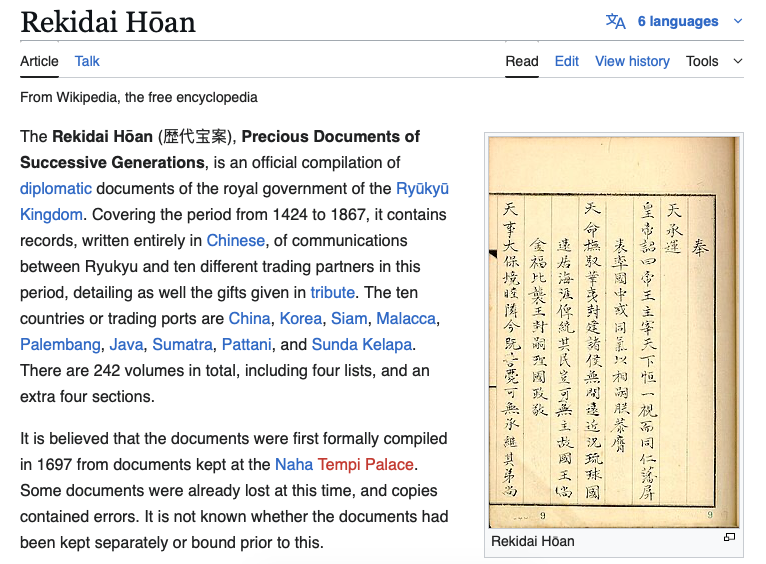
The Ryukuyan history Tim is referring to appears to be the Rekidai Hōan. While original copies were destroyed in Shuri Castle on Okinawa during World War 2, many other copies survived in Tokyo and Taiwan.  


https://en.wikipedia.org/wiki/Rekidai_Hōan

The Rekidai Hōan (ę­“ä»£å®ę”ˆ), Precious Documents of Successive Generations, is an official compilation of diplomatic documents of the royal government of the RyÅ«kyÅ« Kingdom. Covering the period from 1424 to 1867, it contains records, written entirely in Chinese, of communications between Ryukyu and ten different trading partners in this period, detailing as well the gifts given in tribute. The ten countries or trading ports are ChinaKoreaSiamMalaccaPalembangJavaSumatraPattani, and Sunda Kelapa. There are 242 volumes in total, including four lists, and an extra four sections.

It is believed that the documents were first formally compiled in 1697 from documents kept at the Naha Tempi Palace. Some documents were already lost at this time, and copies contained errors. It is not known whether the documents had been kept separately or bound prior to this.

The compilation first became known to the public, and put on display, in 1932, when it was moved from the Tenson Shrine in Naha to the Okinawa Prefectural Library. This "First Series" compiled in 1697 contained 49 volumes, but by 1932 a number were missing or severely damaged. All were destroyed in the 1945 battle of Okinawa

Copies in Taiwan University and Tokyo University survived, and form the basis for scholarship of these documents; unfortunately, further copying errors were introduced in the 1930s-1940s when these versions were created.

Tim is wrong in his description of these historical documents. They didn't completely disappear only to miraculously reappear having been rewritten by the Jesuits. They survived in Taiwan and Tokyo. I suppose he will latch onto copying errors as his proof the text was rewritten but he will have to prove that, not just assert it. Copying errors do not equal a total rewrite. This article says there were copying errors and lost documents as far back as 1697. The fact is we have very reliable history about both the Ryukyu Kingdom and the Philippines dating from centuries ago from various sources both Chinese and European. The problem is Tim does not accept the facts so he has pulled out every trick in the book to dismiss them. 

As for the reference to Chinese history starting in 600 AD Tim is likely referring to The Book of Sui. While that book is not available in English translation the 13th century book  Zhu Fan Zhi is available. Being a later book it is reasonable to assume it has updated information and that Marco Polo would have had access to its knowledge base whether by reading it or conversing with merchants, court officials, and others familiar with it when writing in his journal. That book mentions Liuqiu and the Philippines separately. It also mentions Zipangu as a place separate from the Philippines. The Chinese name Liuqiu is the origin of the European Lequios and all its variants. I have written about that at length in a separate article.

Another problem with this interview is Tim consistently pronounces the name Lequios wrong. He is confusing it with LuƧoes. Lequios has a hard sound with "qu" while LuƧoes has a soft sound with the "Ƨ." What he does is pronounce LuƧoes with a hard "c" and use that as the default name for both areas. He is doing this on purpose to confuse his listeners and because he himself is confused about these two names. In his mind they are equated so they must sound the same. But they are not the same. LuƧones, LuƧon, Luzon, Luson, Lusong are Spanish and Portuguese designations of Luzon Island and its people. Lequios is never used to refer to Luzon. Spanish and Portuguese documents put a difference between those regions both geographically and linguistically. I have already written about them at length and will not reprint that here. There are many articles on this blog disproving Tim's erroneous claims about the Lequios being LuƧon. This one is quite detailed.

What we see here is more of Tim's convoluted and misguided method. He makes a claim and says, "you can't prove otherwise." That is not how proper discourse or reaearch works. If Tim believes the Jesuits rewrote the history of the Ryukyu Kingdom then he should prove that claim. But he can't because it didn't happen. The history of the Lequios and LuƧoes is out in the open for all to see but Tim does not care. It's just more nonsense from Timothy Jay Schwab who is The God Culture.