Sunday, July 6, 2025

The God Culture: Barbosa's 175 Leagues to the East

Timothy Jay Schwab who is The God Culture has found a new horse to beat to death in his quest to prove the Philippines are the Lequios Islands. This time it is a single marginal note in "the Spanish version" of Duarte Barbosa's book. As always with Tim's research, things are not what they seem. Let's take a look. 

https://thegodculturephilippines.com/175-leagues-to-luzon----barbosa-s-true-lequios-exposed/

🪶 THE SMOKING QUILL | May 22, 2025

175 Leagues to Luzon — 

Barbosa’s True Lequios Exposed

🔰 INTRODUCTION: A Note That Changes Everything

In the 16th-century accounts of Duarte Barbosa, a single note in the Spanish version of his journal may contain one of the most significant suppressed geographic truths in colonial history. The marginal annotation “175 leagues to the east” has often been overlooked, yet it aligns precisely with a Luzon-region destination when measured from either China or Malacca. This is not mere coincidence—it is a cartographic key that unlocks the mystery of Lequios. And the story doesn’t end there.

🛍 SECTION 1: Lequios in the Right Place

Barbosa's narrative describes a powerful and wealthy trading people called the "Lequeos" (also noted as Lequios or Liquii in other versions). While many colonial propagandists attempted to reframe Lequios as Ryukyu, Barbosa's own geographic context speaks differently:

  • "Facing the great land of China" situates Lequios across the sea from China.

  • "Come to Malaca every year" situates it along the same east-west trade corridor.

  • The 175-league margin note (Spanish version) places it within sailing range of Luzon, not Okinawa.

🔎 SECTION 4: The Spanish Footnote — Correction or Cover-up?

The Spanish version includes the 175-league distance, while other editions omit it. Why?

  • It's possible the Spanish knew exactly where Lequios was—having sailed there.

  • Magellan himself is suspected of having replaced “Lequios” with “Ofir and Tarsis” in a separate version.

  • If so, this may be a clarification of Barbosa, not a corruption.

Either way, the Spanish annotation confirms that they knew Lequios = Luzon, and 175 leagues is the linchpin.

All evidence points to northern Luzon and Batanes. Ryukyu matches none of the criteria.

Barbosa's marginal note is a smoking quill.

It was never vague. It was never lost. It was Luzon all along.

"The truth was never buried. It was footnoted."
This single line may become iconic.

Before we start, why are all of Tim's articles significantly post-dated? The article being examined is dated May 22nd which is two weeks away from the day I am writing this article, May 8th. Today he has published four articles dated May 23rd, 24th, 25th, and 26th. When he posts an update to an article there is a huge discrepancy between the published date of the article and the published date of the addition. Is this intentional? 

Tim believes a marginal note in the Spanish edition of Barbosa's book saying the Lequios Islands are "175 leagues to the east" of China is a game-changing bombshell proving that leads to the Philippines. If such is the case why doesn't he include a link to the Spanish edition with the annotation? Why is this article absent of at least a screenshot of the marginal note? Does he not want people to check up on his work? The lack of any proper documentation for this extraordinary claim is quite dubious. 


The mention of a "marginal annotation" in the Spanish edition regarding the Lequios Islands as being "175 leagues to the east" of China is to be found in volume 2 of the 1918 edition of The Book of Duarte Barbosa translated by Mansel Longworth Dames. 

The Spanish version, “ a hundred and seventy-five leagues to the east.”

https://archive.org/details/in.ernet.dli.2015.189299/page/n257/mode/2up

Dames elaborates on this Spanish version in the introduction to volume 1 of The Book of Duarte Barbosa.

A Portuguese MS. was found at Lisbon in the early part of the nineteenth century, of which an account is given in the introduction of the Portuguese editors to their edition published in 1813, and manuscripts of a Spanish version exist at Barcelona and Munich, from the former of which the first English translation, that by Lord Stanley, issued by the Hakluyt Society in 1865, was made.

https://archive.org/details/in.ernet.dli.2015.189298/page/n35/mode/2up

Here is Lord Stanley's translation of the section on the Lequeos from the Spanish version which exists at Barcelona.

https://archive.org/details/descriptionofcoa00barbrich/page/206/mode/2up

LEQUEOS.

Opposite this country of China there are many islands in the sea, and beyond them at a hundred and seventy-five leagues to the east there is one very large which they say is the mainland, from whence there come each year to Malaca three or four ships like those of the Chinese, of white people whom they describe as great and wealthy merchants. They bring much gold in bars, silver, silk and many very rich silk stuffs, much very good wheat, beautiful porcelain and other merchandise. And they ship pepper and other things which they carry away. These islands are called Lequeos, the people of Malaca say that they are better men, and greater and wealthier merchants, and better dressed and adorned, and more honourable than the Chinese. There is not much information about these people up to the present time, because they have not come to India since the King of Portugal possesses it.

Oh, look. It's not a marginal annotation. "175 leagues to the east" is embedded in the text. Tim is wrong again. What a shock. 

Lord Stanley has a note on this passage regarding the identity of the Lequeos. 

The Liu Kiu Islands. Lequio major and minor, Y Fermosa, and Reix magas, form a group in Ortelius : in Homannus Formosa is in its proper place, and the group is called Lequeyo or Riukiu Islands.

Not even Lord Stanley believed "175 leagues to the east" of China meant the Lequeos are the Philippines. It should not be forgotten Lord Stanley translated Pigafetta's journal and published it along with several other accounts of Magellan's voyage titled The First Voyage Around the World. He also published a translation of Antonio de Morga's book The Philippine Islands. Lord Stanley was very familiar with the issues Tim, a magazine editor and publisher, is still attempting to resolve. Tim will likely accuse Lord Stanley of colonial bias, being a propagandist for Britain, being willfully blind to erase the Philippines when it's in front of his face, and engaging in Pharisaical Jesuit thinking. Ad hominem argumentation is the scholarly rigor of Timothy Jay Schwab. 

As I have pointed out in numerous articles the totality of evidence concerning the identity of the Lequios Islands (historical, geographical, political, religious, etc.) points away from the Philippines and towards the Ryukyu Islands. There is simply no sound evidence identifying the Lequios Islands with the Philippines unless it is twisted to fit as Tim does. Being able to see Japan from the Lequios Islands and placing them at 29°N as Pinto describes should be game over for Tim, but the facts be damned! Tim prefers to view each individual tree rather than see the forest as a whole. This phrase "175 leagues to the east" is one more branch for Tim to hold aloft as evidence of an imaginary triumph.

Lord Stanley says the Spanish manuscript he translated dates to "the beginning of 1500" and is difficult to read. 

The Spanish manuscript from which this volume has heen translated is in the handwriting of the beginning of 1500, full of abbreviations, and without punctuation or capital letters at the beginnings of sentences or for the proper names, which adds much to the difficulty of reading it. It contains eighty-seven leaves.

This MS. is in the Barcelona Library and is there catalogued "Viage por Malabar y costas de Africa, 1512 : letra del siglo xvi." 

https://archive.org/details/descriptionofcoa00barbrich/page/n11/mode/2up

The original from which Stanley translated can be viewed here. 

https://bipadi.ub.edu/digital/collection/manuscrits/id/61841

This manuscript is dated 1524 or later according to the description. As can be seen, Stanley's observation that this text is difficult to read is an understatement. 

It must be kept in mind this is a translation of the original Portuguese. How accurate is it when another Spanish translation of Barbosa also dating to the 1500's omits "a hundred and seventy-five leagues to the east?"


Lequeos

De frente desta sobre dha tierra a la mar y a lenco de dellas otras yslas va una tierra muy grande q dizen ser tierra firme donde a Malaca. Vienen cada año diez o quatro naos assy como las de los Chinos de ypuntas blancas y dizen q son grandes mercaderes y muy rricos. Traen mucho oro en barras y plata y seda y assy muchos y muy rricos paños de seda y munchos y buen trigo y hermosas porcelanas y otras mercaderías y llevan mucha pimenta a los dichos chíos ubiesse y mayores mercaderes y más rricos y bien vestidos y sabios todos y honrados y los sobre dichos de los reyes de las quales cuentos falta aora no tenemos muncha ynformacion por quanto no viemos a malaca después q es de otro rey.

In front of this land, toward the sea and beyond the other islands, there is a very large land which they say is the mainland where Malacca is. Every year, four ships come, just like those of the white-capped Chinese, and they say they are great merchants and very rich. They bring much gold in bars, and silver, and silk, and also many very rich silken cloths, and much good wheat, and beautiful porcelain, and other merchandise. They bring a lot of pepper to the said Chinese, who are said to be greater merchants, richer, better dressed, all wise and honorable, and subjects of the kings mentioned above. Of all these people we do not have much information now, because we have not seen Malacca since it came under another king.

A Portuguese version published in 1946 also omits this phrase. 
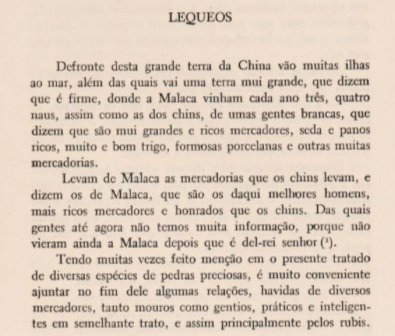
https://archive.org/details/b31358500/page/218/mode/2up?utm_source=chatgpt.com

Defronte desta grande térra da China váo muitas ilhas ao mar, além das quais vai urna térra mui grande, que dizem que é firme, donde a Malaca vinham cada ano tres, quatro naus, assim como as dos chins, de urnas gentes brancas, que dizem que sao mui grandes e ricos mercadores, seda e panos ricos, muito e bom trigo, formosas porcelanas e outras muitas mercadorias.

The 1918 version by Dames, which Tim cites for the "175 leagues to the east" annotation, is based on the 1813 Portuguese edition and also omits the phrase. 

The present version is an entirely new translation from the Portuguese text of 1813.

https://archive.org/details/in.ernet.dli.2015.189298/page/n35/mode/2up

What can we conclude from all this?

First of all, Tim is wrong about "a hundred and seventy-five leagues to the east" being a marginal note in the Spanish edition of this text. It is part of the text itself. He not only misread Dames but he didn't even bother to seek out the Spanish version. Had he read Dames' introduction he would have been led to Stanley's translation which includes the so-called marginal note within the text. Then, had he dug even deeper, he would have found the original manuscript which Stanley translated. 

Second of all, because Tim did not bother to dig deeper into a footnote but relied on it entirely he has ignored and neglected the reality that is textual variation. "A hundred and seventy-five leagues to the east" in this section is not the only variant among the translations of Barbosa's book. 

Lord Stanley writes the following in his introduction.
The greater part of this volume was printed in Italian by Ramusio in 1554 in his collection of travels (Venetia, nella Stamperia de' Giunti), as the narration of Duarte Barbosa, and a large part of this work must have been written by Barbosa ; and a Portuguese manuscript of his was printed at Lisbon in 1812 in the " Colleccao de noticias para a historia e geografia das naçoes ultramarinas.'" This manuscript of Barbosa's, however, is much less full than this Spanish MS. of Barcelona, or than the Italian version of Ramusio, and the Lisbon editors have added from Ramusio translations of the passages which were wanting in their MS. These publications do not contain the number of leagues between one place and another which are given in the Spanish translation.

That the Portuguese manuscript printed at Lisbon in 1812 belongs to Barbosa, stands only on the authority of Ramusio, who gives an introduction by Odoardo Barbosa of the city of Lisbon, which is not to be found either in the Barcelona MS. or in the Portuguese MS., and which has been translated from the Italian of Eamusio and published in the Lisbon edition. The introduction to the Lisbon edition states that the Portuguese MS. is not an autograph MS., and that the account of Barbosa is bound up along with other papers. This introduction refers to the passages in the Portuguese MS. which are not to be found in Ramusio, and says it may be doubted whether these were additions posterior to the work of Duarte Barbosa.

Lord Stanley says "a large part" of Ramusio's Italian edition "must have been written by Barbosa." Yet it lacks the "175 leagues to the east" distance to the Lequios as well as other distances given in the Spanish translation. What, then, is the origin of those distances, if they are not in an edition written by Barbosa? It would be best to take the Spanish version Stanely translates not as Gospel truth but as one version which differs considerably from the others.

Not even the titles of these books are the same. The manuscript Stanley translated is:

"Viage por Malabar y costas de Africa, 1512 : letra del siglo xvi." 

While the Portuguese is titled:

Livro em que dá relação do que viu e ouviu no Oriente

These differences must be considered when assessing this addition of "175 leagues to the east" but Tim is ignorant of all the relevant information. He is in no position to make an authoritative statement on this phrase.  

Despite the distance of 175 leagues being a unique variant limited to a single text it is by no means "the final blow" which confirms the Lequios Islands is the Philippines as Tim claims. 

🪶 THE SMOKING QUILL | May 24, 2025

The Final Blow: Why Ryukyu Was Never 

Lequios, Ophir, or Zipangu

🔰 INTRODUCTION: The Myth of Ryukyu

For decades, scholars have lazily defaulted to Ryukyu (Okinawa) as the legendary Lequios, Ophir, or even Zipangu of ancient geography. But a closer examination of the four most powerful primary accounts—Duarte BarbosaKing Solomon’s Navy (2 Chronicles 9)the Greek Homer, and Marco Polo—shows that Ryukyu fails every test. The Philippines, however, passes all with flying gold.

1️⃣ Barbosa's Test: 175 Leagues to Luzon

Key Markers from Barbosa:

  • Lequios faced China.

  • 175 leagues from Malacca = Northern Philippines, not Ryukyu.

  • Traders arrived in ships laden with:Gold in barsSilverRich clothsPorcelainVery good wheat

Ryukyu Fails:

  • No gold or silver trade

  • Late wheat adoption, no high-quality variety

  • Not facing China (Ryukyu is northeast)

  • Geographically too far (1,500 km vs. 900 km to Luzon)

Philippines Passes:

  • Luzon is directly east of Malacca and south of China

  • Adlay wheat in Batanes and Luzon

  • Documented gold mining and trade (Butuan, Surigao)

  • Ortelius confirms region as Ophir’s incense source (Elemi)

https://thegodculturephilippines.com/why-ryukyu-was-never-lequios-ophir-or-zipangu/

Tim's mapping of this 175 leagues distance is profoundly misleading. 

Why is Tim mapping the distance from the middle of China? The text only says "opposite of China" or "in front of China." He also tests a starting point from Malacca because "Barbosa was in Malacca" which, even if it were true, has nothing to with the text. Barbosa does not give a starting place for measuring the distance. Stanley's translation reads thusly:

Opposite this country of China there are many islands in the sea, and beyond them at a hundred and seventy-five leagues to the east there is one very large which they say is the mainland,

Any measurement that does not include those many islands is invalid. There are not many islands in the sea between the Philippines and China. That makes the archipelago between Taiwan and Japan the only candidate. If Tim took the top arrow, moved it down, and then turned it slightly at an angle it would fit the direction and the distance. 


Tim's map intentionally obscures both the direction and the distance of the Lequios, which Barbosa places 175 leagues to the east. That distance fits perfectly if one is sailing in the correct direction toward Japan. This route includes the islands directly in front of, or opposite, the coast of China. By contrast, the route to the Philippines lies to the south, contradicting Barbosa’s statement that the Lequios Islands are to the east. This map is a straw man argument made visible.

This is the same nonsense we have seen from Tim all over again. His poor research previously led him astray into making false statements about Ginés De Mafra's testimony concerning Magellan's voyage despite never having read it. It was I who posted a link to the book. Tim treated my correction of his mistake as a triumph saying it only proved he was right when in reality it proved he is bad researcher. 

This time around Tim has chosen to do zero research on a footnote which has once again left me to pick up his slack. There is no doubt he will do the same this time and cheer that Lord Stanley's translation strengthens his case and proves him correct. However, the addition of "175 leagues to the east" isn't the win Tim thinks it is. For one thing, the phrase is a textual variant in a single Spanish translation. 

For another thing, the way Tim has mapped out that distance is arbitrary and bears no relation to the words of the text which mentions that the land 175 leagues to the east is beyond many islands. That can only be the Ryukyu Island chain which stretches from Taiwan to Japan and is exactly "in font of" or "opposite" of China. The Philippines is to the South which does not match Barbosa's text.

Finally, conflating the Philippines and the Lequios Islands has no historical precedent. The Suma Oriental describes the Luçoes and Lequios as different people, not as two cultures occupying the same island. Fernando Pinto also describes the Lequios and Luçoes as different people, not as two cultures occupying the same island. Maps of the era place the Lequios north in the modern day Ryukyu Islands. Lord Stanley refers to Abraham Ortelius' 1570 map which shows the Lequios far north of the Philippines. Tim brushes that map away by calling it a deceptive Jesuit map which Ortelius corrected 14 years later by placing them in the Philippines. That is not true as the Lequios Islands (grande and pequeño) and Luzon (Islas de Lucois) are clearly differentiated. 

In the History of the Philippines volume 3 the Lequios and Luzon are differentiated in Relation of the Western Islands called Filipinas by Captain Diego de Artieda. The editors describe his work thusly: 

A Spanish captain, Diego de Artieda, writes (1573) a "Relation of the Western Islands." He enumerates the islands thus far discovered by the Spaniards, describing their location, appearance, and natural resources. He adds much curious information about the natives--concerning their religious beliefs and rites, customs, mode of dress, weapons, food, industries, social condition, etc. Artieda notes all that he has been able to learn concerning Japan and China, with interesting details as to their civilization, and the skill of the Chinese as artisans; he mentions the antiquity of printing among them. He offers to conduct an armed expedition against the coast of China, if the king will supply him with two vessels and eighty soldiers. He advises that Spain abandon the attempt to establish a footing in the Philippines, or else that she ignore the Treaty of Zaragoza and trade with the Moluccas. 

https://babel.hathitrust.org/cgi/pt?id=hvd.32044077731628&seq=22&q1=artieda

Captain Diego de Artieda describes the island of Luzon and mentions the Batanes, which Tim is now claiming to be the Lequios Islands, though not by that name. A few pages later he mentions the Lequios Islands and says they are in-between Japan and China. That is clearly the Ryukyu Islands.    

Farther to the northeast of Masbat lies the island of Ybalon or Luzon. It is a large island, with many rivers, in which gold is found--although, as I have ascertained, in but little quantity, because its most influential inhabitants are Moros. While I was in Panae, [S:the leading man among its people] sent a Moro, his steward or treasurer to trade there; but he could hardly get for me one _marco_ of gold in exchange for four of silver, which he bought for me. Buffaloes are to be found here. We have [M: not] explored much of its coast, and I have seen no one who could inform me fully concerning its south-eastern, southern, and eastern parts, because no one has sailed around it. Between this island of Ybalon and that of Panae, lies Masbat. Farther on, and lying north and south, are some other small islands, in one of which is to be found much brazil-wood.

[62] Probably the _sibucao (Cæsalpina sapan_); its wood produces a red coloring-matter which is highly valued, especially by the Chinese. Some varieties of it are more highly esteemed than are those produced in Brazil. These "Brazil" Islands are apparently the small groups north of Luzón, now known as Batanes and Babuyanes.

Farther north than the aforesaid islands are others, the nearest to Luzon being called Xipon [S: Japan]. 

A little to the east between these islands and China are the islands of Lequios. They are said to be rich; but we have been unable to learn much about them, for I have not seen any one who has been there. For this reason I conclude that they must be small, and that the people are not much given to commerce.

https://babel.hathitrust.org/cgi/pt?id=hvd.32044077731628&seq=206&q1=lequios

No matter how much Tim misinterprets old maps it will not change the fact that the Spanish and the Portuguese both differentiated Luzon Island from the Lequios Islands. The Lequios Islands are always located in the north near Japan. 

All in all it's another bombastic claim that shrivels up and dies when exposed to the light of scrutiny. In short, the “175 leagues” is not a suppressed marginal note, it appears in only one Spanish manuscript and is absent in others, including the original Portuguese text. The  Lequios Islands have long been identified with the Ryukyu Islands, not the Philippines. Far from revealing a suppressed truth, Timothy Jay Schwab's interpretation once more reflects a failure to engage with the sources critically or thoroughly.

Saturday, July 5, 2025

The God Culture: 100 Lies About the Philippines: #38: Tagalog is Derived from Hebrew

Welcome back to 100 lies The God Culture teaches about the Philippines. Today's lie concerns Timothy Jay Schwab's claim that Filipino, especially Tagalog, is derived from Hebrew. As we shall this is just another lie.


We are going to look at Tim's justification for looking for Hebrew words not his linguistics. Tim has two sources he uses to justify his search for Hebrew words in Tagalog. In his video series he says the following:

Solomon's Gold Series - Part 7: Track of the Hebrew to the Philippines. Ophir, Sheba, Tarshish


Tim's claim is that Padre Chirino and Stephen Levinsohn said there were similarities between Hebrew and Tagalog because they share similar words. Some Taglog words are Hebrew in origin! That is a blatant lie. Neither of those men said such a thing. 

Let's look at Padre Chirino first. Tim's source for Chirino is not Chirino but a historian named Dr. D.P. Barrows. 

The Search For King Solomon's Treasure Sourcebook, pg. 166

This is more of Tim's bad research. Rather than look at what Padre Chirino actually wrote he is content to cite a secondary source. And he does not even give the full citation where Chirino says there are similarities with Tagalog in Greek, Latin, and Spanish as well as Hebrew. These similarities are not because they share words but are due to the similarities in the structure of each language. 

Padre Chrino's full comments on the languages of the Philippines can be found in The Philippine Islands volume 12, page 235. They are reprinted here in full.

There is no single or general language of the Filipinas extending throughout the islands; but all of them, though there are many and different tongues, are so much alike that they may be learned and spoken in a short time. Consequently if one is learned, all are almost known. They are to each other like the Tuscan, Lombard, and Sicilian dialects of Italia, or the Castilian, Portuguese, and Galician in Espafia. Only the language of the Negrillos is very different from the rest, as, in Espafia, is the Vizcayan [i.e., Basque]. There is not a different language for each of the islands, because some of them - as, for example, Manila, and even Panai, which is more than four hundred leguas smaller - contain several languages; and there are languages each of which prevails in several islands. In the island of Manila alone, there are six different tongues; in Panai, two; in some others, but one. The languages most used, and most widely spread, are the Tagal and the Bisayan; and in some regions of the Pintados another tongue is also prevalent, called Harayan. The Tagal embraces the greater part of the coast and interior of the islands of Manila, Mindoro, Luban, and some others. Bisaya is in use through all the islands of the Pintados, although in some of the villages therein the Harayan is spoken. Of all these languages, it was the Tagal which most pleased me and which I most admired. As I told the first bishop, and, afterwards, other persons of dignity in the islands and in Europe, I found in this language four qualities of the four greatest languages of the world, Hebrew, Greek, Latin, and Spanish: it has the abstruseness and obscurity of the Hebrew; the articles and distinctions in proper as well as in common nouns, of the Greek; the fulness and elegance of the Latin; and the refinement, polish, and courtesy of the Spanish. Examples of all these characteristics may be seen in the " Ave Maria" done into Tagal; and, as that is a short prayer, and more easily understood than the others, I will place it here with its explanation in our vernacular, and with word-forword equivalents. In this way may be seen the idioms and characteristic expressions of this language which will please some readers, and furnish information, both useful and curious.

The "Ave Maria" in the Tagal language 

Aba Guinoo Maria matoa ca na. 

Hail Lady Mary, joyful thou now, 

Napono ca nan gracia, 

full thou of grace; 

An Panguinoon Dios na saio. 

the Lord God is with thee 

Bucor can pinagpala sa babain lahat. 

especially, thou blessed among women all. 

Pinagpalat naman ang iong anac si Jesus. 

Blessed also he thy son Jesus. 

Santa Maria ina nang Dios 

Holy Mary, mother of God, 

Ipana languin mo cami macasalanan 

Let us be interceded for by thee, us sinners 

igayon at cum mamatai cami. 

Amen, Jesus. now and when shall die we. 

The first word of this prayer ABA, is obscure, but apparently has the force of " salute," like the Latin Ave. Bucor expresses diversity, distinction, and singularity. The article is Si (Jesus), as TON in Greek. The richness of the language lies in its many synonyms and phrases; consequently this prayer, which, as it stands, is very elegant, could be formed with equal elegance in various other ways, without losing its original sense and meaning. The polish and courtesy consist in not saying, as in Latin, Ave Maria (which would seem in this language abrupt and barbaric), without adding that polite word, Guinoo. 

There is none or very little of this courtesy in the other two languages of the Bissayas, which are more rude and unpolished. I thought it good to present the same prayer in these languages, not only as a curiosity, but to give an idea of their similarity and differences-giving notice, however, that it is not my intention to offer an interpretation (which is unnecessary, since we all know the " Ave Maria "), but, as I said, to show the idioms of these languages. These idioms, moreover, ought not to displease or appear ignoble, for every tongue has its own beauty and elegance for those who are born in it, which the eyes of foreigners cannot discern. This point has been discussed by Jesus Sidrac in the prologue to his Ecclesiasticus, a holy and Catholic work; and it was proved at length, and with great erudition, by the most glorious doctor St. Jerome, in the hundred and first Epistle to Pamaquio. 

The "Ave Maria " in the Harayan tongue 

Maliag cao Maria nabota cao can gracia 

Rejoice thou Mary, full thou of grace. 

An atun guinoon Dios dian canimo. 

He our Lord God is with thee, 

Capin icao sa mafga babai nga tanan, 

fortunate thou among women all; 

ig capin naman ang imon bata nga si Jesus. 

and fortunate also he thy son Jesus. 

Santa Maria inang can Dios 

[Holy Mary], mother of God, 

igampo mo cami nga macasasala 

let us be favored by thee, us the sinners, 

caraon, ig cum mamatai cami. 

now and when shall die we. Amen, Jesus. 

The " Ave Maria " in the Bissayan tongue 

Maghimaya ca Maria napon ca sa gracia 

Rejoice, thou Mary, full of grace 

An guinoon Dios anaa can 

the Lord God is with thee 

Guirayeg ca uyamot sa babihun tana 

Exalted thou much among women all, 

ug guirayeg man an imon sanc Jesus 

and exalted also he thy son Jesus 

Santa Maria inahan sa Dios, 

Holy Mary, mother of God,  

iguiampo mo cami macasasala oñia 

let us be interceded for by thee, us sinners, now 

ug sa amun camatai. Amen, Jesus. 

and in our death. 

It has been my object in giving this slight illustration of the difference between these three languages aside from its singularity and novelty, which may furnish some pleasure - to make evident the ease and clearness of the languages and their words and pronunciations, which render them very easy, or at least not difficult to learn. Some of their idioms and transpositions, which are different from our own, must be accepted as they stand, as Father Joseph de Acosta says very well when writing on this matter, (De procur. sal. lib. 4, cap. 9.); but if they are once acquired, and one is accustomed to the sound of them, they do not render the language difficult, but rather make it easy and graceful. But since I have mentioned the courtesy and politeness of the Tagalos, and of their tongue, it will be well, before proceeding further, to speak more at length concerning it, for it is so noble and pleasing a moral virtue. Of the civilities, terms of courtesy, and good breeding among the Filipinos.

Chirino does not simply wax eloquent about Tagalog but compares translations of the Ave Maria in Taglog, Harayan, and Bisayan, showing the differences between all three languages. He calls the latter two languages "rude and unpolished." There is absolutely nothing here about Tagalog sharing Hebrew words or being derived from Hebrew. 

The same can be said for Stephen Levinsohn who also notes similarities between Taglog and Hebrew. 

The Search For King Solomon's Treasure Sourcebook, pg. 167

The similarities between Tagalog and Hebrew have to do with the construction of the language. Namely, the Verb/Subject/Object order. 

Here we see there are similarities between Tagalog, Hebrew, Greek, and Mexican. Is Taglog derived from Mexican or Koiné Greek? English and Chinese also have a similar Subject/Verb/Object ordering. Is English derived from Chinese? Obviously not. 

Levinsohn's point is that Taglog and Hebrew share a similar construction not that they share words or a common origin. 

Now, it is true Tim has not said the exact phrase, "Tagalog is derived from Hebrew" but that is his contention. He has a whole section in his book the Search for King Solomon's Treasure where he pretends to find residual Hebrew words in Tagalog and other Filipino languages. None of them make any sense. His method is to throw so much at the reader that they are overwhelmed. 

The Search of King Solomon's Treasure, pg. 176
As the map opposite illustrates, there is aptitude for Hebrew all over the Philippines. The list is far larger and we could publish an entire book just on the Hebrew influences in Tagalog and other Philippine languages We are not requesting the reader agree with every one of these references and interpretations but there are far too many that are direct letter for letter calibrations that one simply cannot ignore especially in lieu of the overwhelming evidence this research has already achieved. Our point is to continue to go deeper and inundate critics with too much corroboration to even consider an alternative opinion. 

Tim thinks he can throw a bunch of nonsense at people to overwhelm them so much that they can consider no alternative opinion to his claim Tagalog is derived from Hebrew. That is not how an honest researcher works. Why does he say the reader does not have to agree with him if he is telling the truth? That is the hallmark of a charlatan and a liar. 

However, if one looks closer at Tim's sources it is quite apparent that Taglog and other Filipino languages do not derive from Hebrew. That is simply one more lie about the Philippines being taught by Timothy Jay Schwab who is The God Culture. 

Friday, July 4, 2025

Retards in the Government 424

 It's your weekly compendium of foolishness and corruption in the Philippine government.


https://mb.com.ph/2025/06/20/barangay-official-nabbed-for-shooting-scavenger-in-malabon

A 37-year-old barangay official was arrested after allegedly shooting a scavenger during an altercation in Malabon City on Thursday, June 19.
Personnel from the Malabon City Police Station – Substation 6 said that the suspect, who is a barangay kagawad of Barangay Ibaba, was involved in the shooting incident that occurred around 5:35 a.m.
Based on the police report, the official was conducting his regular patrol duties on a motorcycle when he encountered the victim—a 39-year-old scavenger and a resident of Barangay Acacia—who was allegedly obstructing his path.
The confrontation escalated when the suspect reportedly pushed the victim, who in turn shouted at him and allegedly pulled out a bladed weapon.
The official fired his service firearm, hitting the victim on the left thigh. The suspect claimed he acted in self-defense.
The injured victim was brought to the Tondo Medical Center for medical treatment.
The barangay official was immediately arrested.
Police recovered a 9mm pistol from the suspect, which was loaded with three live rounds. Authorities confirmed that the firearm is licensed and valid until March 2032.
The suspect also holds a License to Own and Possess Firearms (LTOPF) valid until March 1, 2027, but his Permit to Carry Firearm Outside Residence (PTCFOR) is still under processing.
The suspect will face charges of attempted homicide.

A 37-year-old barangay official was arrested after allegedly shooting a scavenger during an altercation in Malabon City.

The Dumanjug Police Station has arrested two individuals suspected in the killing of a barangay secretary from Purok 5, Barangay Tubod-Dugoan, Dumanjug town, on Friday morning, June 27, 2025.

Barangay secretary shot dead in Dumanjug; two suspects arrested

The victim was identified as Celsa Regidor Redondo, who was found lifeless inside her room that morning. Authorities confirmed that she sustained gunshot wounds to the head and abdomen.

Police Captain Eden Rex Baguio, chief of the Dumanjug Police Station, said that witnesses were able to describe the suspects, which helped identify them.

The suspects were arrested in the same barangay with the help of barangay officials during a hot pursuit operation.

Police arrested alias “Teban,” 51, allegedly the lookout, and alias “Conrad,” 35, the suspected gunman. Conrad also has a pending murder case from a previous shooting incident.

(There were really only two suspects, according to the victim’s companion, who also said there was a woman present. But they only heard two voices talking. No one else was seen. Only those two entered, barged into the victim’s room—one shot her while the other acted as a lookout outside.)

Among the possible motives police are looking into is mistaken identity.

This is due to the fact that the victim had two helpers, and one of the helpers’ brothers also stayed in the house.

Authorities believe that the real target may have been alias “Kikil”, the helper’s brother, who previously worked with the victim at her coconut farm.

Kikil allegedly borrowed a large sum of money from the 51-year-old suspect and left without paying him back.

(It’s highly possible that Kikil was the real target of the two suspects, so we’re continuing to interview this person. Our investigation into the motive is still ongoing.)

Baguio also said that although the barangay secretary was known to be strict and outspoken in her work, she never got into any serious fights or arguments, and that people in their community were already used to her demeanor.

Currently, police are preparing to file murder charges against the two suspects.

Barangay secretary shot dead in Dumanjug; two suspects arrested

A Manila court has voided the Tarlac town mayorship of Alice Guo, who has been suspected as a foreign spy, as it ruled that she is “undoubtedly a Chinese citizen.”

In a 67-page ruling dated June 27, the Manila Regional Trial Court (RTC) Branch 34 ruled Guo is “nothing more but a usurper” of the Office of the Mayor of Bamban, Tarlac, since she was not only disqualified to hold the position but also from running for the post in the first place as only natural-born Filipinos can run for office under the Constitution.

It said it did not matter if Guo was elected as mayor in 2022 since this does not cure her of being disqualified due to lack of Philippine citizenship, which the court said, “was already existing at the time of the filing of her certificate of candidacy.

“It follows, therefore, that her proclamation was deemed void. Alice Guo is found disqualified from and is hereby adjudged guilty of usurping and exercising the Office of the Mayor of Bamban, Tarlac. Accordingly, she is hereby ousted and altogether excluded therefrom,” Manila RTC Branch 34 Judge Liwliwa Hidalgo-Bucu said in the ruling.

The ruling stemmed from the quo warranto petition filed by the Office of the Solicitor General. It is an exclusive power of the solicitor general to remove a public official who it deems holding a position unlawfully because seen as unqualified or ineligible.

The court found that Guo is “undisputedly” a Chinese national named Guo Hua Ping, who was born of Chinese parents Guo Jian Zhong and Lin Wenyi. She and her parents are holders of Chinese passports.

The Manila RTC also noted that there exists no birth, death and even marriage records of Guo’s purported parents Angelito Guo and Amelia Leal.

The court also gave weight and credence to the expert testimony of Alfredo Kahanding, chief of the Dactyloscopy Division of the National Bureau of Investigation, that Guo matched fingerprints of Chinese citizen Guo Hua Ping, who arrived in the Philippines from Fujian, China in July 1999, with her parents Guo Jian Zhong and Lin Wenyi.

Guo Hua Ping was only nine years old then, and was given an investor’s visa as the minor dependent of her parents who were granted Special Investors Resident Visa.

Guo earlier testified before the Senate that her mother is a full-blooded Filipino named Amelia Leal but she had never met her. Amelia Leal was allegedly the maid of her father Angelito Guo and Alice was their lovechild.

Meanwhile, her birth certificate says Guo was born on July 12, 1986 in Tarlac to Angelito and Amelia who were allegedly married in 1952. The birth certificate was registered only in 2005, or when Guo was already 19 years old.

Kahanding had concluded that the fingerprints were from the same person and that Alice Guo is actually no other than Guo Hua Ping.

The court said Kahanding’s testimony “deserves full weight and credence” since fingerprint evidence is infallible and faultless because no two people, even identical twins, have the same fingerprint, and that fingerprints cannot be forged.

“Alice Leal Guo has utterly failed to prove that she is a Filipino citizen, absent any credible evidence to rebut the petitioner’s evidence… It can, thus, be safely concluded that Guo Hua Ping, a Chinese national, assumed the identity of one Alice Leal Guo, representing herself as a Filipino citizen. Simply, Guo Hua Ping is Alice Leal Guo,” the court said.

“Just imagine a foreign individual, who was allowed to stay in the Philippines, was able to circumvent the law by posing herself as a Filipino citizen in order to meet the citizenship requirement to enter public office and ultimately, assumed the powers and functions of Mayor of Bamban, Tarlac. Such a situation posed a risk to national security which is far more than real,” the court said.

“There is more than meets the eye because Guo Hua Ping assumed the identity of Alice Leal Guo and posed herself as a Filipino citizen to be able to run for, voted upon and be elected for a public position,” it added.

The OSG was assisted by the Presidential Anti-Organized Crime Commission in securing needed documents for the trial and coordinated with the presentation of Kahanding, one of the key witnesses.

The Manila court’s ruling confirming Guo’s Chinese citizenship and declaring her guilty of usurping the mayoralty of Bamban, Tarlac affirms long-held concerns over her eligibility, Sen. Sherwin Gatchalian said yesterday.

“The court ruling affirming that Alice Guo is a Chinese national and finding her guilty of usurping and exercising the Office of the Bamban Mayor validates what we’ve long been saying – that she was never qualified to hold public office,” Gatchalian said.

“Still, the government must rigorously pursue all cases against her and hold her accountable for her illicit activities. She should also be prohibited from owning land,” he added. “I also urge the government to go after those who aided and protected her. Foreigners must never be allowed to use government for their own selfish interests.”

A Manila court has voided the Tarlac town mayorship of Alice Guo, who has been suspected as a foreign spy, as it ruled that she is “undoubtedly a Chinese citizen.”

A police chief in Rizal province has been relieved from his post over alleged inefficiencies, the Philippine National Police (PNP) said Monday. 

At a press briefing, PNP chief Police General Nicolas Torre III said the removal of the official stemmed from the “lazy” handling of complaint filed by a businessman over a missing amount of money. 

“Ayaw ko sanang i-mention 'yung lugar kasi syempre may career pa rin naman 'yung tao, may mga kamag-anak ang ating pulis, at opisyal pa rin natin 'yan,” Torre said.

(I don’t want to mention the place because of course that person still has a career, has relatives, and he’s still our officer.)

“Pero you know I have to put my foot down on these inefficiencies na nakikita natin. Our kababayan do not deserve those kind of services…Gawaing tamad naman talaga 'yun e,” he added.

(But you know I have to put my foot down on these inefficiencies that we see. Our countrymen do not deserve those kinds of services…It’s really lazy work.)

Torre said that over the weekend a businessman sought the help of the concerned police unit after two of their workers and P600,000 went missing.

For Torre, the concerned police personnel could have traced the location of the suspects behind the missing money.

Upon checking the blotter, Torre said the police just reported that “documentation is now being prepared for filing of the appropriate case in court.”

The police also ordered the businessman to go home, according to the PNP chief.

Torre has been conducting inspections in different areas in the country to assess the capabilities of the police as he pushes for a faster response to crimes and emergencies.

A police chief in Rizal province has been relieved from his post over alleged inefficiencies. 


https://www.pna.gov.ph/articles/1253285

Seven police officers assigned at the Manila Police District (MPD) are facing dismissal from the service after they were accused of extorting money from a 49-year-old man, the National Capital Region Police Office (NCRPO) said on Tuesday.

In a statement, NCRPO chief Maj. Gen. Anthony Aberin said the police officers – a lieutenant, three staff sergeants, and three patrolmen, all detailed at the Anti-Drug Unit of Police Station 5 – were arrested inside the station in Ermita, Manila late Monday night.

The operation stemmed from the arrest of the complainant on June 20 based on made-up drug cases. While he was in police custody, the involved officers allegedly extorted PHP50,000 from his spouse in exchange for release.

Although only PHP20,000 was eventually paid via mobile transfer, the complainant was freed without charges. When the officers learned that a formal complaint had been filed, they returned the money in an apparent attempt to dissuade legal action.

Seized from the police officers were seven mobile phones used in the alleged extortion, five official police IDs, screenshots of digital transactions and conversations and remittance records of the extorted amount.

“The arrests were carried out following the swift validation of reports and complaints that exposed the involvement of the said personnel in illegal activities while in the performance of their duties,” said Aberin.

“The immediate arrest of involved PNP (Philippine National Police) personnel reflects the uncompromising enforcement of accountability within the police force. Internal cleansing remains a top priority, and NCRPO is committed to ensuring that only those who embody professionalism, discipline, and integrity will remain in service.”

The arrested officers were put under restrictive custody, awaiting charges for robbery-extortion, grave threats, arbitrary detention and violations of Republic Act 3019 or the Anti-Graft and Corrupt Practices Act; and Presidential Decree 1829, which pertains to obstruction of justice.

Aberin said the operation was in line with the instruction of national police chief Gen. Nicolas Torre III to focus on police accountability.

“There will be no second chances for police scalawags. NCRPO will not allow these criminals to taint the integrity and dedication of those who are doing good in the service. Rogue policemen will be arrested, detained, charged and removed from the service, based on due process of law,” said Aberin.

Aberin ordered a conduct investigation and relieved the commander in Police Station 5 for command responsibility for failure to act on the case.

Seven personnel of the Manila Police District were arrested after taking a man into custody under "fabricated" drug charges.

Robert Dean Barbers, former general manager of the defunct Philippine Tourism Authority (PTA), was sentenced to up to eight years in prison for graft over alleged irregularities in the award and construction of a sports complex project in Intramuros, Manila that was eventually demolished for being illegal.

In a 100-page decision promulgated on June 27, the Sandiganbayan Special Sixth Division has found Barbers guilty of one count of violation of Section 3 (e) of Republic Act 3019 or the Anti-Graft and Corrupt Practices Act.

He was sentenced to a minimum of six years and one month to a maximum of eight years of imprisonment with the accessory penalty of perpetual disqualification from holding public office.

Barbers, together with the other convicted accused, was also ordered to jointly pay the government P3.7 million, equivalent to the amount of public funds found to have been misused.

Apart from Barbers, convicted of one count of graft was former PTA deputy general manager Jose Dion Diaz, while former PTA department manager Armando Miranda and former deputy general manager Edgar Bocar were convicted of two and three counts of graft, respectively.

They were likewise sentenced to six years and one month up to eight years of imprisonment for each count of the offense.

Apart from jointly paying with Barbers the amount of P3.7 million, Miranda and Bocar were also ordered to jointly pay additional P5.1 million, representing the amounts of partial payments released to the contractor I.A. Bosque Construction Corp.

Filed by the Office of the Ombudsman in 2021, the graft cases stemmed from the alleged irregularities in the awarding of the sports complex construction project in Intramuros, Manila in 2005.

The ombudsman said the project, with a total contract price of P24 million, was awarded to I.A. Bosque Construction despite lack of approval from the PTA Board as well as from the Intramuros Administration (IA).

The ombudsman said that despite the irregularities, Barbers signed a disbursement voucher for the release of P3.71 million to I.A. Bosque Construction, representing mobilization fees for the start of the project. The ombudsman said this was even if the construction project at that time still lacked building and development permits, locational clearance and IA approval.

Meanwhile, the ombudsman said Miranda and Bocar also released P1.05 million and P4.06 million, representing the first and second partial payments, respectively, to I.A. Bosque Construction.

The project was eventually declared illegal and was ordered demolished by Branch 52 of the Manila Regional Trial Court.

In convicting Barbers and his co-accused former officials of the PTA (now known as the Tourism Infrastructure and Enterprise Zone Authority or TIEZA), the Special Sixth Division said the prosecution panel of the ombudsman was able to establish their “implied conspiracy” to give unwarranted benefit to I.A. Bosque Construction to the prejudice of the government.

“As pointed out by the prosecution, the accused were given every chance to rectify their errors, but they remained adamant, resulting in the disbursement of funds for nothing. Their open defiance of the law did not merely result in the loss of government funds but also incurred the risk that the project would not comply with the minimum safety standards, as signified by the required permits and licenses,” the court’s decision read.

“To the court, this is not simply overzealousness in the exercise of one’s duties – this is breach of duty in a blatant and extremely careless manner,” it added.

Robert Dean Barbers, former general manager of the defunct Philippine Tourism Authority (PTA), was sentenced to up to eight years in prison for graft over alleged irregularities in the award and construction of a sports complex project in Intramuros, Manila that was eventually demolished for being illegal.

Officials of the Makati Fire Station, whose parked private vehicles were blocking the station’s fire truck bay, were sacked on Tuesday, July 1, during the surprise inspection of Department of the Interior and Local Government (DILG) Secretary Juanito Victor ‘Jonvic’ Remulla. 
Remulla saw the parked vehicles of the concerned personnel obstructing the entry and exit points of fire trucks and emergency response ambulances.
He said the obstruction will cause a huge delay in responding to fires and other public safety emergencies where lives and properties are on the line.
The DILG did not disclose the identities of the fire officials.
The DILG explained that Republic Act (RA) 9514 or the Fire Code of the Philippines of 2018 and the 2019 Revised Implementing Rules and Regulations (IRR) provide that there should be no obstructions in the ingress and egress of fire trucks and emergency response vehicles nor should there be any prevention, interference or obstruction of any operation of the fire service.
“Officials found violating the said provisions may be held administratively liable for willful impropriety or gross negligence in the performance of his/her duty in accordance with Section 11 of the Fire Code,’’ the DILG noted.
To ensure clear exit routes of fire response assets, the DILG called on fire station chiefs to prohibit any parking in front of or near fire trucks and order the immediate removal of all unauthorized parked vehicles blocking fire response units. 

Officials of the Makati Fire Station,whose parked private vehicles were blocking the station’s fire truck bay, were sacked on Tuesday, July 1, during the surprise inspection of Department of the Interior and Local Government (DILG) Secretary Juanito Victor ‘Jonvic’ Remulla.

https://mb.com.ph/2025/07/02/ex-ilocos-sur-town-mayor-convicted-in-p81-m-graft-case

The Sandiganbayan has convicted former mayor Zuriel S. Zaragoza of Narvacan, Ilocos Sur in the reported misuse of P81 million share of the municipality in excise taxes on locally-manufactured Virginia-type cigarettes in 2016.
In a decision promulgated last June 30, the anti-graft court sentenced Zaragoza to a prison term ranging from six to 10 years with perpetual disqualification to hold public office.
However, Zaragoza was acquitted of malversation charge together with his father, also former mayor Edgardo Zaragoza, and former municipal accountant Melody L. Cadacio and education research assistant Mario G. Cabinte.
Former mayor Edgardo, Cadacio, and Cabinte were also acquitted of graft charge for failure of the prosecution to prove their guilt beyond reasonable doubt.
In criminal charges filed on July 18, 2022, the prosecution accused them of misappropriating P81 million intended for the benefit of the Federation of Famers of Narvacan, Ilocos Sur, Inc. (FFNII).
The amount was sourced from the local excise taxes on locally-manufactured Virginia-type cigarettes under Republic Act No. 7171, An Act to Promote the Development of Farmers in the Virginia Tobacco Producing Provinces.
The Sandiganbayan found that the farmer beneficiaries did not receive their allocated financial assistance and FFNII was merely made a conduit for Zuriel to receive the money.
Because of Zuriel’s actions, the anti-graft court said the municipal government lost the opportunity to implement meaningful programs that would have benefited the farmer beneficiaries.
On the malversation charge, the court said the prosecution failed to prove that the accountable public officers received the money and later failed to account for it.
All in all, their collective participation in the alleged conspiracy appears to be more imagined than real. Surely, criminal liability may not be had simply on the basis of acts that can be taken independently and do not show a unity in person, the court also said.
The 47-page decision was signed by Presiding Justice Geraldine Faith A. Econg with Associate Justices Edgardo M. Caldona and Arthur O. Malabaguio.
The Sandiganbayan has convicted former mayor Zuriel S. Zaragoza of Narvacan, Ilocos Sur in the reported misuse of P81 million share of the municipality in excise taxes on locally-manufactured Virginia-type cigarettes in 2016.