Tuesday, July 8, 2025

Insurgency: Anti-Terror Law's Purpose Not Achieved After Five Years On

An 81-year-old man misidentified as an NPA leader was released by the Court of Appeals.  He had been in custody since December 2024. This man's only crime was sharing the name of a wanted NPA leader. In its decision the CA said the lack of due diligence is a blow to the image of the PNP.

https://newsinfo.inquirer.net/2075947/ca-frees-man-81-misidentified-by-pnp-cidg-as-npa-leader

The Court of Appeals (CA) has ordered an elderly man to be released from the Manila City Jail for being wrongly identified by authorities as a New People’s Army (NPA) leader and consultant of the National Democratic Front of the Philippines (NDFP).

The case of mistaken identity, the court said, was a blow to the image of the Philippine National Police because of the “evident lack of due diligence” on the part of the officers who six months ago arrested Prudencio Calubid Jr., an 81-year-old construction worker.

In a decision dated June 27, the CA’s 16th Division granted the writ of habeas corpus filed by the daughter of Calubid, whom agents of the PNP’s Criminal Investigation and Detection Group (CIDG) mistook for their target who had the same name—but minus the “Junior.”

It turned out that the CIDG was after another Prudencio Calubid, an alleged high-ranking officer of the communist NPA and longtime NDFP consultant.

The CA said it was convinced that the arrested person, known in his Olongapo City neighborhood also as “Tay Pruding,” was not the man the police were looking for.

The court directed a respondent in the petition, Supt. Lino Soriano, the Manila City Jail warden, to free Calubid Jr. immediately.

The other respondents are PNP chief Nicolas Torre III, who was the former head of the PNP-CIDG, and former PNP chief Rommel Marbil.

In December last year, the police arrested Calubid Jr. for supposedly being the communist insurgent who had a P7.8-million bounty on his head.

According to court records, Calubid Jr. did not resist arrest since he was “confident he would be released as soon as they verified his identity.”

The CA castigated the manner by which the CIDG handled the investigation, noting that it merely relied on social media sources “as though a comprehensive and meticulous intelligence operation” was conducted.

The CIDG’s conclusion on the supposed resemblance of “Tay Pruding” with the other Calubid was “at best biased, subjective and speculative,” it added.

“It is not uncommon for Filipinos to (have) identical or similar names, though they are clearly different individuals. This is precisely why there are recognized methods of establishing one’s identity and uniqueness,” the court said, referring to government-issued IDs and other official records.

The “serious lapse in judgment” by the police could erode public trust in law enforcement, it said.

While law enforcers must be “vigilant in combating crimes,” CA said, the “fulfillment of their duty should not result in the subversion of basic freedoms.”

“This case does not exist in a vacuum. Rather, it sends the wrong message to the public that those tasked to serve and protect the people … are (the) very reason to fear injustice, and that fundamental rights may be easily overlooked for convenience, carelessness, or possibly, personal and selfish gains,” it added.

Human rights advocates denounced the six-month detention of Calubid Jr. as a “deliberate misidentification” driven by the “perverse incentives of a bounty system.”

The National Union of Peoples’ Lawyers (NUPL), who represented Calubid Jr. in the habeas corpus petition, said the CA ruling revealed “a deeper problem” and exposed how authorities would engage in “bounty-hunting” just to gain merits and incentives.

“A P7.8-million reward was offered for the real Prudencio Calubid’s capture. In such a system, law enforcement agencies, including the PNP, CIDG, and entities under the NTF-Elcac (National Task Force to End Local Communist Armed Conflict), are incentivized not to uphold justice, but to deliver ‘results’ that align with operational quotas and reward mechanisms,” it said.

NUPL lawyers said they were planning to file countercharges against the officers who arrested and investigated Calubid Jr. over his “unlawful incarceration.”

The human rights watchdog Karapatan, through its deputy secretary general Maria Sol Taule, welcomed the court order.

“We are relieved that Tay Pruding is finally free,” Taule said in a statement. “In the first place, Calubid should not have been arrested and detained. He was subjected to harsh prison conditions, worsening his health condition.’’

“He is among the victims of a bounty system of government that has victimized countless others,” she said.

The other Calubid—the one that the police actually wanted—and his wife Celina Palma have been counted among the victims of enforced disappearances since they went missing in 2006.

Rather than conduct a proper intel operation the PNP relied on social media. This is less a blow the image of the PNP than it is business as usual. The NUPL says they may file countercharges but even if they do that is not going to change the culture of the PNP. 

The OSG is seeking to overturn the CA's ruling and place this old man back in jail. 

https://newsinfo.inquirer.net/2079074/osg-wants-octogenarian-tagged-as-npa-back-in-jail

The Office of the Solicitor General (OSG) is seeking to overturn a Court of Appeals (CA) decision that ordered the release of 81-year-old Prudencio Calubid Jr. from detention for being wrongly identified as a rebel leader—a move that rights group Karapatan denounced over the weekend.

In a 19-page motion for reconsideration dated June 30, government lawyers asked the appellate court to reconsider, reverse, and set aside its decision and enter a new one that would deny the privilege of writ of habeas corpus granted to Calubid Jr.

The writ of habeas corpus is a legal remedy for a person illegally deprived of liberty and to relieve him, if such restraint is illegal.

The OSG said Calubid Jr.’s failure to challenge the legality of his arrest in 2024 at the earliest opportunity and his voluntary submission to the jurisdiction of the trial court when he underwent arraignment “cured” the alleged defect in his arrest.

Karapatan secretary general Cristina Palabay, however, said the OSG’s bid to bring back an octogenarian to prison was “utterly devoid of substantive issues,” saying it harps on technicalities and merely repeated the Philippine National Police’s false claims that it had conducted “extensive investigation and intelligence gathering” to verify Calubid Jr.’s identity.

In its ruling issued on June 27, the CA’s 16th Division ordered Calubid Jr. released after granting the habeas corpus petition filed by his daughter.

According to Karapatan, Calubid Jr. is a retired technician and former overseas Filipino worker, who was misrepresented by his captors as Prudencio Calubid, a consultant of the National Democratic Front of the Philippines (NDFP) with a P7.8-million bounty on his head.

The NDFP consultant was abducted and forcibly disappeared in Camarines Sur with five others by suspected state agents on June 26, 2006.

The police mistook Calubid Jr. for their target, who had the same name but without the suffix “Junior.”

Sounds like the OSG's arguments all hinge on technicalities.  But the CA says it is an obvious case of mistaken identity with the old man sharing the name of a wanted NPA leader. Why not prove he is the guy rather than argue that his "failure to challenge the legality of his arrest in 2024 at the earliest opportunity and his voluntary submission to the jurisdiction of the trial court when he underwent arraignment “cured” the alleged defect in his arrest?"

The NUPL is also now saying the Anti-terror law has not served its purpose. 


https://newsinfo.inquirer.net/2078010/anti-terror-laws-purpose-not-achieved-five-years-on-lawyers

Five years after it was signed into law, the Anti-Terrorism Act of 2020 (ATA) has failed to fulfill its purpose of combating terrorism, according to National Union of Peoples’ Lawyers (NUPL) chair Edre Olalia.

“By and large … it will appear that the purported purpose of the Anti-Terror Law has not been achieved in running after the real terrorists, even as vaguely defined in the law itself,” Olalia told the Inquirer. “It has become more of a main tool in political repression.”

Case monitoring by rights group Karapatan shows that 227 individuals have been charged with violating the ATA, while 34 individuals have been designated “terrorists” by the Anti-Terrorism Council (ATC). Karapatan was among the rights groups present at a protest marking five years of the ATA at the Department of Justice earlier today.

“Apart from those more than 200 [charged] and this singular exception of Teves, we do not know of any individual organization that has been credibly charged (with violating) the terrorism law,” he said.

Olalia was referring to former Negros Oriental Rep. Arnolfo Teves Jr. Teves, suspected mastermind of the assassination of former Gov. Roel Degamo, is among 13 individuals designated by the ATC as terrorists.

“The pattern is that these activists … especially in the provinces, they will charge them with the terrorism law using false and perjured witnesses, claiming that these individuals were part of armed encounters by the New People’s Army,” said Olalia, who is also transitional president of the International Association of Democratic Lawyers.

The ATA was signed into law on July 3, 2020, under then-President Rodrigo Duterte, amid opposition from rights groups, indigenous organizations, and civil society coalitions who fear vague definitions and sweeping powers. NUPL represented Bagong Alyansang Makabayan and other activist groups in a 2020 petition to the Supreme Court against the anti-terror law.

“We view this really as a very dangerous law, as proven,” Olalia said. “People may not have seen it five years ago, but people should see it abundantly now, five years after.” 

They bring up an interesting point. If the Makabayan Bloc are CPP-NPA fronts the should have been designated terrorist groups by now. But they have not and terrorism continues to be an issue. 

Terrorists also continue to surrender.  In Surigao Sur an NPA rebel yielded and handed over two landmines. 


https://www.pna.gov.ph/articles/1253389

A New People’s Army (NPA) guerrilla surrendered to the troops of the Philippine Army’s 3rd Special Forces Battalion (3SFBn) in Lianga, Surigao del Sur, on Tuesday.

In a statement on Wednesday, 3SFBn commander Lt. Colonel Jason Pangandoyon identified the rebel surrenderer as Dante Engayas Sanchez, who brought with him an AK-47 rifle and two anti-personnel mines.

“The surrender of Sanchez was the result of the collaborative efforts between the 3SFBn troops and the community in Barangay Diatagon, Lianga town,” Pangandoyon said.

Sanchez is now in the custody of the 3SFBn for debriefing and processing for his enrollment in the government’s Enhanced Comprehensive Local Integration Program (E-CLIP).

“We continue our call to the remaining NPA members to lay down their arms and avail of the government’s reintegration program,” Pangandoyon said.

He will definitely receive a lot of assistance in the form of money and food and housing. 

8 ex-rebels in Sorsogon were given 100,000 pesos in cash to aid them in rentering society. 


https://newsinfo.inquirer.net/2076087/pnp-chief-gives-p100000-cash-aid-to-8-ex-rebels-in-sorsogon

Philippine National Police (PNP) chief General Nicolas Torre III on Sunday, June 29, personally handed over P100,000 in financial aid to eight former communist rebels in this province.

The assistance forms part of the government’s reintegration program for rebel returnees, aimed at supporting their transition back into mainstream society.

Torre was in the city to lead the inauguration and blessing of a new police station here.

During his speech, he lauded the Police Regional Office in Bicol (PRO V), headed by Brigadier General Andre Perez Dizon, for its role in counterinsurgency efforts.

“We welcome them back into society and assure them of the government’s continued support, just like the assistance given by the provincial government of Sorsogon,” Torre told reporters.

During the event, Torre also showcased the PNP’s five-minute emergency response capability through 911, which was demonstrated via teleconferencing.

He said the system plays a vital role in saving lives and maintaining public order.

It's not clear if they got 100,000 each or if it was divided among them. Probably it was divided among them. 

Three terrorists in Maguindanao Norte surrendered. They were pictured handing over RPG's while standing behind boxes of noodles and canned sardines.

https://www.pna.gov.ph/articles/1253391

Three militants operating under local terrorist groups surrendered to the Philippine Marines here, turning over two 60mm mortar launchers and a rocket-propelled grenade launcher with one live round on Wednesday.

In a statement, the Marine Battalion Landing Team 2 (MBLT-2) said two of the extremists belonged to the Bangsamoro Islamic Freedom Fighters (BIFF) under the Kagui Karialan faction, while one operated under the Dawlah Islamiya (DI)-Hassan Group.

According to the MBLT-2, the extremists' surrender was primarily due to combat fatigue, family pressure, and fear of continued military operations. Both the BIFF and DI have a history of violence ranging from bomb-making, targeted killings, extortion, and terrorism, which has threatened the safety of civilians and military personnel.

The MBLT-2 said DI-Hassan members are hiding in Barangay Barira, Barira, Maguindanao del Norte, although its base is in the marshland of Maguindanao del Sur. They are part of the group led by Emarudin Kulaw Kasan and his father, Mustapha Kasan.

Last March 17, a military raid resulted in the neutralization of four individuals, including Mustapha Kasan, although Emarudin escaped. His father’s death reportedly triggered vows of revenge.

The MBLT-2 said the surrenderers are now entering formal reintegration procedures and will receive government-supported livelihood assistance.

As immediate aid, each received cash aid and a grocery package with rice, canned goods, and noodles, provided by MBLT-2 with stakeholders' support.

Seems they got tired of making bombs. Now they will get off scot-free as long as they apply for amnesty.

Monday, July 7, 2025

Assassinated Businessmen April to June, 2025

This is a list of businessmen who have been assassinated or survived an assassination attempt or who were kidnapped or who were the victim of a crime in the second quarter of 2025.


The two cadavers found on a roadside in Rodriguez, Rizal belong to businessman Anson Que and his driver, the Department of the Interior and Local Government (DILG) said on Thursday.

“Yes, that’s confirmed,” DILG Secretary Jonvic Remulla told GMA News Online in a message.

In an interview with reporters, PNP spokesperson Police Brigadier General Jean Fajardo said businessman Que, also known as Anson Tan, and his driver were last seen alive on March 29 around 2 p.m. when they left Valenzuela City for a meeting.

“The following day, the family reported po na hindi nga po umuwi at nakarating doon sa mga scheduled po na activities. Noong hapon din po noon, noong March 30, nag-report na po ang family sa AKG,” she said.

(The following day, the family reported that he did not return home and did not arrive for scheduled activities. That afternoon, on March 30, the family reported to the AKG.)

Fajardo said that the last vehicle the victims used was found by the PNP’s Highway Patrol Group (HPG) in Quezon City on Tuesday.

According to Fajardo, the police are looking into the real motive in the abduction considering that the perpetrators supposedly asked for ransom but still killed the victims.

Fajardo refused to confirm if the family of the businessman sent ransom money to the perpetrators.

“As to the specifics, we will not be revealing ilang mga detalye po dahil ongoing po 'yung investigation including 'yung possibility na nagbigay po ng ransom po yung pamilya,” she said.

(As for the specifics, we will not be revealing any details because the investigation is ongoing, including the possibility that the family paid a ransom.)

Fajardo said the bodies bore signs of bruises and injuries.

She said investigators are pursuing some leads in the case including the possibility that the perpetrators were involved in previous kidnappings and Philippine offshore gaming operators (POGOs).

A special investigation task group has been created to focus on the case, according to Fajardo.

The team will be headed by PNP’s chief of the directorial staff Police Lieutenant General Edgar Allan Okubo and the probe will be led by the Criminal Investigation and Detection Group (CIDG) under its chief Police Major General Nicolas Torre III.

Police Regional Office 4A (PRO 4A) said the bodies were discovered by a concerned citizen in Sitio Udiongan, Barangay Macabud around 6 a.m. on Wednesday.

“The two bodies were placed in a nylon bag, tied with nylon rope, and their faces were wrapped with duct tape,” PRO 4A public information office chief Police Lieutenant Colonel Chitadel Gaoiran said.

According to a report by James Agustin on GMA Integrated News’ Unang Balita, the victims were only wearing underwear and their heads were covered in blood.

A businessman was robbed of almost P1 million in cash and jewelry on Friday evening, April 11, in a subdivision in Barangay San Rafael, this city. 

Police identified the victim as Joven, 51.

Investigation said a man onboard a Gelly Sports Utility Vehicle  with license  plates NEW-8149 arrived and entered the victim’s house by climbing the concrete fence and destroying the steel grills on the second floor.

The suspect carted away P750,000 in assorted jewelry and P300,000 in cash stored in a portable vault.

The suspect was identified through a PhilHealth ID he presented upon entering the subdivision.

Police are conducting manhunt and follow-up investigation.


A 34-year-old vegetable vendor was shot dead and his two companions were wounded in Barangay San Roque, this city, on Tuesday afternoon, April 22.

Police identified the fatality as Joseph Gonzaga and wounded were Mariz Bicaldo, 39, and Myra Villanueva, 47.

Investigation said the victims were onboard a tricycle to this city when two men riding a motorcycle shot them.

Gonzaga died on the spot and his companions were taken to the Santo Tomas General Hospital.

Recovered from the crime scene were two empty shells and one 45 caliber bullet.

A 63-year-old businesswoman was fatally shot in her store in Barangay Nancapian here on Tuesday. 
Police said the victim and her niece were attending to their store when a man wearing a white helmet with bonnet arrived and pretended to buy snacks. 

The victim leaned her head out of the small window of her store  and was shot once in her mouth with a caliber .45 pistol.

The suspect fled and the victim was taken to a hospital where she was pronounced dead.

Police are conducting dragnet operations against the suspect and backtracking surveillance cameras to determine his whereabouts.

https://mb.com.ph/2025/5/4/businessman-shot-dead-in-quezon-1

A 40-year-old businessman was shot dead in Barangay Cagacag here on Saturday night, May 3.

Police identified the victim as Ranie. 

Investigation said Renie was outside his store when a man appeared and shot him at 9:20 p.m. 

He died on the spot from multiple bullet wounds. 

The suspect fled and police are conducting follow-up investigation.


A shipyard operator, bicycling with a group, was shot dead by men on a motorcycle along the highway in Barangay Talisayan here on Sunday.

Police Station 10 investigators identified the victim as 59-year-old Walter Tong Jr., owner of the Varadero Cawit.

Tong was heading home with nine other bicyclists when two men on a motorcycle opened fire in front of the Zamboanga Economic and Free Port Zone.

Emergency responders rushed Tong to a nearby hospital where he was declared dead on arrival.

Police have launched a manhunt for the killers.

Police have launched a manhunt for two men believed to be behind the killing of a couple who owned a restaurant in Marawi City on Friday morning.

Col. Robert Daculan, Lanao del Sur police director, said the bodies of Bairah Sangcaan Monte, 56, of Molundo, and her husband, Usodan Hadjicaya Monte, 58, of Tamparan, were discovered in the basement of their restaurant, B&E Inasal, in Barangay Sarimanok around 7 a.m. on May 16.

The victims bore hack wounds to the head and body and died on the spot, according to a police report submitted to Brig. Gen. Romeo Macapaz, director of the Bangsamoro Autonomous Region in Muslim Mindanao (BARMM) police.

“We condemn the killing of the couple and we are tracking the suspects,” Daculan said in a statement Saturday.

“Rest assured of our in-depth investigation to bring these criminals behind bars,” he added, noting that two persons of interest have already been identified.

Witnesses told investigators the suspects were two male helpers at the restaurant, estimated to be between 20 and 25 years old and believed to be residents of Butuan City.

Maj. Salahuddin Basher, spokesperson for the Lanao del Sur police, said the couple’s bedroom was found in disarray, suggesting robbery may have been a motive.

Marawi City Mayor Majul Gandamra has ordered police to thoroughly investigate the incident and file appropriate charges once the suspects are identified.

“The loss of life is always a matter of great concern to the PNP,” said Lt. Col. Muhidin Pagayawan, Marawi City police chief. “We are committed to uncovering the truth and ensuring that due process is followed in all aspects of the investigation.”


A Chinese businessman was shot and killed just before midnight on Saturday, May 24, while inside his vehicle along AB Fernandez Street in this city.

Police identified the victim in a report Sunday, May 25, as 40-year-old Tony Hou, a resident of Calasiao, Pangasinan.

According to initial investigations, Hou had just attended the wake of a fellow Chinese national at a funeral parlor on AB Fernandez Street. Moments after leaving the venue and boarding his vehicle, he was shot multiple times by an unidentified male assailant.

Hou sustained multiple gunshot wounds and was taken to Region 1 Medical Center on Arellano Street but died along the way.

Police launched dragnet and checkpoint operations and coordinated with adjacent stations in an attempt to apprehend the fleeing assailant.

Recovered from the crime scene were four fired cartridge cases of a suspected 9mm caliber pistol, one deformed slug of undetermined caliber, one bullet jacket, and one deformed lead bullet.

Authorities said the motive for the killing has yet to be established.

https://mb.com.ph/2025/05/27/cop-shoots-bizwoman-dead-in-davao-city

A 39-year-old businesswoman was shot dead by a police officer in Davao City on Sunday night, May 25.

Police said the victim was a resident of Barangay Angliongto, Davao City.
Investigation said witnesses heard two gunshots at around 11:35 p.m. from a black Mitsubishi pickup parked on Palma Gil St., Barangay 13-B.
A man wearing dark clothing, jeans, and a cap left the vehicle, followed by the wounded victim, who was taken by responding lawmen to a hospital in Davao City where she was declared dead on arrival.
The suspect was positively identified by witnesses as a member of the Davao City Police Office Police Station 15 (Ecoland) through photographs shown by responding officers.
Recovered from the crime scene were two fired cartridge cases and two fired bullets. These pieces of evidence are currently undergoing ballistic examination. 
Davao City lawmen swiftly launched a manhunt resulting in the suspect’s voluntary surrender at 5 a.m. in Digos City on Monday, May 26. 
The suspect, allegedly involved in an extramarital affair and had quarreled with the victim before the incident, was turned over to DCPO Police Station 1 (Santa Ana) for the filing of appropriate charges.
Davao City police chief Police Col. Hansel Marantan said they are conducting a thorough investigation of the case.
Marantan assured the public that all legal action will be pursued in accordance with established procedures.
He reminded DCPO to uphold the law, serve the public with integrity, and maintain the highest standards of professionalism.

A 52-year-old businessman was shot dead by his neighbor in Sitio San Jose, Barangay Magsaysay District, Santa, Ilocos Sur on Sunday night, June 1.
Police identified the victim as Desiderio Ballalo.
Investigation said that the suspect, who was wearing a dark blue sweater, black pants, and black cap, bought soft drinks and candy from the victim’s store and approached Ballalo who was washing the dishes at about 7:30 p.m.
The suspect drew a gun and shot the victim several times. Ballalo died on the spot.
The suspect was arrested in a follow-up operation.
Lawmen recovered three empty caliber 9mm shells in the crime scene.
Police withheld the identity of the suspect pending the filing of a murder charge against him in court.
Follow-up investigation is ongoing.

Two Chinese nationals were arrested for shooting a 40-year-old Filipino businessman while boarding his parked vehicle in Makati City on Thursday night, June 27.
According to the police, the incident occurred at the parking lot of a mall on Amorsolo Street in Barangay Pio Del Pilar.
Initial investigation indicated that the victim was boarding his black SUV when he was approached by a man wearing a cap who fired multiple shots at him and his vehicle. The gunman quickly escaped onboard a sedan being driven by his accomplice.
The victim was unhurt.
Responding Makati Police officers cornered the suspects along Arnaiz Avenue corner Paseo De Roxas.
The suspects were identified as alias Liquan, 44, and Xunjun, 36.
The police recovered three firearms from the suspects including an HK MP5K submachine gun, two knives, a hammer, packaging tape, and other items.
Makati Police OIC Col. Reycon Garduque said the police are still investigating if the arrested suspects are gun-for-hire or are involved in Philippine Offshore Gaming Operations (POGO).
The two are facing charges of attempted murder and illegal possession of firearms.

A businesswoman was shot to death by an unknown suspect while walking along Barangay Commonwealth in Quezon City.  
Based on the police report, the incident occurred on Monday night, June 23.  
Barangay Commonwealth Kagawad Elmer Buena said a concerned citizen reported the incident after hearing a gunshot sound.  
"We quickly went with the BPSOs and I also called our ambulance. When we arrived at the scene, we saw that the woman was lying there, covered in blood and with a head injury. We had our medics check on her, she didn't have a pulse anymore,” he said.  
The victim was declared dead on the spot by the first responders.  
Law enforcement authorities are investigating the possible motives for the killing. 
The victim reportedly owns various enterprises including a grocery store, piggery, and lending business.

https://mb.com.ph/2025/06/24/businessman-robbed-shot-dead-by-riding-in-tandem-in-sta-maria-bulacan
A businessman was robbed and shot dead by motorcycle-riding suspects inside a burger store in Sta. Maria, Bulacan, on Sunday, June 22.
Sta. Maria police identified the victim as Cris Mendoza, a resident of Barangay Tabing Bakod.
A CCTV footage captured the arrival of two motorcycles carrying four individuals at a nearby gas station.
The riders were later seen conversing and appeared to be targeting a man purchasing food at a burger stall.
Two of the back riders dismounted, approached Mendoza, and attempted to forcibly take his bag.
Mendoza resisted and fought back, prompting one of the suspects to shoot him.
Following the shooting, the suspects took the victim's Yamaha NMAX motorcycle and fled in an unknown direction.
Footage also showed the wounded victim pleading for help and asking for water from bystanders, some of whom were seen recording the incident on their phones.
Police later arrived and rushed Mendoza to a hospital, but he was declared dead on arrival by the attending physician.
The Sta. Maria police continue their investigation to identify the suspects and determine the motive behind the crime.
Meanwhile, Mendoza’s family is demanding justice and expressing frustration over what they describe as the slow response of authorities and the indifference of bystanders.

Sunday, July 6, 2025

The God Culture: Barbosa's 175 Leagues to the East

Timothy Jay Schwab who is The God Culture has found a new horse to beat to death in his quest to prove the Philippines are the Lequios Islands. This time it is a single marginal note in "the Spanish version" of Duarte Barbosa's book. As always with Tim's research, things are not what they seem. Let's take a look. 

https://thegodculturephilippines.com/175-leagues-to-luzon----barbosa-s-true-lequios-exposed/

🪶 THE SMOKING QUILL | May 22, 2025

175 Leagues to Luzon — 

Barbosa’s True Lequios Exposed

🔰 INTRODUCTION: A Note That Changes Everything

In the 16th-century accounts of Duarte Barbosa, a single note in the Spanish version of his journal may contain one of the most significant suppressed geographic truths in colonial history. The marginal annotation “175 leagues to the east” has often been overlooked, yet it aligns precisely with a Luzon-region destination when measured from either China or Malacca. This is not mere coincidence—it is a cartographic key that unlocks the mystery of Lequios. And the story doesn’t end there.

🛍 SECTION 1: Lequios in the Right Place

Barbosa's narrative describes a powerful and wealthy trading people called the "Lequeos" (also noted as Lequios or Liquii in other versions). While many colonial propagandists attempted to reframe Lequios as Ryukyu, Barbosa's own geographic context speaks differently:

  • "Facing the great land of China" situates Lequios across the sea from China.

  • "Come to Malaca every year" situates it along the same east-west trade corridor.

  • The 175-league margin note (Spanish version) places it within sailing range of Luzon, not Okinawa.

🔎 SECTION 4: The Spanish Footnote — Correction or Cover-up?

The Spanish version includes the 175-league distance, while other editions omit it. Why?

  • It's possible the Spanish knew exactly where Lequios was—having sailed there.

  • Magellan himself is suspected of having replaced “Lequios” with “Ofir and Tarsis” in a separate version.

  • If so, this may be a clarification of Barbosa, not a corruption.

Either way, the Spanish annotation confirms that they knew Lequios = Luzon, and 175 leagues is the linchpin.

All evidence points to northern Luzon and Batanes. Ryukyu matches none of the criteria.

Barbosa's marginal note is a smoking quill.

It was never vague. It was never lost. It was Luzon all along.

"The truth was never buried. It was footnoted."
This single line may become iconic.

Before we start, why are all of Tim's articles significantly post-dated? The article being examined is dated May 22nd which is two weeks away from the day I am writing this article, May 8th. Today he has published four articles dated May 23rd, 24th, 25th, and 26th. When he posts an update to an article there is a huge discrepancy between the published date of the article and the published date of the addition. Is this intentional? 

Tim believes a marginal note in the Spanish edition of Barbosa's book saying the Lequios Islands are "175 leagues to the east" of China is a game-changing bombshell proving that leads to the Philippines. If such is the case why doesn't he include a link to the Spanish edition with the annotation? Why is this article absent of at least a screenshot of the marginal note? Does he not want people to check up on his work? The lack of any proper documentation for this extraordinary claim is quite dubious. 


The mention of a "marginal annotation" in the Spanish edition regarding the Lequios Islands as being "175 leagues to the east" of China is to be found in volume 2 of the 1918 edition of The Book of Duarte Barbosa translated by Mansel Longworth Dames. 

The Spanish version, “ a hundred and seventy-five leagues to the east.”

https://archive.org/details/in.ernet.dli.2015.189299/page/n257/mode/2up

Dames elaborates on this Spanish version in the introduction to volume 1 of The Book of Duarte Barbosa.

A Portuguese MS. was found at Lisbon in the early part of the nineteenth century, of which an account is given in the introduction of the Portuguese editors to their edition published in 1813, and manuscripts of a Spanish version exist at Barcelona and Munich, from the former of which the first English translation, that by Lord Stanley, issued by the Hakluyt Society in 1865, was made.

https://archive.org/details/in.ernet.dli.2015.189298/page/n35/mode/2up

Here is Lord Stanley's translation of the section on the Lequeos from the Spanish version which exists at Barcelona.

https://archive.org/details/descriptionofcoa00barbrich/page/206/mode/2up

LEQUEOS.

Opposite this country of China there are many islands in the sea, and beyond them at a hundred and seventy-five leagues to the east there is one very large which they say is the mainland, from whence there come each year to Malaca three or four ships like those of the Chinese, of white people whom they describe as great and wealthy merchants. They bring much gold in bars, silver, silk and many very rich silk stuffs, much very good wheat, beautiful porcelain and other merchandise. And they ship pepper and other things which they carry away. These islands are called Lequeos, the people of Malaca say that they are better men, and greater and wealthier merchants, and better dressed and adorned, and more honourable than the Chinese. There is not much information about these people up to the present time, because they have not come to India since the King of Portugal possesses it.

Oh, look. It's not a marginal annotation. "175 leagues to the east" is embedded in the text. Tim is wrong again. What a shock. 

Lord Stanley has a note on this passage regarding the identity of the Lequeos. 

The Liu Kiu Islands. Lequio major and minor, Y Fermosa, and Reix magas, form a group in Ortelius : in Homannus Formosa is in its proper place, and the group is called Lequeyo or Riukiu Islands.

Not even Lord Stanley believed "175 leagues to the east" of China meant the Lequeos are the Philippines. It should not be forgotten Lord Stanley translated Pigafetta's journal and published it along with several other accounts of Magellan's voyage titled The First Voyage Around the World. He also published a translation of Antonio de Morga's book The Philippine Islands. Lord Stanley was very familiar with the issues Tim, a magazine editor and publisher, is still attempting to resolve. Tim will likely accuse Lord Stanley of colonial bias, being a propagandist for Britain, being willfully blind to erase the Philippines when it's in front of his face, and engaging in Pharisaical Jesuit thinking. Ad hominem argumentation is the scholarly rigor of Timothy Jay Schwab. 

As I have pointed out in numerous articles the totality of evidence concerning the identity of the Lequios Islands (historical, geographical, political, religious, etc.) points away from the Philippines and towards the Ryukyu Islands. There is simply no sound evidence identifying the Lequios Islands with the Philippines unless it is twisted to fit as Tim does. Being able to see Japan from the Lequios Islands and placing them at 29°N as Pinto describes should be game over for Tim, but the facts be damned! Tim prefers to view each individual tree rather than see the forest as a whole. This phrase "175 leagues to the east" is one more branch for Tim to hold aloft as evidence of an imaginary triumph.

Lord Stanley says the Spanish manuscript he translated dates to "the beginning of 1500" and is difficult to read. 

The Spanish manuscript from which this volume has heen translated is in the handwriting of the beginning of 1500, full of abbreviations, and without punctuation or capital letters at the beginnings of sentences or for the proper names, which adds much to the difficulty of reading it. It contains eighty-seven leaves.

This MS. is in the Barcelona Library and is there catalogued "Viage por Malabar y costas de Africa, 1512 : letra del siglo xvi." 

https://archive.org/details/descriptionofcoa00barbrich/page/n11/mode/2up

The original from which Stanley translated can be viewed here. 

https://bipadi.ub.edu/digital/collection/manuscrits/id/61841

This manuscript is dated 1524 or later according to the description. As can be seen, Stanley's observation that this text is difficult to read is an understatement. 

It must be kept in mind this is a translation of the original Portuguese. How accurate is it when another Spanish translation of Barbosa also dating to the 1500's omits "a hundred and seventy-five leagues to the east?"


Lequeos

De frente desta sobre dha tierra a la mar y a lenco de dellas otras yslas va una tierra muy grande q dizen ser tierra firme donde a Malaca. Vienen cada año diez o quatro naos assy como las de los Chinos de ypuntas blancas y dizen q son grandes mercaderes y muy rricos. Traen mucho oro en barras y plata y seda y assy muchos y muy rricos paños de seda y munchos y buen trigo y hermosas porcelanas y otras mercaderías y llevan mucha pimenta a los dichos chíos ubiesse y mayores mercaderes y más rricos y bien vestidos y sabios todos y honrados y los sobre dichos de los reyes de las quales cuentos falta aora no tenemos muncha ynformacion por quanto no viemos a malaca después q es de otro rey.

In front of this land, toward the sea and beyond the other islands, there is a very large land which they say is the mainland where Malacca is. Every year, four ships come, just like those of the white-capped Chinese, and they say they are great merchants and very rich. They bring much gold in bars, and silver, and silk, and also many very rich silken cloths, and much good wheat, and beautiful porcelain, and other merchandise. They bring a lot of pepper to the said Chinese, who are said to be greater merchants, richer, better dressed, all wise and honorable, and subjects of the kings mentioned above. Of all these people we do not have much information now, because we have not seen Malacca since it came under another king.

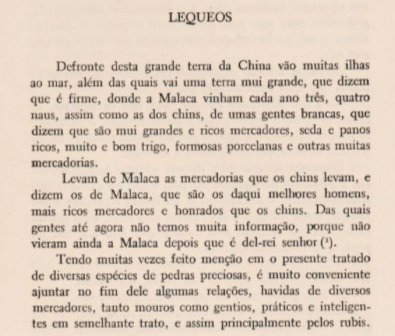
A Portuguese version published in 1946 also omits this phrase. 

https://archive.org/details/b31358500/page/218/mode/2up?utm_source=chatgpt.com

Defronte desta grande térra da China váo muitas ilhas ao mar, além das quais vai urna térra mui grande, que dizem que é firme, donde a Malaca vinham cada ano tres, quatro naus, assim como as dos chins, de urnas gentes brancas, que dizem que sao mui grandes e ricos mercadores, seda e panos ricos, muito e bom trigo, formosas porcelanas e outras muitas mercadorias.

The 1918 version by Dames, which Tim cites for the "175 leagues to the east" annotation, is based on the 1813 Portuguese edition and also omits the phrase. 

The present version is an entirely new translation from the Portuguese text of 1813.

https://archive.org/details/in.ernet.dli.2015.189298/page/n35/mode/2up

What can we conclude from all this?

First of all, Tim is wrong about "a hundred and seventy-five leagues to the east" being a marginal note in the Spanish edition of this text. It is part of the text itself. He not only misread Dames but he didn't even bother to seek out the Spanish version. Had he read Dames' introduction he would have been led to Stanley's translation which includes the so-called marginal note within the text. Then, had he dug even deeper, he would have found the original manuscript which Stanley translated. 

Second of all, because Tim did not bother to dig deeper into a footnote but relied on it entirely he has ignored and neglected the reality that is textual variation. "A hundred and seventy-five leagues to the east" in this section is not the only variant among the translations of Barbosa's book. 

Lord Stanley writes the following in his introduction.
The greater part of this volume was printed in Italian by Ramusio in 1554 in his collection of travels (Venetia, nella Stamperia de' Giunti), as the narration of Duarte Barbosa, and a large part of this work must have been written by Barbosa ; and a Portuguese manuscript of his was printed at Lisbon in 1812 in the " Colleccao de noticias para a historia e geografia das naçoes ultramarinas.'" This manuscript of Barbosa's, however, is much less full than this Spanish MS. of Barcelona, or than the Italian version of Ramusio, and the Lisbon editors have added from Ramusio translations of the passages which were wanting in their MS. These publications do not contain the number of leagues between one place and another which are given in the Spanish translation.

That the Portuguese manuscript printed at Lisbon in 1812 belongs to Barbosa, stands only on the authority of Ramusio, who gives an introduction by Odoardo Barbosa of the city of Lisbon, which is not to be found either in the Barcelona MS. or in the Portuguese MS., and which has been translated from the Italian of Eamusio and published in the Lisbon edition. The introduction to the Lisbon edition states that the Portuguese MS. is not an autograph MS., and that the account of Barbosa is bound up along with other papers. This introduction refers to the passages in the Portuguese MS. which are not to be found in Ramusio, and says it may be doubted whether these were additions posterior to the work of Duarte Barbosa.

Lord Stanley says "a large part" of Ramusio's Italian edition "must have been written by Barbosa." Yet it lacks the "175 leagues to the east" distance to the Lequios as well as other distances given in the Spanish translation. What, then, is the origin of those distances, if they are not in an edition written by Barbosa? It would be best to take the Spanish version Stanely translates not as Gospel truth but as one version which differs considerably from the others.

Not even the titles of these books are the same. The manuscript Stanley translated is:

"Viage por Malabar y costas de Africa, 1512 : letra del siglo xvi." 

While the Portuguese is titled:

Livro em que dá relação do que viu e ouviu no Oriente

These differences must be considered when assessing this addition of "175 leagues to the east" but Tim is ignorant of all the relevant information. He is in no position to make an authoritative statement on this phrase.  

Despite the distance of 175 leagues being a unique variant limited to a single text it is by no means "the final blow" which confirms the Lequios Islands is the Philippines as Tim claims. 

🪶 THE SMOKING QUILL | May 24, 2025

The Final Blow: Why Ryukyu Was Never 

Lequios, Ophir, or Zipangu

🔰 INTRODUCTION: The Myth of Ryukyu

For decades, scholars have lazily defaulted to Ryukyu (Okinawa) as the legendary Lequios, Ophir, or even Zipangu of ancient geography. But a closer examination of the four most powerful primary accounts—Duarte BarbosaKing Solomon’s Navy (2 Chronicles 9)the Greek Homer, and Marco Polo—shows that Ryukyu fails every test. The Philippines, however, passes all with flying gold.

1️⃣ Barbosa's Test: 175 Leagues to Luzon

Key Markers from Barbosa:

  • Lequios faced China.

  • 175 leagues from Malacca = Northern Philippines, not Ryukyu.

  • Traders arrived in ships laden with:Gold in barsSilverRich clothsPorcelainVery good wheat

Ryukyu Fails:

  • No gold or silver trade

  • Late wheat adoption, no high-quality variety

  • Not facing China (Ryukyu is northeast)

  • Geographically too far (1,500 km vs. 900 km to Luzon)

Philippines Passes:

  • Luzon is directly east of Malacca and south of China

  • Adlay wheat in Batanes and Luzon

  • Documented gold mining and trade (Butuan, Surigao)

  • Ortelius confirms region as Ophir’s incense source (Elemi)

https://thegodculturephilippines.com/why-ryukyu-was-never-lequios-ophir-or-zipangu/

Tim's mapping of this 175 leagues distance is profoundly misleading. 

Why is Tim mapping the distance from the middle of China? The text only says "opposite of China" or "in front of China." He also tests a starting point from Malacca because "Barbosa was in Malacca" which, even if it were true, has nothing to with the text. Barbosa does not give a starting place for measuring the distance. Stanley's translation reads thusly:

Opposite this country of China there are many islands in the sea, and beyond them at a hundred and seventy-five leagues to the east there is one very large which they say is the mainland,

Any measurement that does not include those many islands is invalid. There are not many islands in the sea between the Philippines and China. That makes the archipelago between Taiwan and Japan the only candidate. If Tim took the top arrow, moved it down, and then turned it slightly at an angle it would fit the direction and the distance. 


Tim's map intentionally obscures both the direction and the distance of the Lequios, which Barbosa places 175 leagues to the east. That distance fits perfectly if one is sailing in the correct direction toward Japan. This route includes the islands directly in front of, or opposite, the coast of China. By contrast, the route to the Philippines lies to the south, contradicting Barbosa’s statement that the Lequios Islands are to the east. This map is a straw man argument made visible.

This is the same nonsense we have seen from Tim all over again. His poor research previously led him astray into making false statements about Ginés De Mafra's testimony concerning Magellan's voyage despite never having read it. It was I who posted a link to the book. Tim treated my correction of his mistake as a triumph saying it only proved he was right when in reality it proved he is bad researcher. 

This time around Tim has chosen to do zero research on a footnote which has once again left me to pick up his slack. There is no doubt he will do the same this time and cheer that Lord Stanley's translation strengthens his case and proves him correct. However, the addition of "175 leagues to the east" isn't the win Tim thinks it is. For one thing, the phrase is a textual variant in a single Spanish translation. 

For another thing, the way Tim has mapped out that distance is arbitrary and bears no relation to the words of the text which mentions that the land 175 leagues to the east is beyond many islands. That can only be the Ryukyu Island chain which stretches from Taiwan to Japan and is exactly "in font of" or "opposite" of China. The Philippines is to the South which does not match Barbosa's text.

Finally, conflating the Philippines and the Lequios Islands has no historical precedent. The Suma Oriental describes the Luçoes and Lequios as different people, not as two cultures occupying the same island. Fernando Pinto also describes the Lequios and Luçoes as different people, not as two cultures occupying the same island. Maps of the era place the Lequios north in the modern day Ryukyu Islands. Lord Stanley refers to Abraham Ortelius' 1570 map which shows the Lequios far north of the Philippines. Tim brushes that map away by calling it a deceptive Jesuit map which Ortelius corrected 14 years later by placing them in the Philippines. That is not true as the Lequios Islands (grande and pequeño) and Luzon (Islas de Lucois) are clearly differentiated. 

In the History of the Philippines volume 3 the Lequios and Luzon are differentiated in Relation of the Western Islands called Filipinas by Captain Diego de Artieda. The editors describe his work thusly: 

A Spanish captain, Diego de Artieda, writes (1573) a "Relation of the Western Islands." He enumerates the islands thus far discovered by the Spaniards, describing their location, appearance, and natural resources. He adds much curious information about the natives--concerning their religious beliefs and rites, customs, mode of dress, weapons, food, industries, social condition, etc. Artieda notes all that he has been able to learn concerning Japan and China, with interesting details as to their civilization, and the skill of the Chinese as artisans; he mentions the antiquity of printing among them. He offers to conduct an armed expedition against the coast of China, if the king will supply him with two vessels and eighty soldiers. He advises that Spain abandon the attempt to establish a footing in the Philippines, or else that she ignore the Treaty of Zaragoza and trade with the Moluccas. 

https://babel.hathitrust.org/cgi/pt?id=hvd.32044077731628&seq=22&q1=artieda

Captain Diego de Artieda describes the island of Luzon and mentions the Batanes, which Tim is now claiming to be the Lequios Islands, though not by that name. A few pages later he mentions the Lequios Islands and says they are in-between Japan and China. That is clearly the Ryukyu Islands.    

Farther to the northeast of Masbat lies the island of Ybalon or Luzon. It is a large island, with many rivers, in which gold is found--although, as I have ascertained, in but little quantity, because its most influential inhabitants are Moros. While I was in Panae, [S:the leading man among its people] sent a Moro, his steward or treasurer to trade there; but he could hardly get for me one _marco_ of gold in exchange for four of silver, which he bought for me. Buffaloes are to be found here. We have [M: not] explored much of its coast, and I have seen no one who could inform me fully concerning its south-eastern, southern, and eastern parts, because no one has sailed around it. Between this island of Ybalon and that of Panae, lies Masbat. Farther on, and lying north and south, are some other small islands, in one of which is to be found much brazil-wood.

[62] Probably the _sibucao (Cæsalpina sapan_); its wood produces a red coloring-matter which is highly valued, especially by the Chinese. Some varieties of it are more highly esteemed than are those produced in Brazil. These "Brazil" Islands are apparently the small groups north of Luzón, now known as Batanes and Babuyanes.

Farther north than the aforesaid islands are others, the nearest to Luzon being called Xipon [S: Japan]. 

A little to the east between these islands and China are the islands of Lequios. They are said to be rich; but we have been unable to learn much about them, for I have not seen any one who has been there. For this reason I conclude that they must be small, and that the people are not much given to commerce.

https://babel.hathitrust.org/cgi/pt?id=hvd.32044077731628&seq=206&q1=lequios

No matter how much Tim misinterprets old maps it will not change the fact that the Spanish and the Portuguese both differentiated Luzon Island from the Lequios Islands. The Lequios Islands are always located in the north near Japan. 

All in all it's another bombastic claim that shrivels up and dies when exposed to the light of scrutiny. In short, the “175 leagues” is not a suppressed marginal note, it appears in only one Spanish manuscript and is absent in others, including the original Portuguese text. The  Lequios Islands have long been identified with the Ryukyu Islands, not the Philippines. Far from revealing a suppressed truth, Timothy Jay Schwab's interpretation once more reflects a failure to engage with the sources critically or thoroughly.