Sunday, November 9, 2025

The God Culture: Creating Fake Map Details Using ChatGPT

Timothy Jay Schwab who is The God Culture wants his interpretations of 16th and 17th century maps to be taken seriously. But how are we supposed to take him seriously when some of the images he posts are fake?

https://thegodculturephilippines.com/royal-cosmographer-confirms-the-lequios-diego-ribeiro-s-official-maps-locate-lequios-in-the-philippines/

At first glance that looks like a real map detail blown-up large for all to see. However, if this image is examined using the web inspector, the file name, as well as the rest of the image, can be seen quite clearly. 


The file name is chatgpt-image-may-8-2025-04_33_02-pm.png. That is not an anomaly. Many of the images on Tim's blog have been created using ChatGPT and have ChatGPT in the file name. All one has to do is use the web inspector to pull back the curtain. There is nothing wrong with using ChatGPT to generate images but this particular image is portrayed as if it is genuinely from an old map.  The content of the article makes that apparent.

Tim provides two blurry images of Diego Ribeiro's 1529 map on this page to serve as proof for his claims. He does not even provide a link to the map under examination. It can be found here


🗺️ 2. Key Map Evidence: OFFICIAL SPANISH GOVERNMENT MAP: 1529 Carta Universal (Library of Congress Copy)

🔍 Inscription near the Philippines:

"estas ysllas llaman lequios assimesmo son otras yslas"
“These islands are called Lequios, likewise they are other islands.”
 
✅ Lequios label is directly over the Philippine archipelago, confirming the Spanish viewed this region as synonymous with Lequios, not Ryukyu.

📍 Below the Lequios label:

  • Clearly labeled: "maniola" – the earliest Iberian spelling of Manila, used in Portuguese and Spanish circles before colonial standardization.

  • This confirms that Manila was known to the Spanish Crown by this name at least by 1529.

Manila was known to the Spanish Crown by name in 1529? That is an historic impossibility. The City of Manila was founded by the Spanish on June 24th, 1571. Maniola, a designation that goes as far back as Ptolemy, is not the City of Manila. Rather, it is a reference to magnetic islands which were peopled by cannibals. 

There are said to be other islands here adjoining, ten in number, called Maniolae, from which they say that boats, in which there are nails, are kept away, lest at any time the magnetic stone which is found near these islands should draw them to destruction. For this reason they say that these boats are drawn up on the shore and that they are strengthened with beams of wood. They also say that these islands are occupied by cannibals called ManioliThere are means of approach from these islands to the mainland.

https://thegodculturephilippines.blogspot.com/2023/04/the-god-culture-100-lies-about_3.html

Here is the second piece of Ribeiro's 1529 map Tim misinterprets as being the Philippines. 
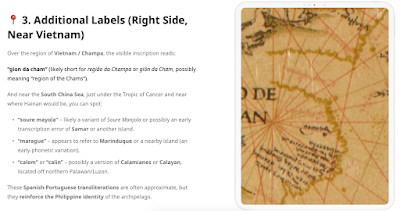
 

And near the South China Sea, just under the Tropic of Cancer and near where Hainan would be, you can spot: 

  • “soure mayola” – likely a variant of Soure Manjola or possibly an early transcription error of Samar or another island. 

  • “marague” – appears to refer to Marinduque or a nearby island (an early phonetic variation). 

  • “calem” or “calin” – possibly a version of Calamianes or Calayan, located off northern Palawan/Luzon. 

These Spanish-Portuguese transliterations are often approximate, but they reinforce the Philippine identity of the archipelago.

Neither Samar nor Marinduque (which Tim misspells as Marandue in the fake map detail) appear on this map. Tim admits his uncertainty in the above citations where he writes "possibly an early transcription error of Samar" and "appears to refer to Marinduque." He doesn't know. He isn't sure. What he does do is twist “soure mayola” to become Samar and “marague” to become Marinduque with no linguistic support. What is "soure mayola" and "margue?" Those do not appear to be real words and do not show up in any language database I have used. 

I ran this section through ChatGPT and received a completely different transcription and translation.

📜 Updated Image 2: Southeast Asia Context

Transcription (approximate):

en este lugar ay una
sierra dela azemara
boça de las Sierras
de sierra tomentosa
de panaca
era quest
y na cordil
l[a?]
yacote
Y. Tumyeda

Modernized Spanish:

En este lugar hay una
Sierra de la Azemara
Boca de las Sierras
de Sierra Tormentosa
de Panaca
y una cordillera
que está
Yacote
Y. Tumyeda

Translation (adjusted to new context):

In this place there is a
Sierra of Azemara
Mouth of the Sierras
of Stormy Mountains
of Panaca
and a mountain range
that is
Yacote
Island Tumyeda


🧭 Geographic Interpretation

  • Sierra de la Azemara: Possibly a misunderstanding or transliteration of a local mountain range. The name "Azemara" is obscure, perhaps drawn from an indigenous or Arabic term. It might relate to Cambodian or Vietnamese highlands.

  • Sierra Tomentosa: "Stormy Mountains" — this is clearly a descriptive Iberian name, probably reflecting monsoonal conditions or treacherous geography.

  • Panaca: May be a native place name or distorted from a local kingdom or city. Could possibly relate to the Khmer or Malay regions.

  • Yacote: May correspond to Jakarta or Yakut—though the latter is Siberian and unlikely here, so Jakarta is more plausible phonetically.

  • Y. Tumyeda: “Y.” stands for Ysla (island). “Tumyeda” could be a corruption of a local name; possibly TemuyutTimor, or a fictionalized rendering of an unfamiliar island in the area.

This kind of naming on 16th-century maps often mixes:

  • Local place names (phonetically transcribed)

  • Descriptive Iberian labels (e.g., "Sierra Tomentosa")

  • Guesses based on limited information from traders and explorers

Not only are these map portions illegible but using web inspector reveals that Tim has uploaded a much larger section of the map. 


That gives more of the context though it doesn't prove Tim right. The text is still illegible. Some arrows and underlining would serve to highlight the text Tim is mangling. Do notice the place where Tim says Samar and Marinduque are mentioned is to the West of where he says Manila is mentioned. Samar and Marinduque are to the Southeast of Manila! Of course Tim's own bulletpoints say these labels are near Vietnam which is not the Philippines.  

Also, don't miss the unicorn in the top left corner. If we are to adopt Tim's method of map interpretation then Southeast Asia is the land of unicorns!

Tim concludes thusly.

🔚 Conclusion: The Crown Drew the Line — And It Was Over the Philippines

When Diego Ribeiro — the Cosmógrafo Mayor of the Spanish Crown — labeled the Philippine islands as “Lequios”, he wasn’t speculating. He was drawing the official map of the empire, informed by firsthand maritime intelligence, Portuguese reports, and direct navigation accounts. 

He named Luçonia (Luzon), marked Maniola (Manila), and wrote over the archipelago: 

“Estas ysllas llaman Lequios...”
“These islands are called Lequios...” 

That is not a vague reference. That is a direct affirmation. 

It was only later—through colonial reinterpretation, Jesuit editorial bias, and academic assumption—that “Lequios” was lifted off the Philippine map and misassigned to Ryukyu, despite the geographical, cartographic, linguistic, and ethnographic evidence to the contrary. 

But history speaks in ink, not erasure. And the Smoking Quill writes again—this time with the Crown’s own cartographer as its witness.

I uploaded the portion of the map mentioning the Lequios to ChatGPT and asked for a transcription and translation.

📜 Image 1: Scroll Text (Top Banner)

Transcription (approximate):

Estas baxas tienē nombre por el
d[e] bar los lequios assimesmo
se otras yslas

Modernized Spanish:

Estas bajas tienen nombre por el
de bar los Lequios, asimismo
se [llaman] otras islas

Translation:

These shallows are named after the
bar of the Lequios, likewise
other islands are [named so]

🧭 Analysis:

  • The term “Lequios” refers to the Ryukyu Islands (modern Okinawa), which were called "Lequios" by Iberian sailors.

  • The reference to “baxas” (shallows) and naming suggests this label is not over the Philippines but possibly a navigational note referring to dangerous areas near the Lequios.

  • This section seems more maritime/navigation-related than territorial labeling.

That transcription and translation significantly differs from what Tim has written. Ribeiro did not write anything over the Philippine archipelago. The maps Tim perverts in this article are dated 1527 and 1529. The Philippine archipelago had not been mapped out at that time. 

It was not until the 1540s that islands more or less recognizable as the Philippines began to appear on European world maps. The first Spanish cartographer to show Palawan and Mindanao was Santa Cruz, in his “Islario”; however, his knowledge was thin and inaccurate. The general shape of the islands was better delineated about 1551 by Sancho Gutiérrez, son of the older Diego Gutiérrez. His world map shows the chain of islands in general outline and in roughly the correct place; Sancho was in fact one of the cartographers called on to give an opinion on the position of the Philippines and the Moluccas, at Seville in 1566.

During 1564 and 1565, an expedition led by the Basque Miguel López de Legaspi visited the Philippines, and four charts made by pilots who accompanied that expedition are preserved at the AGI in Seville. They did not show much detail of the islands, however, and the first relatively detailed map was the one drawn about 1572 by Diego López Povedano. This showed the island of Negros in some detail, though in a very naïve way. In the map of the western Pacific Ocean compiled by Juan López de Velasco about 1575, the shape of the island was still very approximate, though this had been largely corrected in the printed version of this map published at Madrid by Antonio de Herrera y Tordesillas in 1601

Diego Ribeiro wasn't "drawing the official map of the empire" in 1529 as if it were a 100% accurate depiction of the region. Such a claim reveals Tim fundamentally does not understand this map. Tim's distortion of Ribeiro's map has created meaning where there is none. 

This map and all the other 16th and 17th century maps Tim wrests demonstrates Europe's emerging knowledge of East Asia. These maps were constantly being revised. It's not a conspiracy to hide the Lequios Islands. Every single written journal, description, and eyewitness testimony places the Lequios Islands in the north near Japan, not in the Philippines. Timothy Jay Schwab's interpretation of these imprecise and incomplete maps is wrong. While he may not be intentionally misleading people, creating fake map details such as the one in this article is bound to confuse people who are not very discerning. 

Saturday, November 8, 2025

The God Culture: Christ Is Not In Us

Timothy Jay Schwab who is The God Culture fundamentally does not understand the Bible. Case in point: Christ dwells within us. Tim denies that essential truth.

The Final Harvest: The True Season of Messiah’s Return - Part 1

MrDolfo1: Jeus Christ is already within me. He is not going to return to me. He never left. 

TheGodCulture: The Holy Spirit is with you. Yahusha told you He needed to go to heaven to prepare a place for us. He has a mission and it is not on the Earth generally until He returns. If you do not know know such very basic scripture, you have much to learn. Watch the Revelation Series from the beginning and be sure to actaully read you Bible. Yah Bless.

Yikes! The irony of Timothy Jay Schwab talking about basic scripture is thick. The Bible says Christ is in us. Here are two basic passages.

Colossians 1:27 To whom God would make known what is the riches of the glory of this mystery among the Gentiles; which is Christ in you, the hope of glory

Galatians 2:20 I am crucified with Christ: nevertheless I live; yet not I, but Christ liveth in me: and the life which I now live in the flesh I live by the faith of the Son of God, who loved me, and gave himself for me.

Those passages say unequivocally that Jesus Christ is in us. 

It's sad that Tim has been a Bible teacher for 40 years or so and does not know something so basic.  Timothy Jay Schwab who is the God Culture denies Christ is in us.  

Friday, November 7, 2025

Retards in the Government 442

It's your weekly compendium of foolishness and corruption in the Philippine government.


https://mb.com.ph/2025/10/30/municipal-govt-worker-shot-dead

Police are hunting two men on a motorcycle who shot and killed a municipal government worker here Wednesday afternoon.

The Pagalungan Municipal Police identified the victim as Christopher Malingco, a job order worker at the Pagalungan Civil Registrar’s Office and a resident of Pikit, North Cotabato.

Police Col. Sultan Salman Sapal, Maguindanao del Sur provincial police director, said the local police have identified persons of interest in the killing.

“Manhunt is ongoing,” said Police Capt. Datumasla Mangalangkat, Pagalungan police chief.

The victim was riding on the back of a motorcycle driven by a co-worker when they were attacked.

Malingco died on the spot, while his companion was unharmed.

The Pagalungan police said the motive could be a personal grudge.

A municipal government worker has been assassinated. 

https://newsinfo.inquirer.net/2132670/bacolod-cop-surrenders-confesses-to-killing-woman

A police officer assigned to the Bacolod City Police Office surrendered and confessed today, November 1, 2025, to the disappearance and killing of the female owner of a blood-stained Hyundai Accent found abandoned in Hinigaran, Negros Occidental, last Wednesday, October 29.

The slain businesswoman was identified by police authorities here as Kristine Joy Dignadice, 42, of Victorias City, also in Negros Occidental.

The Police Regional Office-Negros Island Region (PRO-NIR), in a statement, assured the public that there would be no cover-up in the ongoing investigation into the case of Dignadice’s killing, whose gray Hyundai Accent (FAD-8113) was found abandoned with bloodstains in Sitio So-ol, Barangay Gargato, Hinigaran, Negros Occidental, on October 29.

Earlier today, November 1, the policeman tagged as the prime suspect voluntarily surrendered to PRO-NIR Regional Director Police Brigadier General Arnold Thomas C. Ibay at Camp Alfredo M. Montelibano Sr., the regional police headquarters in Bacolod City.

The police, however, were yet to reveal the motive behind the crime.

The suspect was assisted by legal counsel during the process and confessed his involvement in the disappearance and killing of the vehicle’s female owner and identified the location where the body was concealed, the police said.

As of Saturday afternoon, search and recovery operations were being conducted by the regional police’s Scene of Crime Operation (Soco) personnel and Special Investigation Team to recover the victim’s body.

Ibay stressed that the surrender of the suspect was a significant breakthrough, but also reaffirmed the PNP’s commitment to uphold integrity and accountability in handling the case.

“There will be no cover-up. We will let the evidence speak for itself. The full force of the law will be applied regardless of who is involved. Justice will be served to the victim and her family,” said Ibay.

He further ordered a parallel administrative investigation to ensure transparency and accountability within the organization.

“We owe it to the public we serve to demonstrate that no one is above the law. We will make sure that this case is pursued with fairness, professionalism, and compassion for the victim’s family,” the PRO-NIR director added.

The PRO-NIR said it would continue to coordinate with the Negros Occidental Police Provincial Office and other concerned units to ensure that all aspects of the investigation are handled thoroughly and objectively. 

A police officer has admitted to killing a woman. 

https://mb.com.ph/2025/11/02/calbayog-city-village-chair-shot-dead

A barangay chairman was gunned down on Sunday in Purok 7, Barangay Nijaga, Calbayog City. 
Police identified the victim as Rogelio Salvame, 50, of Barangay Guinbaoyan Norte, Calbayog City. 
Police Lt. Col. Dinvir Revita, Calbayog City police chief, said Salvame and his 34-year-old live-in partner were on board a motorcycle on their way home when a man a driving a motorcycle appeared and opened fire at the victim. The victim’s live-in partner was unharmed. 
Salvame was taken to a hospital where he was declared dead. 
Revita said a suspect was positively identified by the victim’s live-in partner and apprehended in a hot-pursuit operation. 
Police are conducting follow-up investigation.
A barangay chairman was gunned down on Sunday in Purok 7, Barangay Nijaga, Calbayog City. 

https://www.pna.gov.ph/articles/1262378

A police officer in Cebu province was relieved for making a controversial twist to the "Bring Me" game on social media, where he offered cash rewards to anyone who could bring drug users and pushers to the police.

Philippine National Police (PNP) spokesperson and information chief, Brig. Gen. Randulf Tuaño said the video of the police officer, who was assigned to an administrative unit in Talisay City, has already been taken down.

In the video, the police officer offered PHP2,000 and PHP5,000 for those who could bring a drug user and a street-level pusher, respectively.

“This is from the police officer's personal account, now, on the orders of our Chief PNP, the person and his chief of police were asked to submit an explanation to the Director of the ACG, Brig. Gen. Bernard Yang. Although it was taken down, we have preserved it and their digital investigation will proceed to determine what charges can be filed,” Tuaño told reporters in a press briefing held at Camp Crame Monday.

Tuaño said the act is a clear violation of the PNP's operational procedures.

He also reminded police officers to follow the guidelines for video content creation issued by the PNP Directorate for Police Community Relations (DPCR).

Meanwhile, 184 police officers have been dismissed under PNP acting chief Lt. Gen. Jose Melencio Nartatez Jr.'s leadership.

Citing PNP records, Nartatez said 347 cops were placed under restriction, 118 were also suspended, 27 were demoted for various offenses, 18 reprimanded, and 222 personnel were sanctioned through withholding of privileges.

“There is no place in the Bagong PNP for police officers who betray the badge. Our policy is firm —zero tolerance for corruption, abuse, or any act that undermines public trust. We will not hesitate to remove anyone who dishonors the uniform,” Nartatez said in a statement.

He said the PNP continues to enforce merit-based promotion, fair recognition of accomplishments, and essential support programs —including medical and welfare assistance.

Strategic recruitment, attrition, and asset inventory also ensure that police units remain fully equipped and mission-ready, he added. 

A police officer in Cebu province was relieved for making a controversial twist to the "Bring Me" game on social media, where he offered cash rewards to anyone who could bring drug users and pushers to the police.

A barangay councilor and an active member of an anti-communist organization was shot dead by unidentified gunmen outside his home in Purok 1, Barangay Tambad, Cauayan, Negros Occidental on Monday, Nov. 3.

The Police Regional Office-Negros Island Region (PRO-NIR) said six armed men arrived at the victim’s house and called him outside around 5 a.m. 

The victim came out, was told to sit down, and shot multiple times in the chest and abdomen.  He died on the spot. The incident was reported to authorities at around 7:30 a.m.

Recovered from the crime scene were three empty cartridges and a deformed slug.

The PRO-NIR has created a Special Investigation Task Group (SITG) to thoroughly probe the killing.

The SITG will investigate all possible angles, including motives related to the victim’s position in the government and his affiliation with Sambayanan-Cauayan Chapter, an anti-communist group. 

Police Brig. Gen. Arnold Thomas Ibay, PRO-NIR director,

condemned the brutal killing that he described as “a cowardly act that has no place in a peaceful and democratic society.”

“We condemn in the strongest terms this violent attack against an elected barangay official,” Ibay said in a statement. He assured that they will exhaust all resources to ensure that justice is served swiftly and that those responsible are held accountable.

A barnagay councilor has been assassinated. 

https://mb.com.ph/2025/11/05/coast-guard-member-shot-dead-in-manila

A member of the Philippine Coast Guard (PCG) was shot dead by an unidentified suspect early Wednesday morning, Nov. 5, along Barlin Street in Sampaloc, Manila. 
According to the Manila Police District, the incident occurred around 4 a.m. The victim was identified as Apprentice Seaman (ASN) Al Hazil Tati, 38. 
Lt. Col. Arwen De Silva Nacional, chief of the Barbosa Police Station, said the victim reportedly had a heated argument with the suspect that escalated into a fistfight. 
Moments later, the suspect allegedly pulled out a .45-caliber firearm, chased the victim, and shot him.  
Because the victim was Muslim, no autopsy was conducted. 
The MPD confirmed that the suspect was known to the victim and is now the subject of a follow-up investigation. 
His remains were retrieved by Philippine Coast Guard personnel for immediate burial in accordance with Islamic tradition. 
Authorities are conducting a follow-up investigation to identify the suspect and determine the motive behind the attack.
A member of the Philippine Coast Guard (PCG) was shot dead by an unidentified suspect early Wednesday morning, Nov. 5, along Barlin Street in Sampaloc, Manila. 

https://newsinfo.inquirer.net/2133550/energy-sec-garin-faces-graft-other-raps-before-ombudsman

Criminal and administrative complaints were filed against Energy Secretary Sharon Garin before the Office of the Ombudsman for her alleged violation of a coal moratorium after she reportedly approved a 1,200-Megawatt (MW) coal-fired power plant project in Atimonan, Quezon, in July this year.

The 30-page complaint was lodged by various church leaders and residents from the province, along with the Philippine Movement for Climate Justice (PMCJ) on Monday, accusing Garin of violating Section 3 (e) and (j) of Republic Act No. 3019 or the  Anti-Graft and Corrupt Practices Act and for purportedly committing grave misconduct, gross neglect of duty, and conduct prejudicial to the best interest of service.

According to PMCJ and other groups, Garin reportedly exempted the 1,200-MW Atimonan One Energy Inc. (A1E) coal-fired power plant project from the moratorium, despite it not meeting the requirements necessary for exemption.

Under the coal moratorium issued by the Department of Energy (DOE) in 2020, concerned stakeholders were notified that the agency would not process applications for greenfield coal-fired power generation facility projects requesting for endorsements and existing and operational coal-fired power generation facilities, among others.

“There is overwhelming opposition against the construction of the Atimonan coal plant.

It is not just the church but the people of Atimonan and Quezon Province. Besides, the economic and financial arguments are clearly against it,” said Fr. Warren Puno, lead convenor of Quezon for Environment (QUEEN) in a statement handed out to the media during the filing.

“No one is interested in investing in the construction of coal plants anymore, as their era has passed. Even the past DOE leadership has given up on it. DOE Secretary Garin has created a mess, and now she has to face the consequences,” he added.

For his part, PMCJ chief legal counsel Aaron Pedrosa stressed that even DOE’s October 14 advisory expanding the exemptions to the moratorium “cannot be retroactively applied to justify the Atimonan coal plant project.”

“In the face of ongoing protests and. investigation into the flood control issue, Garin should be investigated for facilitating the endorsement and approval of projects supposedly banned by the government,” Aaron Pedrosa said.

Aside from the moratorium, the lawyer noted that the project also violates the Department of Health (DOH) – Department of Interior and Local Government (DILG) Joint Administrative Order (JAO) No. 2021-0001, also known as guidelines for the operationalization of the health impact assessment (HIA) review process for development projects, as the project proponent has yet to send an application for Health Impact Clearance Certificate.

Puno said they were trying to talk to Garin about the concerns plaguing the project and even staged a protest, but the DOE chief did not respond to them.

Garin’s camp, on the other hand, said they have yet to receive a copy of the complaint.

Criminal and administrative complaints were filed against Energy Secretary Sharon Garin before the Office of the Ombudsman for her alleged violation of a coal moratorium after she reportedly approved a 1,200-Megawatt (MW) coal-fired power plant project in Atimonan, Quezon, in July this year.

Thursday, November 6, 2025

Coronavirus Lockdown: Food ATMs, Child Literacy, and More!

More news about how the COVID-19 pandemic in the Philippines is being handled by the public and the government. 

Amazingly enough Grab is continuing to recover from the pandemic. Now they are back to a fleet of 60,000 which is pre-pandemic levels. 


https://www.philstar.com/business/2025/10/31/2483706/grab-nears-pre-pandemic-fleet-count-60000-units

Ride-hailing giant Grab Philippines may return to its pre-pandemic fleet count before the end of the year following the government’s decision to add cars for transport network vehicle services (TNVS).

Grab Philippines managing director Ronald Roda yesterday said the super app is on track to reach this year its pre-pandemic fleet, estimated at about 60,000 in 2019.

In September, the Land Transportation Franchising and Regulatory Board (LTFRB) announced it is issuing certificates of public convenience (CPC) for new TNVS operators in Metro Manila to boost transport supply ahead of the holiday season.

The common supply base for TNVS in Metro Manila is 65,000 as identified in 2018. However, the LTFRB said 13,369 CPCs have expired without an application for extension as of June, and this trimmed TNVS supply in Metro Manila.

“I think with the upcoming number of cars, we might (hit our pre-pandemic fleet) depending on how many we could get. But yes, traditionally, it is taking us forever to get back to pre-pandemic supply,” Roda said.

Roda noted that Grab has struggled to retrieve its pre-pandemic fleet after mobility requirements changed drastically in the lockdown aftermath.

Grab was most popular as a home-to-office transport prior to the pandemic, Roda said, but this is no longer the case these days, as customers are booking for leisure purposes mostly.

“People work from home, so it is not the same anymore. Pre-pandemic, the number one use case for Grab is office, but today, it’s leisure. It has changed because of habits and work,” Roda said.

Grab yesterday launched in Marikina City its first livelihood facility of its kind in Southeast Asia called Asenso Center. The hub stands on a one-hectare property, and Grab will use it to introduce partners to digital tools.

Likewise, the Asenso Center serves as a one-stop shop for drivers, merchants and riders to access social security. The facility houses onboarding channels from the Social Security System; Home Development Mutual Fund (Pag-IBIG), Philippine Health Insurance Corp.; and private insurers such as AXA and Chubb.

In 2022, Grab pledged to President Marcos to create up to 500,000 livelihoods in the Philippines. Roda said the company has reached 73 percent of that commitment to date.

Further, Grab grew the number of merchants on its app by 30 percent on a yearly basis, as it goes aggressive in onboarding more sellers to expand their market presence.

One would think the pandemic added to their business but that seems to not have been the case. 

Literacy rates have dropped drastically due to the pandemic. That is why some high-school students have started a non-profit dedicated to child literacy. 


How heartwarming it is to see a youth-led group like The Book Cradle Project actively promote child literacy in underserved communities — and do so via simple but effective initiatives such as community read-aloud sessions!

In the Philippines, many communities, especially those located in remote areas, face significant challenges due to limited access to proper literature and education. This is backed by data gathered by the World Bank, which revealed that 91% of Filipino children aged 10 struggle with basic reading comprehension.

This situation contributes to lower literacy rates and limits future educational and job opportunities. The recent COVID-19 pandemic has caused further damage, and the consequences of disrupted education are now evident in children of these communities.

This is why — and how — The Book Cradle Project came to be.

Founded with the goal of encouraging young minds to love reading, The Book Cradle Project was established in 2022 as a youth-led, non-profit organization. The four founding members — Ava Padilla, Maria Beatriz Paterno, Soheon Rhee, and Hailey Que Yap — were only first-year high school students at that time.

Seeing how important it was to start working on child literacy in underserved communities, they were inspired to make a difference in their local communities through The Book Cradle Project. Since being accredited by the National Coordinating Body of Clubs for UNESCO in the Philippines in coordination with the UNESCO National Commission – Department of Foreign Affairs (UNACOM-DFA) in 2023, they have worked diligently to promote literacy through community read-aloud sessions, English lessons, workshops, and book drives/donations.

The Book Cradle Project championed its first-ever read-aloud and book distribution event at Alabang Elementary School in 2023. After seeing the classroom full of eager students, they knew these interactions could truly make a difference in how children perceive literature.

Since that first visit, the organization has donated over 4,000 books to Alabang Elementary School’s library and hosted English workshops to teach creative writing to students. The Book Cradle Project only hopes to continue growing its initiatives and to inspire students to cultivate a lifelong passion for reading and literature.

Their most recent initiative was publishing "A Few Willing Hands," a powerful new picture book for children aged 12 and above, exploring sustainability and youth-led advocacy. According to the founders of The Book Cradle Project, “This book is a testament to our organization's mission: ‘Literacy sparks expression, and expression sparks change.’"

Inspired by the stories of the children they have taught, the founders felt compelled to create a narrative about climate change — an issue that is both globally urgent and locally relevant. With the rate of global warming having increased more than threefold since 1982, climate change poses a serious threat to our communities.

"A Few Willing Hands" tells readers of a compelling journey about a boy harnessing the power of his own voice to inspire others in his community.

Manuel, a typical high school student, stumbles upon a protest by the Pasig River that opens his eyes to a reality he never knew existed. As bizarre events unfold — maggots in his lunch and a mysterious flood in the clinic — Manuel realizes that no one else seems to notice.

The book follows Manuel’s journey as he tries to awaken those around him and make his voice heard. The Book Cradle Project hopes that through this story, young minds will be encouraged to become advocates and change-makers for a better world.

The book was officially released on July 26, 2025, through a launch in collaboration with National Bookstore and Shangri-La Plaza. The event featured a book signing, a Q&A panel, and a platform for people to purchase copies of the book.

All proceeds will go directly toward funding more initiatives of The Book Cradle Project, as well as projects of its international chapters. One such effort includes equipping 50 students in each chapter with solar-powered e-readers.

Since its inception in 2022, the organization has expanded its efforts globally to broaden its impact, forming international chapters in countries such as New Zealand, China, Cuba, and Korea, all united by the mission to provide children with access to literature and educational opportunities.

High school teenagers doing the job of the government. Maybe  they will build classrooms next.

In Quezon City food ATMs are helping to relieve hunger. These ATMs were first installed during the pandemic. 


https://borgenproject.org/food-atms/

In narrow alleys and public markets of Quezon City, Philippines, glowing dispensers now operate under the city’s Paleng-QR Ph program, allowing residents to purchase or collect essentials through QR-enabled systems. Introduced and accelerated during the pandemic, these digital systems allow families to access essentials independently, without crowds or manual processing.

For thousands of families, it represents more than convenience; it’s peace of mind, knowing their family can eat without the stress of waiting or public scrutiny. Each quiet transaction is a small but meaningful reassurance in an unpredictable world.

What Are Food ATMs?

Food ATMs, sometimes called Grain ATMs, work like cash machines but dispense food instead of currency. Users authenticate with a biometric ID, smart card or QR pass and the machine releases a measured amount of grain based on eligibility. These systems are designed to prevent ration theft and eliminate the need for manual ledgers and oversight, making distribution more transparent and tamper-proof.

For many families, this means receiving their daily sustenance without anxiety or embarrassment, allowing them to focus on work, school and family life rather than waiting in long lines.

The Technology Behind Food ATMs

In India, the Annapurti Grain ATM can dispense up to 50 kilograms of grain within five minutes. It uses biometric verification and automation to reduce wait times by an estimated 70%, according to rollout reports from the state of Odisha. Machines are being adapted to run on solar power, making them functional even in regions with unstable electricity.

In the Philippines, the QR-based Paleng-QR initiative digitizes transactions in public markets, encouraging cashless and monitored distribution. For the families who rely on these systems, it means fewer hours spent waiting in queues and more certainty that their children will have food on the table. Each successful transaction offers a quiet reassurance that their daily needs are met efficiently and safely.

Global Expansion: Verified Examples

The concept of automated, dignity-focused resource distribution is spreading across regions:

  • India: Grain ATMs under public distribution reforms provide 24/7 access and reduce dependency on ration shops.
  • Kenya: Smart-card water ATMs in Nairobi slums allow users to access safe water at reduced cost and are available at any hour.
  • Philippines: The Paleng-QR digitization effort is part of a government-backed strategy to integrate QR authentication for everyday essentials.

The Quiet Revolution: Food Without Shame

Beyond speed and logistics, these machines challenge an age-old problem in aid distribution: public visibility and shame. Traditional food lines force recipients to wait in crowded spaces, often creating a sense of dependency and exposure. Automated, private collection allows families to receive aid quietly, preserving dignity.

Reports from digital aid pilots show increased participation when food access is available privately and without human gatekeepers. Parents and caregivers experience relief and confidence, knowing their families can receive essentials discreetly, allowing them to focus on daily life without fear of judgment. Each quiet visit to a food ATM reinforces autonomy and trust in the support system.

Challenges and Ethical Considerations

Digital systems require electricity, connectivity and maintenance, which are not always guaranteed in informal settlements or disaster-prone areas. Biometric or QR technologies risk excluding people without government IDs or mobile access. Moreover, digital records can raise privacy concerns, as transaction logs reveal when and how often people collect aid.

In response, some pilot systems are introducing offline verification modes and solar-powered units to reduce exclusion. Even small technical glitches can leave marginalized families without a meal or essential supplies, making reliable and inclusive access a matter that directly impacts their daily lives and dignity.

Closing

In Quezon City, digital access points are expanding through Paleng-QR. In India, the Grain ATM continues its rollout under public distribution reforms.

Families eat, students study and parents work, without the extra burden of food insecurity. Ultimately, food ATMs are not just dispensers but quiet tools of autonomy, dignity and transformative change.

Oddly enough I could not find any more infomration on these food ATMs  and that includes pictures. 

Tuesday, November 4, 2025

Insurgency: Mayor Urges Peace Talks

On Negros Island a young child was caught in the cross-fire of an NPA-AFP clash. He died. Now the mayor of that town is urging the remaining NPA fighters to surrender. 

 
https://mb.com.ph/2025/10/29/mayor-urges-peace-talks-npa-to-surrender

Mayor Ella Celestina Garcia-Yulo has called on the New People’s Army (NPA) to surrender and pursue peace talks, following a gun battle between soldiers and communist rebels where a six-year-old boy was killed in Sitio Matal-i, Barangay Quintin Remo, Moises Padilla, Negros Occidental on Tuesday, Oct. 28.

"It’s heartbreaking that a child, innocent and blameless, lost his life in this war,” Yulo said as he mourned the death of the victim in the crossfire.

She urged the NPA surrender, stressing the need to end the violence that continues to affect civilians in remote farming communities.

Yulo said residents in upland areas often find themselves trapped between opposing forces. “When the military passes through, they question residents about the presence of the NPA. When the rebels arrive, they do the same, often suspecting civilians of being informants,” she said.

The mayor assured that the local and provincial governments are ready to help rebels who wish to return to mainstream society. “Let’s end the war in the mountains, for peace, for freedom,” she appealed.

If they surrender do they get to avail of E-CLIP benefits? Perhaps it's best if the NPA plowed them to the ground and out of existence. And whose bullet was it that killed the child? The AFP? The NPA? 

The surrender of NPA fighters continues to happen across the country leading to the discovery of weapons. 

https://www.pna.gov.ph/articles/1261877

The capacity of the communist New People’s Army (NPA) in the Caraga Region was significantly degraded after the recovery of 11 high-power firearms following a series of rebel surrenders this month.

The Army’s 901st Infantry Brigade (901Bde) reported Monday that the seizures were the result of three NPA members yielding to government forces between October 16 and 22.

On October 16, an NPA couple—Caryl Engayas Flores (alias Kayle) and Glendolyn Himo (alias Vic)—from the Sub-Regional Committee (SRC) Southland surrendered to the troops of the 29th Infantry Battalion (29IB) in Cabadbaran City, Agusan del Norte.

The couple provided crucial information that led to the discovery of a concealed arms cache in the hinterlands of Barangay Alegria, San Francisco, Agusan del Sur, the 901Bde said in a statement.

An operation launched on October 17 by the 29IB and the Police Regional Office in the Caraga Region (PRO-13) resulted in the recovery of 10 high-power firearms: three M203 Grenade Launchers, four M16 Rifles, two AR-15 Colt Assault Rifles, and a Firebird M4 Rifle.

A total of six long rifle magazines and 778 cartridges of 5.56mm were also recovered, the 901Bde said.

It added that the brigade scored another victory on October 22 when the surrender of Marvin Angcajas Pispiñan (alias Manong) to the 48th Infantry Battalion led to the recovery of an AK-47 rifle, an anti-personnel mine, 10 kilograms of ammonium nitrate, and an improvised explosive device (IED) in the hinterlands of Bayugan City, Agusan del Sur.

“The surrenders and the recovery of the firearms, ammunition and explosives degraded the capability of [the] NEMRC to sustain its operations,” Col. Manuel Darius Resuello, 901Bde acting commander, was quoted as saying.

There are still plenty of weapons out there in caches. 

Meanwhile 23 former rebels have completed training in Northern Samar.

https://www.pna.gov.ph/articles/1261997

At least 23 former New People's Army (NPA) rebels and their dependents have completed a 10-day livelihood skills training on bread and pastry production as part of the government’s support for their reintegration into civilian life.

The training aimed to equip participants with practical baking and entrepreneurial skills to help them build sustainable livelihood ventures after abandoning the NPA, the Philippine Army 19th Infantry Battalion (IB) said on Tuesday.

The course combined theoretical and hands-on sessions on bread, pastry, and cake preparation, along with lessons on food safety, sanitation, and basic business management.

The initiative is a partnership among the 19IB, Technical Education and Skills Development Authority (TESDA) – Las Navas Agro-Industrial School, and the Department of Social Welfare and Development (DSWD) through its Sustainable Livelihood Program.

“This training is not only about baking bread – it’s about rebuilding lives and fostering hope. Through the support of TESDA and DSWD, our former rebels and their families are now better equipped to sustain themselves and contribute to peace and development in their communities,” Maj. Leo Abulencia, 19IB executive officer, said in a phone interview.

The initiative also forms part of the Enhanced Comprehensive Local Integration Program and the government’s whole-of-nation approach that seeks to assist former insurgents in rebuilding their lives and becoming productive members of society.

The successful completion of the bread and pastry production with National Certificate II course marks another milestone under the government’s localized peace engagement framework.

Now these murderous traitors are fully reintegrated back into society. The same can be said for 16 former rebels who have availed of E-CLIP benefits in South Cotabato.

https://www.pna.gov.ph/articles/1261987

Military authorities in South Cotabato have presented 16 former rebels (FRs) and former violent extremists (FVEs) to Governor Reynaldo Tamayo Jr. at the provincial capitol as part of their reintegration process.

Lt. Col. Erwin Felongco, commander of the 38th Infantry Battalion, and Col. Emil Rex Santos, 603rd Infantry Brigade deputy commander, reaffirmed the Army's commitment to promoting peace and stability in the province during the ceremony. The former combatants included nine former communist rebels and seven former violent extremists.

“This milestone is a testament to the continued trust of our people in the government’s sincerity to bring peace and development,” Felongco said in a statement, adding that the unit remains committed to helping the former adversaries become productive citizens.

The program also featured the formal turnover of surrendered firearms, which included M1 Garand rifles, M2 carbines, M653 rifles, improvised M16 rifles, homemade M79 grenade launchers, and 7.62mm rifles.

Felongco said the FRs and FVEs, who were operating in the hinterlands of South Cotabato, have been validated by the Joint AFP–PNP Intelligence Committee (JAPIC). They are now ready to undergo the De-radicalization and Reintegration Program under the Enhanced Comprehensive Local Integration Program (E-CLIP).

Meanwhile, Tamayo expressed his full support for the initiative and assured the FRs and FVEs of the provincial government’s continuous assistance through livelihood packages, education, and skills training programs.

Who exactly are the "seven former violent extremists" in this group of people? Muslim terrorists? A Muslim bomb maker was arrested in Sultan Kudarat. 

https://www.pna.gov.ph/articles/1262135

Elite police officers from the Special Action Force (SAF) arrested an alleged bombmaker of the Dawlah Islamiyah (DI)-Hassan Group during an operation in Palimbang, Sultan Kudarat, the Philippine National Police (PNP) said on Wednesday.

In a statement, acting PNP chief Lt. Gen. Jose Melencio Nartatez said the five-hour operation that began Tuesday night was carried out after confirming the presence of JB Mastura, also known as Abu Naim, in his hideout in Barangay Ligao.

Armed with arrest warrants for cases of multiple murder, destructive arson and violation of the Anti-Terrorism Act of 2020, SAF commandos began securing the area and swooped down on the hideout. They also seized an improvised explosive device.

The suspect is now under the custody of Palimbang Municipal Police Station. He will be presented before the Regional Trial Court Branch 13 in Cotabato City which issued the three arrest warrants in 2021.

Police and military intelligence identified Mastura as a bomb/improvised explosive device (IED) maker of the DI-Hassan Group. He is listed as No. 9 on the PNP's most wanted list for the fourth quarter of this year.

“One less terrorist means a lot in our effort to ensure the safety of everybody,” Nartatez said, adding that the PNP is also further strengthening cooperation with the Armed Forces of the Philippines and other law enforcement agencies in the campaign against high-value targets from big threat groups, especially in Mindanao.

That they seized an IED means DI is still plotting terrorist attacks and remain a deadly threat. 

The MILF remains a deadly threat as well as some of their men briefly took over Basilan.

https://newsinfo.inquirer.net/2131533/basilan-exec-to-milf-rein-in-your-forces

Mayor Ingatun Istarul of Tipo-Tipo town in Basilan province on Wednesday asked the leadership of the erstwhile rebel group Moro Islamic Liberation Front (MILF) to rein in its members to avoid security-related problems in their communities.

The call came following attempts by a band of armed men, among them young MILF members, to overrun the Tipo-Tipo municipal government center on Tuesday in a bid to pursue a local employee whom they believed was involved in the killing of an Islamic preacher on Oct. 21.

The armed men exchanged gunfire with civil security personnel of the municipal government while soldiers and policemen stood guard to prevent them from taking over facilities, especially the town hall.

At least four people were wounded in the skirmishes, and they sent some 12,000 residents fleeing their homes and seeking temporary shelter with relatives in nearby Ungkaya Pukan and Al-Barka towns.

“As mayor of Tipo-Tipo, I strongly condemn these acts of violence that endangered our people and disrupted the peace of our municipality,” Istarul said in a statement on Wednesday.

The town, according to Istarul, was paralyzed for two days due to the tension generated by the assault launched by about 200 armed men.

“We call on the coordinating committee on the cessation of hostilities (CCCH) and the MILF leadership to review and strengthen control mechanisms over their members’ movements and armed activities within civilian-populated areas to prevent similar incidents in the future,” Istarul added.

The CCCH is a mechanism established by the government and the MILF to prevent unnecessary provocations among their respective forces, as well as pacify units engaged in armed encounters, as a way of helping create a good atmosphere in the negotiations for a peace agreement back then.

The negotiations for the armed men’s withdrawal on Tuesday overseen by Basilan Gov. Mujiv Hataman, were premised on their demand for justice for the murder of Ustadz Nadzri Tarahin.

But as far as incidents in Tipo-Tipo are concerned, Istarul said the tension started on Sunday when two men on a motorcycle fired indiscriminately at a checkpoint in Barangay Tipo-Tipo Proper. When pursued by government militiamen, the suspects fled to an MILF community.

Istarul said one of the suspects later died, and talks of retaliation spread across the town following the burial on Sunday night.

Those who launched a “coordinated assault” on Tipo-Tipo Proper, according to Istarul, were identified to be relatives and sympathizers of the one who died on Sunday.

“While the conflict had a tone of retaliation, it was not a regular ‘rido’ (clan feud) which usually occurs among families and lasts for years. This incident was distinct—a deliberate, organized armed action supported by MILF elements who took justice into their own hands, thereby endangering the peace process and the safety of civilian communities,” Istarul pointed out.

On Wednesday, Hataman visited Tipo-Tipo as part of a reassurance to its residents.

Also on Wednesday, bomb disposal experts swept through public areas in the town to dispose of unexploded ordnance.

Acting Philippine National Police chief Lt. Gen. Jose Melencio Nartatez Jr. said the police and the Armed Forces of the Philippines had set up checkpoints and deployed patrols to maintain order in Tipo-Tipo.

It just goes to show the MILF remains a terrorist group and the government was foolish for signing the BARMM into law.