Saturday, January 31, 2026

The God Culture :100 Lies About the Philippines: Lie #46: Cagayan Is A Hebrew Word

Welcome back to 100 Lies the god Culture teaches about the Philippines. Today's lie concerns Timothy Jay Schwab's claim that the Philippine place-name Cagayan is Hebrew. 


This lie is taught in his videos.

Lost Isles of Gold LIVE Series - Part 12: Hebrew in the Philippines?

11:00 Here is an amazing one because this name is found throughout the Philippines, Cagayan. Cagayan means Feast of Yah. Oh, what? In the Philippines? Feast of Yah? What would that have to do? How did that get here? And that's the real question. When you seek the answer to that question you'll realize it's because this is the ancient land of the Garden of Eden and the land of gold that has had a connection all along. Uh, someone will say, oh, but Cagayan you know that means, uh, that means river, right? Cagayan's River. No it isn't. No it isn't. No, no, no. Because if it was then it wouldn't be the name of some of the islands that don't have rivers. Oops. You wouldn't name an island river when it doesn't have a river, right? Okay, so you have Cagayan do Oro. Uh, you have Cagayan Sulu. You have Cagayancillo Cagayan de Oro would be would be uh Feast of Yah with gold, right? Cagayan Sulu. Sulu is an Indian word meaning highway, right? Feast of Yah highway because it's in the middle of the Sulu sea so it's the highway in ancient times. Uh, cillo is Spanish, right? So, Cagayancillo is tithe. That's what that Spanish word means, tithe. So, tithe of the Feast of Yah. That doesn't sound like a coincidence to me and and you know these names are just too much to ignore.

Tim also makes this claim in his book The Search for King Solomon's Treasure. Because his claim is very intricate I will take it apart one piece at a time. 

The Search for King Solomon's Treasure, pg 197

Cagayan:

Hebrew: chaggayah: חגיח: Feast of Yah, a Levite. Origin of name Chaggay or Haggai the prophet. [191]

One sees this name utilized all over the Philippines in Cagayan Province in North Luzon, Cagayan de Oro and Cagayan Sulu in the Mindanao region, and Cagayancillo in Visayas. Examine the traditional etymologies on the origin of this word and there is no track whatsoever on it’s actual root. Assumptions are made without an accurate historical paradigm. The assumption that the Spanish renamed everything is already disproven and to ignore the Philippines existence of a far more sophisticated society who named their own land prior to the Spanish is to ignore even Spanish chroniclers.

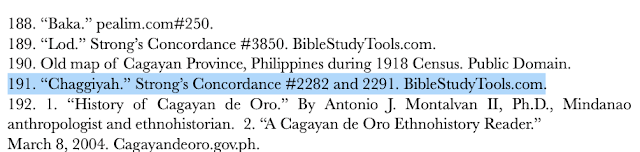
Tim's source for his etymology of Cagayan is numbered 191. 
The Search for King Solomon's Treasure, pg 374

Strong's numbers H2282 and H2291 are listed as his sources but his sourcebook has a completely different word, H2293.

Solomon's Treasure Sourcebook, pg 205

This same blunder is made in his video where one Hebrew word is shown on screen while two others are referenced.


Which is it? Is Cagayan a compound word or is it a single word, the same as the Hebrew name Haggai? That Tim makes this error shows he is simply guessing and is not clear on the Hebrew at all. No wonder since Cagayan is not a Hebrew name but is a native Filipino term meaning river. 

“Spanish documents in 1500s already referred to the area around Himologan as Cagayan. On January 25, 1571, the Spanish government granted this area, including what is now Northern Mindanao, as an encomienda to Juan Griego.” [192]

What is the origin of this name there and also in the other regions? There is a strong possibility, the Spanish did not name either of these areas Cagayan.

“According to Father Miguel Bernad, S.J. of Xavier University, “cagayan” comes from the Malayo-Polynesian word ag, which means “water”. Ag is present in words like agus, agusan, and kagay. Agus means “flowing water”, and agusan “place of flowing water”. Kagay means “river” and kagayan is “place with a river.” [192]

“But according to Dr. Lawrence A Reid, Professor Emeritus, Department of Linguistics, University of Hawai`i, “cagayan” comes from an ancient Philippine word *kaRayan, which means “river”. In an email sent to the Ancient Baybayin Scripts Network of Yahoogroups, Reid explained, “The evidence for the Proto-Philippine word reconstructable for river, kaRayan, comes from the Ilokano karayan, Central Agta kahayan, Itawis kayan, etc... Note that in all the languages that have a reflex of this form, it simply means ‘river’. It is not a morphologically complex form. There is no language that reflects a form kagay. Nor is there any evidence that either the final -an was a suffix, or for that matter that the initial ka- was a prefix ....” [192]

Even archaeology shows a thriving community in Cagayan de Oro in at least 350 A.D. Cagayan Province has a prehistoric history with the oldest bones of humans and animals found there. [192] Cagayan Sulu is mentioned by Pigafetta and also had a community prior to the Spanish. One scholar claims all it takes is the Malay word “ag” to determine an etymology of the word Cagayan. That’s not logic and only a tiny piece of the word. It is not that he may not have a point, it is that he would go public with an opinion of unfinished research which we review consistently from many scholars. What if the Malay word “ag’ actually originates in Cagayan instead as modern science proves that the Philippines populated the other Polynesian Islands and not the other way around. The land bridge theory has also crumbled and with it, many of their antiquated etymologies which need to be updated.

Why is Tim refuting the claim that the Spanish named any area in the Philippines Cagayan? Nobody has made this claim. Father Miguel Bernad says the name originates in the Malayo-Polynesian word "ag" which means water. He then gives several examples of words that contain "ag" and have to do with water.  Tim says that is not logical but gives no reason why except to say "ag" is "only a tiny piece of the word." This is poor reasoning. Disbelief is not proof.

He then says maybe "the Malay word “ag’ actually originates in Cagayan." Well, that would require proof which Tim does not provide. Instead he claims Filipinos "populated the other Polynesian Islands and not the other way around." Ok, but "ag" is a MALAYO-Polynesian word. It seems Tim forgot the Malay part. Ancient Filipinos did not colonize Malaysia. This whole first section is full of unfounded speculation and proves Tim does not understand linguistics as he dismisses Father Bernad's arguments without actually engaging them. Never forget Tim is not a linguist nor does he care to be one.

What about the other Cagayans? Another scholar attempts to connect “karayan,” an Ilocano word, and “Cagayan.” Are they now saying Ilocanos migrated to Visayas and Mindinao prior to the Spanish? There is no history to support that and before positing such a theory would it not be wise to consider such? In other words, it only takes “ayan” to connect the words yet would not “Cag” be a different word from “kar” in any language essentially. Is this really logic? They are guessing and these are not hypotheses as that requires educated reason. Instead, we find that the Hebrew word Chaga or Chag means “feast.”

Having done battle with Father Miguel Bernad Tim now jumps into the fray against Dr. Lawerence A. Reid. Take note that Tim's source is the Cagayn de Oro City website. 

The Search for King Solomon's Treasure Sourcebook, pg. 204

The link given in the sourcebook has been changed and the new page can be found here. But it is the same content as on the old web page. Both pages have a link to more about the History of Cagayan. If Tim had bothered to follow the link he would have eventually found Dr. Reid's full explanation of his etymology of Cagayan.

https://elson.elizaga.net/articles/meaning-of-cagayan.html

There is nothing about Ilocanos migrating to the Visayas and Mindanao in this explanation.

Reid says that the term for ‘river’ as used by the early migrants from Taiwan who became Filipino peoples some 4000 years ago, must have been *kaRayan. Reid states that the asterisk in front of the form is a linguistic symbol and is used to show that the form is a reconstructed word, based on the widely accepted methodology of the science of comparative-historical linguistics. He also comments that the methodology is based on the fact that all languages change from generation to generation, and that sounds change regularly over time. 

What about the letter R in the middle of the word? Reid states that it stands for a sound that must have occurred in the language at that time. This is a sound that occurred in many words, and regularly developed into the sound g in the languages of the Cagayan Valley as well as Tagalog, Cebuano and the other Central Philippine languages. It developed into the sound r in Ilokano, and into y in Kapampangan and the other Central Luzon languages. Reid notes that the symbol R is used because the symbol for the actual sound was not commonly found on typewriters. Linguists suggest that the sound was what they call a velar fricative, or a fricative g, and it is symbolized in the International Phonetics Alphabet by the Greek letter, ɣ. This is a sound that is not used in most Philippine languages today, but was probably present in the first language spoken by the migrants from Taiwan, since it also occurs in the indigenous languages of Taiwan that are cousins of Philippine languages.
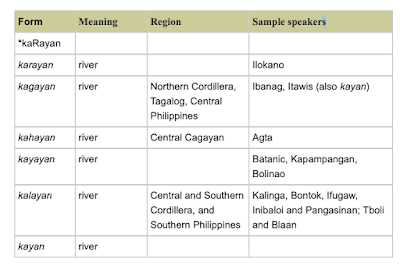
He then shows the following chart.


When Tim asks "yet would not “Cag” be a different word from “kar” in any language essentially" he shows that he is not familiar with Dr. Reid's arguments or with linguistics in general. Never forget Tim is not a linguist and he boasts about that fact. Funny that he calls Dr. Reid's etymology an uneducated guess.

Tim ends by saying "the Hebrew word Chaga or Chag means “feast.”" He will next attempt to prove Cagayan is a compound Hebrew word even though the etymology in The Search for King Solomon's Treasure and the sourcebook show it is one word, the proper noun Haggai. 

If only they were aware of the Hebrew associated through the sons of Eber and the alliance with Israel, many would see this as we. Yah is the name of God and even “yan” is Yah’s Grace (ין). [199].   Some say the connection between these four areas is they each have a river. What rivers are even on Cagayan Sulu? They only have lakes. What about Cagayancillo and the Cagayan Islands? Still no significant rivers. Thus, half of the references already fail to support a meaning for rivers which is a stretched etymology that does not connect from a language not even prevalent in three of the four areas until centuries later.

Incredibly two of Tim's sources for the word "Yan" are baby name dictionaries!

The Search for King Solomon's Treasure Sourcebook, pg 206

This is not the first time he has used a baby name dictionary as a source. He also used one when interpreting the Book of Jubilees. 

https://philippinefails.blogspot.com/2021/04/the-god-culture-timothy-jay-schwab-uses.html

And he has the nerve to call actual linguists uneducated??? 

Tim is insistent in both his videos and books that Cagayan cannot mean rivers because some places are named Cagayan that do not have "significant rivers." There could be a number of reasons why places are named Cagayan that do not have rivers. Has Tim bothered to research when and why these places were named Cagayan? He says they do not have "significant rivers" but does that mean they have no rivers? 

Really the question why a place without rivers is named Cagayan is a red herring Tim is using to distract the reader and listener. Here are some questions for him: Why is there no place called Cagayan in Israel if it is indeed a Hebrew phrase proper for a place name? Why do the two words "Chaga" and "yan" or "yah" never appear together in the scriptures? In his sourcebook Tim links the word "Yan" to Strong's H2605. 

https://www.blueletterbible.org/lexicon/h2605/kjv/wlc/0-1/

But that word is NOT Yan. It's Hanan! In Tim's etymology that would render as Cagahanan which is not  Cagayan. Now, Tim has four different Hebrew words, H2282, H2291, H2293, and H2605, to account for his alleged etymology of Cagayan. He is clearly making things up.

Here is Tim's final proof for Cagayan being a Hebrew word. No surprise it's all pure speculation. 

In fact, in Cagayan Province, the people were already referred to as Cagayanos or Cagayanes when the Spanish arrived. Cagayan appears to us based on this evidence, to be of Hebrew ancestry. This is why the word is all over the archipelago because the Feast of Yah mattered all over. How can one think that the Queen of Sheba brought back nothing from Israel in way of answers of God if nothing else? Did the Wise Men just take some gifts there and visit the Son of God and just take selfies and leave as if they were on a pleasure cruise? It is far more likely they brought texts of scripture and great knowledge upon their return that they would have disseminated to the people all over the land of Ophir, Sheba and Tarshish.

Actually, the three Cagayan’s in Visayas and Mindanao appear to serve a greater purpose as Cagayan de Oro is on the East border of the Garden of Eden. De Oro is said to refer in Spanish to “of gold” and thus Cagayan assumed river. However, Oros is the Greek word for “mountain” and the gold is in the mountains. [193] Cagayan Sulu is on the Southern border of the Garden. The word Sulu in Akkadian (Phoenician, spoken by Hiram, Solomon’s Admiral) is “highway” and the sea was certainly the highway for Solomon’s navy. [194] Cagayancillo is on the Northern border of the Garden. “Cilla” is Spanish for “tithe barn, granary, tithe.” [195] This is a rather odd circumstance rendering the meaning Tithe of the Feast of Yah. We believe Cagayan is Hebrew in origin as it makes far greater sense than the attempt to connect rivers which are not there in half the areas and we see no support to assume an Ilocono origin of the names of three places in Visayas and Mindanao. Cagayan is far better rendered in Hebrew as “Feast of YAH” than contrived etymologies which have no real basis. As the Philippines is the Land of Creation thus the very region of the first Feasts, of all places on earth, Biblical feasts should be observed there and this will be restored

Not only is Cagayan Hebrew but some of the places named Cagayan have other non-Filipino words attached to them. Ancient Filipinos knew Akkadian and Greek. 


As for Cillo meaning tithe, that is all wrong. Cagayancillo means "little Cagayan" as -cillo is a suffix meaning small.

https://spanish.kwiziq.com/revision/grammar/using-the-diminutive-suffix-illo-cillo-ecillo-ececillo

In Spanish we use the suffixes -illo, -cillo or -ecillo after a noun or adjective for two purposes: to qualify it as smaller (diminutive) or to talk about it in an affectionate way.  

Why would the Spanish call these small islands Cagayan Tithe? They wouldn't. That doesn't make any sense whatsoever. It's not some kind of "odd circumstance" that cilla is the Spanish word for "tithe." It's not something to make you go hmmm. It's simply Tim's horrible linguistic and research methods on display as he conflates a word with a suffix. Cilla is not -cillo. He does not give a flip about the truth. 

Tim has not proved a single thing except he is a poor researcher and he is not a linguist. He has not bothered to understand Dr. Reid's etymology of Cagayan and is quick to dismiss him as being uneducated. He has done no actual etymology in this section of his book. Instead he is reaching very far to prove his thesis that the Philippines is The Garden of Eden, Ophir, Tarshish, and Sheba, and that Filipinos are Hebrews by saying it must make sense that there are Hebrew words in the Philippine language. 

The fact is Cagayan is not a Hebrew word meaning "feast of yah." Tim cannot even get his etymology correct as his sourcebook and the main book have different Hebrew word sources! He even uses a baby name dictionary which is not something a real linguist would ever do. That Cagayan is a Hebrew word is simply one more lie being taught about the Philippines by Timothy Jay Schwab who is The God Culture. 

Friday, January 30, 2026

Retards in the Government 454

It's your weekly compendium of foolishness and corruption in the Philippine government.


https://www.pna.gov.ph/articles/1267451

A former local official in Kalinga province who was wanted for a string of serious offenses was killed in a predawn shootout with the police on Wednesday.

Corey Dickpus, former vice mayor of Lubuagan town, was killed when he engaged police officers in a shootout that lasted 30 minutes, according to the Philippine National Police (PNP).

The PNP said Dickpus was initially wounded and was brought to the Kalinga District Hospital where he was declared dead on arrival.

A police officer was wounded in the firefight and is now in stable condition, the PNP added.

"I commend all the personnel who took part in the planning and the operation to arrest this fugitive," acting PNP chief Lt. Gen. Jose Melencio Nartatez Jr. said, as he vowed assistance to the wounded police officer.

Seized during the operation were an M16 rifle with M203 grenade launcher, an M14 rifle, a caliber .45 pistol, 19 rounds of .40mm ammunition, five magazines for M14 rifle, five magazines for M16 rifle and two magazines for caliber .45 pistol.

The PNP said Dickpus was included in the Department of the Interior and Local Government's Most Wanted Persons list due to a string of criminal offenses, including the killing of two police officers.

Dickpus served as barangay captain and vice mayor of Lubuagan town multiple times. He once again ran for vice mayor in 2025 but lost. 

A former local official in Kalinga province who was wanted for a string of serious offenses was killed in a predawn shootout with the police.

Malacañang on Thursday vowed accountability following the circulation of videos showing Russian vlogger Vitaly Zdorovetskiy allegedly recording content while in detention.

Palace Press Officer Claire Castro Castro said the vlogger had been detained at a Bureau of Immigration (BI) facility, adding that some of the videos may have been recorded during the early stages of his arrest.

“Three immigration officials were removed and several cellphones confiscated,” Castro told Palace reporters.

“But If there are others involved, this will be investigated, and those abusing their positions will be removed,” she added.

Castro said the Palace coordinated with the BI to ensure proper procedures are followed in detention facilities and to prevent lapses in protocol.

She said the investigation will continue until all lapses are addressed and appropriate measures are implemented to prevent recurrence.

Zdorovetskiy on Wednesday posted photos and videos showing himself inside the BI’s warden facility at Camp Bagong Diwa in Taguig City.

The vlogger has since been deported to Russia after spending approximately nine months in the country’s detention facility following a series of incidents involving the harassment of Filipinos.

Based on the Bureau of Immigration’s deportation order, Zdorovetskiy has been officially designated as an “undesirable alien."

Malacañang on Thursday vowed accountability following the circulation of videos showing Russian vlogger Vitaly Zdorovetskiy allegedly recording content while in detention.

The Philippine Coast Guard District Southeastern Mindanao (CGDSEM) announced Thursday that the commander of the Coast Guard Santa Ana Substation and seven others have been relieved following the disappearance of the MBCA Amejara, an outrigger boat, off the waters of Davao Occidental province. 
During a press briefing, CGDSEM deputy commander Macy Gabion said the relieved personnel will be reassigned to the district headquarters while an investigation is ongoing. 
On Jan. 19, the recreational motor banca MBCA Amejara was reported missing after departing Santa Ana Wharf in Davao City bound for Gov. Generoso, Davao Oriental with 16 people on board. 
A day later, survivor Christopher Bulig, a crew member of the boat, was rescued by Coast Guard personnel 
“As of today, the investigation is ongoing and the Philippine Coast Guard, particularly CGDSEM, will not preempt the results. Our focus remains on search and rescue operations, as time is critical,” Gabion said. 
She added that details about the vessel and its intended destination are still being verified.
“At present, there is no information yet to divulge to the media and the public because the investigation is still underway,” Gablon said. 
Now on its fourth day, search and rescue operations continue with the Police Regional Office-Davao (PRO-11) reaffirming its full support and coordination with the Philippine National Police Maritime Group, Coast Guard, and local disaster response agencies. 
In a statement, PRO-11 Director Police Brig. Gen. Leon Victor Rosete assured that all concerned agencies are exhausting all possible means to locate and rescue the missing passengers and crew. 
“PRO-11 assures the public that all agencies involved are firm in their resolve to safeguard lives and uphold public safety,” Rosete said. 
Meanwhile, the PCG has deployed its Britten-Norman Islander to take part in the fourth day of the search and rescue operations. 
Gabion said the aircraft flew from Manila and refueled in Cebu. 
The twin-engine propeller aircraft with tail number PCG-251 flew past this city enroute to the vicinity of Sarangani Island at 12:45 p.m. Thursday.
PCG-251 is primarily utilized for surveillance, search and rescue (SAR), and maritime law enforcement. 
Gabion also disclosed that the Philippine Air Force has deployed an unmanned aerial vehicle (UAV) to assist in the SAR mission. 
Asked why the PCG did not deploy the more advanced Airbus H-145 helicopter, Gabion said that the decision will depend on general headquarters. “We just requested an aircraft for the SAR mission and it’s up to the general headquarters if what they are going to send,” she said. 
The PCG acquired two Airbus H-145 helicopters in 2020. They are equipped with FLIR (Forward Looking Infrared) cameras, which can detect infrared radiation (heat) and translate it into a visible image and allow users to see in total darkness, fog, or smoke. 
Gabion said that PCG-251 is not equipped with FLIR cameras. However, the BN Islander aircraft has a longer range of about 1,400 kilometers while the Airbus H-145 has a maximum range of 650 kilometers. 
Relatives and friends of the missing have been asking through social media channels where they can rent or borrow drones equipped with thermal imaging features. The request has been making rounds in social media pages since Wednesday. 
The PCG said that the coverage of the SAR mission has now shifted towards the international waters, more particularly along the borders of Indonesia. 
Lt. Commander Jerome Bryan Mauring, spokesperson of the Naval Forces Eastern Mindanao (NFEM), said they are now coordinating with their Indonesian counterparts in ongoing SAR operations. 
The PCG said that there were 16 people onboard as one of the passengers was not listed in the manifest.
The Philippine Coast Guard District Southeastern Mindanao announced Thursday that the commander of the Coast Guard Santa Ana Substation and seven others have been relieved following the disappearance of the MBCA Amejara, an outrigger boat, off the waters of Davao Occidental province. 

https://mb.com.ph/2026/01/21/municipal-govt-employee-shot-dead-in-zamboanga-del-sur

Police are pursuing a gang of six persons who allegedly shot and killed a young government employee of Midsalip municipality, Zamboanga del Sur province last Monday, Jan. 19.

The 25-year-old employee, whose identity was withheld, succumbed to a lone bullet wound in the head after two days in a coma.

The suspects, including a woman, confronted and killed the victim in Purok 4, Barangay Pisompongan, Midsalip.

Two persons who were in the area when the shooting occurred were unharmed. 

Police recovered a single spent shell from a 12-gauge shotgun at the crime scene.

A manhunt operation is underway against the suspects.

A government employee of Midsalip municipality, Zamboanga del Sur province has been assassinated.

https://mb.com.ph/2026/01/21/lgu-employee-shot-dead-in-batangas

A 49-year-old municipal government employee was shot dead by a vendor in Barangay Bukal here on Tuesday morning. 
Police identified the victim as Mike. 
Investigation said the victim was sitting on a motorcycle and talking to a companion when the suspect Ron, 38, arrived on a tricycle, disembarked, and shot Mike using a caliber .45 pistol. 
The suspect fled on foot and lawmen recovered five fired caliber .45 cartridge cases and a black holster. 
Follow-up investigation and manhunt operations are ongoing.

A Batangas municipal government employee was assassinated by a vendor. 

https://newsinfo.inquirer.net/2171758/sandiganbayan-suspends-pampanga-mayor-tied-to-malampaya-fund-scam

The Sandiganbayan has ordered the 90-day preventive suspension of Candaba, Pampanga Mayor Rene Maglanque in connection with graft and malversation charges tied to the alleged P900-million Malampaya fund scam.

In a six-page resolution dated January 19, the anti-graft court’s Special Third Division directed Maglanque to cease and desist from “further performing and/or exercising the functions, duties and privileges of his position.”

In implementing the suspension order, the court cited Section 13 of Republic Act No. 3019, or the Anti-Graft and Corrupt Practices Act, which mandates the preventive suspension of public officials charged under a valid information involving the misuse of public funds.

“Any public officer against whom any criminal prosecution under a valid information under this Act or under the provisions of the Revised Penal Code on bribery is pending in court shall be suspended from office,” Section 13 reads.

The court directed the Department of the Interior and Local Government secretary, or a duly authorized representative, to inform the Sandiganbayan of the implementation of the suspension within five days from receipt of the resolution.

Maglanque is among the co-accused of former Budget Secretary and Camarines Sur Rep. Rolando Andaya Jr., who faced 97 counts each of graft and malversation of public funds in connection with the Malampaya fund scam. 

The case was filed in 2017 and stemmed from Andaya’s alleged role in the P900-million Malampaya fund anomaly, which involved the supposed diversion of government funds intended for typhoon victims to bogus nongovernmental organizations (NGOs) linked to convicted pork barrel scam mastermind Janet Lim-Napoles.

In the same year the case was filed, Maglanque posted a reduced surety bail bond for his provisional liberty, which was subsequently approved by the court. 

He pleaded “not guilty” to the charges against him during his arraignment on February 23, 2018.

In 2009, Andaya allegedly authorized the release of the funds for relief, rehabilitation and reconstruction efforts following Tropical Storm “Ondoy” and Typhoon “Pepeng,” but prosecutors said the money was instead funneled to 12 NGOs allegedly controlled by Napoles.

The Malampaya project, launched in 2002, involves the extraction of natural gas off the coast of Palawan and is operated by Shell Philippines Exploration B.V. and Chevron Malampaya LLC, with the government holding a minority stake.

The Sandiganbayan has ordered the 90-day preventive suspension of Candaba, Pampanga Mayor Rene Maglanque in connection with graft and malversation charges tied to the alleged P900-million Malampaya fund scam.

Criminal and administrative complaints were filed against the mayor of Mandaue City for alleged unlawful appointments of two incumbent barangay officials. 
The Office of the Ombudsman for the Visayas was asked to preventively suspend Mayor Thadeo “Jonkie” Ouano while he is being investigated for alleged grave misconduct and conduct prejudicial to the best interest of the service. 
Also named respondents in the complaints were Ian Negrido Arioja and Renee Lynn de Guzman Castro, barangay councilors in Compostela town, Cebu. 
The complaints were filed on Friday, Jan. 23, by radio commentator and international boxing judge Edward dela Cerna Ligas. 
The complaints cited violations of Section 3(e) of Republic Act 3019, unlawful appointments under Article 244 of the Revised Penal Code, and administrative offenses of grave misconduct and conduct prejudicial to the best interest of the service. 
Ligas said Ouano approved a Contract of Service (COS) for Arioja as administrative specialist from Aug. 1 to Dec. 31, 2025, with a monthly salary of P21,448. 
During this period, Arioja served as an incumbent kagawad or councilor of Barangay Cogon and performed continuing administrative duties under the City Administrator’s Office. 
The second complaint stated Castro, an incumbent kagawad of Barangay Poblacion, was appointed as an accounting specialist under a COS for the same period, with a monthly salary of P20,110. 
Castro’s duties included maintaining financial records, verifying procurement documents, and preparing reports for audits under the City Legal Office. 
Ligas alleged that Ouano acted with “evident bad faith or at least gross inexcusable negligence” by approving the COS arrangements despite clear legal prohibitions on dual employment and double compensation for elective officials. 
Ligas said hiring them is considered as a “circumvention-by-contract” to allow them to hold city positions while receiving public funds. 
Ouano said he expected the complaints filed by Ligas. The mayor noted that Ligas also filed a complaint against his sister, Mandaue lone district Rep. Lolypop Ouano-Dizon. 
Ligas sued the lawmaker and her husband, Barangay Opao, Mandaue Captain Nixon “Jojo” Dizon, for alleged plunder, violations of the Anti-Graft and Corrupt Practices Act, and falsification of public documents, including Statements of Assets, Liabilities, and Net Worth.
Criminal and administrative complaints were filed against the mayor of Mandaue City for alleged unlawful appointments of two incumbent barangay officials. 

https://mb.com.ph/2026/01/24/marikina-cop-involved-in-blocking-firetruck-relieved-from-post-drivers-license-suspended

The Marikina City Police Station announced on Friday, Jan. 23, that a police officer seen in a viral video blocking a fire volunteer truck has been temporarily relieved from his post. 
The Land Transportation Office (LTO) also issued a show cause order to the registered owner and driver of a Toyota Vios. The driver, who appeared to be a police officer, was seen in a video deliberately stopping in front of a fire truck to block its passage and making inappropriate remarks toward the fire truck driver. 
The LTO directed the driver to appear before its Intelligence and Investigation Division in Quezon City on Jan. 29 at 1 p.m. 
Based on the Marikina CPS investigation, the incident began with a brief misunderstanding on the road in Pasig City. 
It said that the actions of the fire truck driver initially caused confusion, as it was unclear whether the vehicle intended to proceed or stop. The police officer then continued driving forward. 
It added that the truck then followed closely and reportedly suddenly sounded its horn loudly, which startled the police officer. 
“It was further noted that there was a near-miss incident involving a tricycle due to the truck’s maneuver,” it said. 
Authorities said the situation quickly de-escalated and later ended in a brief conversation between the parties. The police officer and the owner of the volunteer fire vehicle have since reached an amicable settlement. 
The parties also requested the removal of posts related to the video to put the matter to rest.
“The owner of the truck personally reached out to apologize on behalf of his driver and expressed willingness to resolve the matter peacefully. Both parties were brought together, and all involved agreed to put the incident to rest and requested the removal of posts related to the video,” authorities said. 
However, in line with accountability and in adherence to Philippine National Police policies, the involved police officer was temporarily relieved from his post, reassigned to the Sub-Station, and later designated to the Station Headquarters Support Unit (SHSU). 
He has also been directed to submit a written explanation to determine if there is enough basis for a possible pre-charge, despite the amicable settlement between the parties. 
The LTO has also placed the vehicle under alarm status and suspended the police officer’s driver’s license for 90 days. 
In a statement, LTO Chief Assistant Sec. Markus Lacanilao said that any action that obstructs emergency vehicles is unacceptable. 
“Fire trucks and other emergency response vehicles play a critical role in protecting the lives and property of citizens,” he said. 
“Blocking their path and engaging in inappropriate behavior is not only against the law but also violates the principles of being a responsible citizen and, as a public servant, if the person involved is a government employee,” he added. 
Meanwhile, the Marikina CPS, under Col. Jenny DC Tecson, assured the public that appropriate actions are being undertaken in accordance with established rules and procedures.
The Marikina City Police Station announced on Friday, Jan. 23, that a police officer seen in a viral video blocking a fire volunteer truck has been temporarily relieved from his post. 

https://newsinfo.inquirer.net/2172903/maguindanao-del-sur-town-mayor-survives-3rd-attempt-on-his-life

The mayor of Shariff Aguak, Maguindanao del Sur survived an ambush at 6:30 a.m. today, Sunday, January 25, but two of his escorts were hurt, his executive assistant said.

Anwar Kuit Emblawa, executive assistant of Shariff Aguak Mayor Akmad Mitra Ampatuan, said the mayor was safe after his black Toyota Land Cruiser was ambushed along the road of Barangay Poblacion in Shariff Aguak town of Maguindanao del Sur.   

It was the third time that Ampatuan had been ambushed and survived.

His back-up vehicle, a Toyota pick-up, was also damaged after it was hit by bullets.

Emblawa said two of the mayor’s security escorts were slightly injured.

He added that police had killed the four perpetrators during the hot pursuit operation along the national highway in Shariff Aguak. 

The suspects were on board a white Suzuki mini van (KAO-9462) when they carried out the ambush against Ampatuan’s 2-vehicle convoy.

Emblawa said police found high powered firearms from the suspects’ vehicles.

The mayor of Shariff Aguak, Maguindanao del Sur survived an ambush at 6:30 a.m. today, Sunday, January 25, but two of his escorts were hurt, his executive assistant said.

http://mb.com.ph/2026/01/24/denr-emb-employee-nabbed-for-extortion
Police arrested an employee of the Department of Environment and Natural Resources-Environmental Management Bureau for alleged extortion in an entrapment operation in a gasoline station on Saturday afternoon, Jan. 24, in Barangay Ugad, Cabagan, Isabela. 
The suspect was identified as Mona, 35. She was apprehended following complaints from businesswoman Neila, 56, owner of the gasoline station. Recovered from Mona were the marked money and a mobile phone. 
Mona allegedly demanded money from the victim multiple times. The victim had been under severe stress due to Mona's activities, prompting her to report her to authorities. 
Major Merwin Villanueva, Cabagan police chief, said that victims of extortion should immediately seek police assistance to prevent further stress and harassment. 
The suspect was taken to the Cabagan Police Station for proper disposition.

An employee of the Department of Environment and Natural Resources-Environmental Management Bureau was arrested for alleged extortion in an entrapment operation in a gasoline station. 

https://mb.com.ph/2026/01/26/village-dad-gunned-down-in-negros-occidental

A 59-year-old barangay councilor was shot dead in Purok Puncian, Barangay Santa Rosa, Murcia, Negros Occidental on Monday morning, Jan. 26. 
Police identified the victim as Kagawad Joe of Barangay Santa Rosa. 
Police Capt. Honey Labaro, Murcia police chief, said the victim had just alighted from a car when a man appeared and shot him in the head. 
The victim came from a clean-up drive in the barangay when he was killed at 10:25 a.m. 
He was declared dead in a hospital.  
The victim will be subjected to an autopsy to determine his injuries. 
Labaro said that they have no lead yet on the perpetrator as witnesses are hesitant to provide information due to fear. 
He said the barangay official had not reported any threats before.  
Police are conducting follow-up investigation.
A 59-year-old barangay councilor was shot dead in Purok Puncian, Barangay Santa Rosa, Murcia, Negros Occidental on Monday morning, Jan. 26. 

https://www.pna.gov.ph/articles/1267866

Dismissal proceedings have been initiated against an AWOL (absence without leave) police officer tagged in the kidnapping of a businessman in Cabanatuan City, Nueva Ecija.

In a statement Wednesday, acting Philippine National Police (PNP) chief Lt. Gen. Jose Melencio Nartatez Jr. said administrative and criminal cases will be pursued "to their full extent" against the unnamed police officer.

"The PNP has no room for people who think and act like the very criminals that we arrest," Nartatez said.

Authorities said the businessman was abducted at gunpoint from his warehouse in Barangay Kapitan Pepe. The suspects later demanded PHP5 million in ransom, but the police were able to rescue the victim in Barangay Bakod Bayan on Monday.

The police arrested the 49-year-old AWOL police officer, tagged as the mastermind who is also the victim’s cousin, in San Miguel, Bulacan. Follow-up operations led to the arrest of two other suspects in Cabanatuan City and Palayan City, Nueva Ecija.

Following the incident, Nartatez ordered a nationwide validation of AWOL police officers, including the accounting of service firearms and issued police identification cards.

Meanwhile, Nartatez commended the Parañaque City Police Station for their swift action in arresting a robbery hold-up suspect who victimized a Japanese tourist.

"The quick police response and the certainty of arrest of those who violate the law are best anti-crime measures," he said in a separate statement.

The suspect, Ariel Alido, 49, was apprehended after allegedly attacking and robbing a 62-year-old Japanese who sustained injuries during the attack that occurred along Cavitex Access Road in Barangay San Dionisio, Parañaque City on Sunday. 

Dismissal proceedings have been initiated against an AWOL (absence without leave) police officer tagged in the kidnapping of a businessman in Cabanatuan City, Nueva Ecija.

The Office of the Ombudsman has suspended a barangay official in Mandaue City over the delayed payment of honoraria to job-order workers who were tasked with keeping the city clean.

In a decision dated Dec. 11, 2025, the Ombudsman found Barangay Umapad Kagawad Libertine J. Lumapas administratively liable for grave abuse of authority and oppression in connection with the non-payment of honoraria for workers in the barangay’s Clean and Green Program. 

Lumapas chairs the barangay’s appropriations committee. Officials served the decision on Tuesday, Jan. 27.

The case stemmed from a complaint that five job-order workers had filed. They worked for Umapad from Jan. 1 to April 30, 2024, with a monthly honorarium of ₱5,000 each. 

Yet despite rendering services during this period, their honoraria remained unpaid from January to August 2024.

Case documents identified the complainants as Gemma Mata Ortega, Girlie Reyes Gabisan, Lea Gabisan Jimenez, Lima Sotchesa Orogan, and Erwina Batulan Caño.

The decision showed that Lumapas declined to certify the availability of funds, citing the absence of appointment papers, oaths of office, approved daily time records, and concurrence from the Sangguniang Barangay.

In her counter-affidavit, Lumapas said that her actions were in good faith and in compliance with laws and regulations, including Republic Act No. 7160 and Commission on Audit and Department of Budget and Management guidelines.

However, the Ombudsman ruled that the complainants were job-order workers and not appointive barangay officials who required the barangay council’s concurrence. 

The decision further noted that funds for the honoraria had already been appropriated and that the barangay captain had verified the workers’ services.

The Ombudsman concluded that there was no sufficient basis to withhold the certification that the funds were available, which delayed the affected workers’ honoraria. 

Lumapas was ordered to serve a three-month suspension without pay.

“The complainants, who are lowly workers living from hand to mouth, were not paid the honoraria due to them from January to August 2024. She (the councilor) may, therefore, be held liable for grave abuse of authority/oppression with an imposable penalty of suspension for three months without pay,” part of the ruling stated.

The Ombudsman decision was signed by Carla M. Chavez-Gonzaga, Graft Investigation and Prosecution Officer II.

Councilor Lumapas, in a message, confirmed that she received the decision. However, she will not comment on the merits of the case, out of respect for the ongoing proceedings.

“For now, I am consulting my lawyer as to the appropriate action. No further comment,” said Lumapas.

Clean and Green personnel and complainants expressed relief that they may already receive their payments.

These personnel continued to work in the barangay despite the delayed honoraria for those eight months. They received regular salaries starting September 2024 after the barangay council concurred.

"This brings us great joy because we endured this for years. By God’s mercy, our prayers have been answered. We worked hard for this. While those officials were still asleep, we would be digging in the dirt, cleaning up our area," said Lima Sotchesa Orogan. 

"We would be up early to clean up Barangay Umapad. It was also our way of supporting our captain. We are not happy that the councilor has been suspended. All we are happy about is that we will rightfully receive what we worked hard for," said Erwina Batulan Caño. 

I am glad because now I can pay for my graduating child’s school fees. That has been my problem,” said Gemma Mata Ortega. 

They plan to use the money to pay back the debts they incurred during the delay, including tuition and house repairs.

Barangay Captain Reb Cortes also expressed his happiness for the workers, saying they finally received justice for their hard work.

Cortes said that the barangay council will need to pass a supplemental budget for the workers’ honoraria. Last year, he said, they allocated a supplemental budget for the unclaimed wages for eight months, but Councilor Lumapas said to wait for the ombudsman’s decision.

A total of ₱2.3 million is needed for the unclaimed wages for eight months, as more than 120 workers were not paid, including barangay tanods, Clean and Green personnel, lupon members, and drivers. The five complainants’ unpaid honoria for those months would amount to ₱200,000.

The barangay has prepared an annual budget of ₱29 million, pending approval by the Mandaue City Council. 

Barangay Captain Cortes said the supplemental budget does not carry over, so last year’s approved supplemental budget cannot be used. However, he said they will fast-track the approval of the supplemental budget so the honoraria can be disbursed.

For now, the barangay captain said he will ask for the Department of the Interior and Local Government’s opinion on the signatories who will temporarily replace Lumapas as chairperson of the appropriations committee.

The Office of the Ombudsman has suspended a barangay official in Mandaue City over the delayed payment of honoraria to job-order workers who were tasked with keeping the city clean.