Monday, February 2, 2026

Residential Fires January, 2026

This is a reported list of residential fires in the Philippines for January, 2026. The Bureau of Fire Protection is on record saying the fire codes does not apply to residential areas which is why so many of them go up in flames during a fire. Being made of light materials all it takes is one spark to cause massive devastation. 

https://www.pna.gov.ph/articles/1266061

A 7-year-old girl was injured after a fire of unknown origin destroyed two houses and several motor vehicles in Sibulan, Negros Oriental, on Thursday, New Year’s Day.

Capt. Stephen Polinar, spokesperson of the Negros Oriental Police Provincial Office (NOrPPO), said the fire was reported around 3:55 a.m. at a compound in Barangay Cangmating.

Polinar said it was too early to determine whether the fire was caused by Christmas lights left switched on by the homeowners.

Initial investigation reports showed that the fire also destroyed three motorcycles and a four-wheeled vehicle.

The girl was taken to a hospital after sustaining burns on her shoulder.

Polinar said no fire incidents related to Christmas and New Year celebrations have been reported in the province so far.


https://mb.com.ph/2026/01/01/7-families-lose-homes-in-bacolod-fires

Seven families lost their homes in two fires here on New Year's Day, Jan. 1. 
The first blaze was reported in Purok Christian, Barangay Bata, at 12:19 a.m., damaging three houses and affecting six families and 10 individuals. 
The Bureau of Fire Protection (BFP)-Bacolod declared fire out 20 minutes later. Damage to property was P22,500. 
The second fire was reported in Purok San Benito, Barangay Sum-ag, at 12:23 a.m. One house was partially damaged. One family or five persons were affected by the fire that was declared out seven minutes later. Damage to property was P1,000. 
Arson investigators are probing the cause of the two fires


https://newsinfo.inquirer.net/2162251/residential-fires-hit-tagbilaran-city-baclayon-on-new-years-day

Two residential fires broke out in separate areas of Bohol on New Year’s Day, damaging houses in Tagbilaran City and Baclayon town but leaving no one injured, the Bureau of Fire Protection (BFP) said.

The first fire was reported at around 3:23 a.m. at a two-story residential house in Purok 1, Barangay Dao, Tagbilaran City. The property, owned by Nicasio Calamba, housed three families with a total of nine individuals.

Firefighters from the BFP Tagbilaran City Fire Station responded within five minutes, deploying three fire trucks, an ambulance, and an auxiliary water tanker. 

A first alarm was declared at 3:28 a.m., with the fire placed under control at 3:35 a.m. and declared “fire out” at 3:44 a.m. One residential structure with an estimated floor area of 192 square meters was damaged in the blaze. Authorities placed the estimated cost of damage at P1.44 million. No injuries or fatalities were reported.

Later that day, at 5:42 p.m., another residential fire was reported in Barangay Santa Cruz, Baclayon town. The fire involved a house owned by Gilda EstaƱo and affected one family consisting of a single individual.

The BFP Baclayon Fire Station responded within five minutes and declared a first alarm at 5:47 p.m. The blaze damaged an estimated 100 square meters of the residential structure. No casualties were recorded.

Authorities said the causes of both fires are still under investigation.


https://www.abs-cbn.com/news/regions/2026/1/10/fire-razes-80-houses-in-cebu-city-1013

A fire in Cebu City razed 80 houses in Barangay Tinago on Saturday morning.

The fire at Villagonzalo 1 in Sitio Riverside reached third alarm, the Cebu City Fire Station said.

SFO3 Wendell Villanueva, station spokesperson, said that the houses were made out of light materials

“The area was also too narrow,” said Villanueva in Cebuano.

It took them about one hour and a half to put out the fire.

About 90 families, or 400 people,  were affected, including a 45-year-old man who suffered burns on his left arm.

Firefighters have yet to determine the cause of the fire, which caused an estimated P3.6 million in damage.


https://cebudailynews.inquirer.net/686578/400-left-homeless-after-huge-fire-hits-tejero-cebu-city

An early morning fire left around 400 individuals homeless and one person injured in a densely populated residential area in Barangay Tejero, Cebu City, on Saturday, January 10, 2026.

The fire broke out at Sitio Riverside, Villagonzalo 1, initially reported as Brgy. Tinago but eventually updated and corrected to Brgy. Tejero, prompting an alarm at about 5:22 a.m., according to the Bureau of Fire Protection (BFP) in Cebu City

Firefighters arrived at the scene within seven minutes, but the blaze had already spread rapidly through closely built houses made mostly of light materials.

The fire lasted for roughly two hours. 

The injured individual was identified as Jonathan Duterte, 45, the owner and one of the occupants of the affected homes in the area. 

He sustained burns on his left arm and was given medical attention. 

No fatalities were reported.

The fire affected a total of 90 families, or an estimated 400 individuals, leaving them displaced. 

BFP data showed that around 80 residential structures were damaged, with the fire burning an estimated 2,400 square meters of land.

It left approximately P3.6 million in damages.

Authorities raised the first alarm at 5:32 a.m., followed by the second alarm at 5:37 a.m. as flames continued to intensify. 

A third alarm was declared at 5:54 a.m. to call in additional firefighting units. 

At least three ambulances and 15 rescue teams had been deployed to assist residents and responders during the operation.

The fire was declared under control at around 6:30 a.m. and was fully extinguished by 7:09 a.m.

The cause of the fire has yet to be determined as fire investigation is currently underway.


https://newsinfo.inquirer.net/2169277/4-houses-gutted-by-fire-in-tuguegarao

Four houses were gutted by fire along Campos Street in Barangay Caritan Sur here late Friday night, firefighters said on Saturday.

The blaze broke out shortly before 11 p.m. in a house made of light materials, allegedly due to an unattended mobile phone charger that exploded, according to initial reports. The fire quickly spread and destroyed three other nearby houses.

The more than three-hour fire prompted city firefighters to seek assistance from neighboring towns in Cagayan and Isabela before it was declared a fire-out.

Fire officials said that an investigation is still ongoing and an official report is expected to be completed on Saturday. The total cost of damage is still being assessed.

No fatalities or injuries were reported.

https://mb.com.ph/2026/01/19/5-hurt-in-mandaluyong-residential-fire

Five people, including two minors, were injured in a fire that hit a residential area on Block 36 in Barangay Addition Hills, Mandaluyong City on Monday, Jan, 19. 
According to the Bureau of Fire Protection (BFP), the blaze started at around 6:12 a.m. and was quickly raised to the second alarm at around 6:28 a.m. as the affected houses were built with light materials. 
The third alarm was raised at 7:34 a.m. and was eventually declared fire out at 9:17 a.m. 
Meanwhile, first responders attend to five individuals who were hurt in the incident, including a 11-year-old boy who sustained abrasion on his left knee, a 16-year-old boy who sustained a laceration wound on his left foot, a 20-year-old man who had abrasions on his abdomen, a 29-year-old man who sustained a huge laceration wound on his left forearm, and a 36-year-old man who had burn blisters on his right hand. 
All five of them were given immediate medical assistance and are now in stable condition. 
Arson investigators are still determining the cause of the fire and amount of damage to property.


https://newsinfo.inquirer.net/2170616/fire-razed-4-houses-in-lanao-del-norte-town

A fire that raged on for about an hour razed four houses along the national highway of Purok, Barangay Taguitic in Kapatagan, Lanao del Norte, around 7:30 p.m. on Monday. 

Abeliza Manzano, chief of the Provincial Disaster Risk Reduction Management Office (PDRRMO), said in a phone interview that a lighted candle that was left unattended in one of the houses had started the fire which quickly spread to nearby houses made of light materials, according to the initial investigation from the Bureau of Fire Protection. 

Four families, comprising 19 individuals, have been affected and are now temporarily staying with their respective relatives, Manzano said. 

The Bureau of Fire Protection (BFP, with firefighting teams from the Lanao del Norte towns of Kapatagan, Sapad, Lala, and Aurora, Zamboanga del Sur, declared the fire out at 8:32 p.m. No one was reported injured in the incident.

Joy Corpuz, head of the Kapatagan Municipal Disaster Risk Reduction Management Office (MDRRMO), said the local government of Kapatagan, through its municipal social welfare and development office, had extended relief and food packs to the affected families.

https://mb.com.ph/2026/01/20/fire-razes-houses-in-sta-mesa-manila

Several houses were destroyed in a fire that hit a residential area in Bacood, Sta. Mesa, Manila, on Tuesday afternoon, Jan. 20, TXTFIRE PHILIPPINES reported. 
According to the Bureau of Fire Protection (BFP), the blaze reached the second alarm at around 4:25 p.m and the third alarm at 4:59 p.m. 
The fire was extinguished at around 6:31 p.m. 
Firefighters said about 70 families were affected in the blaze. 
Arson investigators are still determining the cause of the fire and amount of damage to property.

https://mb.com.ph/2026/01/23/iligan-fire-displaces-300-individuals

More than 100 families were displaced by a fire on Thursday afternoon in Barangay Saray here. 
The City Social Welfare and Development Office said 114 families were affected by the fire. No casualties were reported but while six persons were injured. 
Sixty-two houses made of light materials were destroyed. Seventeen sustained partial damage. Damage to property was placed at P675,000. 
The fire reportedly started at the house of Josefina Rivera who was not home during the fire. 
Arson investigators have yet to determine the cause of the fire that reached the fourth alarm. 
The Bureau of Fire Protection said this was the 11th fire incident recorded here this month. 
Arson investigators said houses with firewalls were spared and prevented the fire from spreading. 
Barangay Saray Captain Nietzsche T. Largo said more than 300 individuals were affected by the fire, prompting the declaration of a state of calamity. 
Iligan City Disaster Risk Reduction and Management Office (ICDRRMO) chief Armien Alorro said victims are staying in evacuation centers and provided with initial relief assistance, including hygiene kits, kitchen kits, and rice.


https://mb.com.ph/2026/01/24/2-elderly-people-die-6-wounded-in-makati-residential-fire

Two senior citizens, a 70-year-old woman and a 69-year-old man, were killed in a fire that hit a residential area at the corner of D. Gomez Street and Sandico Street in Barangay Tejeros, Makati City, early Saturday morning, Jan. 24, Makati City Mayor Nancy Binay confirmed.

According to the Bureau of Fire Protection (BFP), the blaze started at around 1:57 a.m., was raised to the second alarm at 1:59 a.m., and escalated to the third alarm at 2:35 a.m.

Firefighters declared the fire out at 6:40 a.m.

In addition to the fatalities, six other individuals required medical attention: a 24-year-old man who sustained abrasion wounds, a 37-year-old woman who experienced weakness of the body, an 81-year-old man who is suffering from dementia, a 25-year-old woman who also sustained abrasion wounds on her elbows, a 20-year-old woman who experienced dizziness, and a 50-year-old woman who had a seizure.

Meanwhile, the Makati Social Welfare Department (MSWD) said 185 families, equivalent to 502 individuals, were severely affected by the fire. 

Relief efforts are underway to assist the affected residents.

Arson investigators are still investigating the cause of the fire and the cost of damage to property.


https://mb.com.ph/2026/01/24/fire-destroys-27-houses-in-bacolod

Twenty-seven houses were destroyed in a fire on Saturday afternoon in Barangay 10 here.
Fire Insp. Jemarie Tapiru, deputy city fire marshal, said the fire was reported at 2:19 p.m. and the Bureau of Fire Protection (BFP) responded immediately. 
Due to strong winds and huge flames, the BFP raised the status to third alarm, prompting more fire trucks to respond. 
Tapiru said that 22 houses were totally destroyed and five were partially damaged. 
Firefighters had difficulty entering the area due to narrow alleys. 
Tapiru said that other fire volunteers crossed a creek to be able to reach the area and contain the fire. 
The fire was put under control at 2:59 p.m. and fire out was declared at 3:28 p.m. 
Tapiru said the area was considered a red zone or fire hazard, considering its congested state and small alleys, with houses mostly made of light materials. 
Investigation is ongoing to determine the cause of fire. 
Mayor Greg Gasataya arrived at the scene to check affected residents who are temporarily staying at the barangay multi-purpose hall.  
Gasataya said that a school near the barangay is being prepared for fire victims. Initial assistance has been extended by the city government. 
“We will ensure that ample support is given to those affected by this fire incident.” 


https://mb.com.ph/2026/01/25/principal-killed-in-fire-in-samar

A school principal was killed in a fire that hit his home in Barangay Malihao, Hinabangan, Samar, on Saturday morning. 
The victim was identified as Dolfo, 58. 
A housemate noticed smoke from the victim’s room and observed a thick smudge on the door frame.  
The housemate called the victim’s nephew who attempted to open the door but was unsuccessful.  
The nephew forcibly kicked the door open and thick smoke came out. The victim’s body was found on the floor near the door. 
The victim’s body was transported to a funeral home in Catbalogan City, Samar. 
The Hinabangan Municipal Police Station (MPS) have coordinated with the Scene-of-the-Crime Operatives (SOCO) for a post-mortem examination.  
The Hinabangan Fire Station is conducting further investigation. Damage to property was estimated at P250,000.

https://mb.com.ph/2026/01/26/35-families-homeless-in-bacolod-fires

Thirty-five families were homeless and 16 houses were destroyed in two fires here on Sunday and Monday. 
The first fire at 4:40 p.m. on Sunday in Purok 3 Batad, Sitio Magsungay, Barangay Singcang-Airport affected five families or 13 individuals and destroyed three houses.  
Damage to property was placed at P15,000. Fire out was declared at 4:59 p.m. 
The fire was caused by an overheated ceiling fan from a house occupied by two siblings.  
The second fire happened at 5:20 a.m. in Purok Masanag 1, Barangay 26. Thirteen houses were destroyed and 30 families or 60 persons were rendered homeless. Fire out was declared at 5:55 a.m. 
The fire started from an unoccupied house due to electrical ignition caused by arcing. Damage to property was pegged at P150,000. 
No injuries were reported in the two fires.  
The city government has extended assistance to fire victims.

https://mb.com.ph/2026/01/30/60-families-displaced-by-early-morning-fire-in-bacoor

Around 60 families were displaced by a fire that hit a residential area in Barangay Talaba 2 in Bacoor City at 1:30 a.m. on Friday, Jan. 30.

Mayor Strike Revilla said the fire reached the second alarm at 1:42 a.m. and was declared under control at 2:08 a.m. The flames were fully extinguished at 2:30 a.m.

No injuries or fatalities were reported. 
A total of nine Bureau of Fire Protection trucks and 44 volunteer fire trucks responded to put out the blaze. 
The City Social Welfare and Development Office told the Manila Bulletin that the affected families are currently seeking temporary shelter at the Maliksi I evacuation center. 
They have been provided with hot meals while interviews and psychosocial debriefing are ongoing.

https://mb.com.ph/2026/01/31/man-hurt-as-fire-razes-3-houses-in-muntinlupa

Fire razed three houses, affecting five families and injuring a man in Barangay Cupang, Muntinlupa.

The Muntinlupa City Fire Station reported that the blaze started from a house on Gavino Loraya Street at about 2:58 p.m. 

The first alarm was raised at 3:06 p.m. before the fire was put under control at 3:42 p.m. and extinguished at 4:01 p.m. 

Luisa, one of the residents in the house, said she was sleeping when she was suddenly awakened by an increase in temperature. 

When she checked, she saw that the first floor of their houses was on fire. She told her grandfather and niece to immediately go out of the house. She tried to get a bucket of water to put out the fire but to no avail. She called for help. 

The fire spread and razed two other houses. 

During the incident, Medardo Getalado Jr., 56, suffered a laceration on the left side of his face. He was given first aid by the Bureau of Fire Protection (BFP) Emergency Medical Services. He declined to be taken to a hospital. 

The fire affected five families or 18 individuals. The cause of the fire is under investigation. 

A total of seven fire trucks from the BFP and the Muntinlupa City government, three ambulances, and a rescue vehicle responded to the incident. 

That is 18 reported incidents for January. Remember, these are only the major fires reported in the national media. Residential fires are up all across the nation and they do not all make the news. This is the tip of the iceberg concerning the real situation in the Philippines. 

Sunday, February 1, 2026

The God Culture: Flip Flopping Claims About Greek Armor In Mindanao

Way back in 2019 Timothy Jay Schwab who is The God Culture published a video that included a claim about ancient Greek armour being unearthed in Mindanao. Oddly enough that claim did not show up in his book The Search For King Solomon's Treasure. The reason why it was omitted has now been revealed by Tim. 


Lost Isles of Gold LIVE Series - Part 12: Hebrew in the Philippines? 

@kkruz Just saw this history. Ancient Greek Armour found in Mindanao. Grabe indeed.  https://www.youtube.com/watch?v=IqJ_rPHfSyU

@TheGodCulture We covered that long ago even visiting the hotel museum which housed it. Though the find seems authentic, there has been little done to preserve the find and report it properly unfortunately. Thus, we dropped it from our book, and did not cover it any further. We still get ridiculed even though we did the right things. That does not mean it is not true as it may well be as it certainly makes sense. It just means those who discovered it did not keep their records opening the find up to scrutiny. Scrutiny is not disproof, and many times proves to be mere scoffing, but that is the method of academia today, which has become a Pharisee realm in thinking. 

Also, the channel that first reported this find, has proven to lead in propaganda to China and Russia as the supreme authority to the Philippines, which is just a propaganda vlog. They take the finding of Chinese pottery in ancient times to mean China came to the Philippines, when Chinese records document Filipinos and Austronesians arriving there and nto the other way around. They even take the Japtheth's son Javan who is well documented as the founder of Greece, or Ioanan (Iwan or Javan, even named for him), as founding China which is in Shem's territory, not Japheth's. Careful with that group they backload to China in propaganda. Yah Bless.

A commenter alerted Tim to the original video posted by Kasaysayan Hunters about Greek armor being found in Mindanao. Tim says he covered that video long ago but dropped the claim from his book because "there has been little done to preserve the find and report it properly" and  "those who discovered it did not keep their records opening the find up to scrutiny." 

That is kind of an odd sentence. Tim is lamenting both that records were not properly kept and that as a result the find has been opened up to scrutiny. Does that mean if records were kept the armor would not be open to scrutiny? What exactly is the problem with "opening up the find to scrutiny?" 

Tim doesn't seem to think much of academic vetting, writing "scrutiny is not disproof and many times proves to be mere scoffing."  Is Tim really unaware of the magnitude of what it would mean to find actual genuine ancient Greek armor in the Philippines? That would change everything we know about world history. Such a claim must be scrutinized to the utmost to ensure it is not a hoax. But Tim shrugs that off as "Pharisee thinking." According to Tim, the proper way to do things is to make a claim and accuse anyone who dares examine it of committing slander, defamation, and libel.

He goes on to say "That does not mean it is not true as it may well be as it certainly makes sense" which undoubtedly means he believes the armor is genuine. After all, he teaches that Greeks were trading with the Philippines by circumnavigating Africa for nearly a thousand years between 800 B.C. and the beginning of current era. He needs this find to be true. 

Tim also says, "We still get ridiculed even though we did the right things." What are those right things? Dropping it from the book because he could not verify it? Yet the claim is still embedded in TWO VIDEOS which he has not deleted or edited. Those videos can be viewed here and here. The first is in English and the second is in Tagalog. Is he going to do the "right thing" and delete or edit those videos in which he unambiguously decalres this armor to be "indisputiably Greek?"

100 Clues #2: Philippines Is The Ancient Land of Gold: Gold Found - Ophir, Sheba, Tarshish. Edited.                       

13:27 I know someone's thinking if the Greeks came to the Philippines there would have to be archaeology to prove it. I mean come on. Oh, so glad you asked.

When we visited Butuan, Philippines in May we were actually able to see this Greek armor which was found in 2018 in the Philippines. The thing is these are indisputably Greek from the symbols and the structure and they are dated all the way back to 800 B.C. up to about 480 B.C. 
So, here we go, full circle. History, a map and, archeology all agree to support this, not as speculation, but as fact. Proven.

Until Tim deletes or edits these videos it must be assumed he still believes this armor is "indisputably Greek" and is proof that "Greeks came to the Philippines." Dropping it from his book is a mere diversion while this claim remains on his Youtube channel. 

After distancing himself from the fraudulent ancient Greek armor Tim disavows the channel from which he got this claim, Kasaysayn Hunters, calling it "a propaganda vlog."

Also, the channel that first reported this find, has proven to lead in propaganda to China and Russia as the supreme authority to the Philippines, which is just a propaganda vlog. 

Is Tim aware the owner of this channel is J.G. Cheock?

https://www.youtube.com/@KasaysayanHunters

Tim has praised this woman in his book The Search For King Solomon's Treausre and in a recent article on his website. 

As we wanted to shout out with a plug to a local Filipino author, we maintained the secondary source, because it remained accurate.

The local author was preferred by our authors because she uncovered that truth, and deserved credit, which we continue to acknowledge.

https://thegodculturephilippines.blogspot.com/2025/04/the-god-culture-understanding-pintos.html

These comments were posted on April 13th, 2025 which as of now is only 15 days ago. His comments disparaging J.G. Cheock and Kasaysayan Hunters were posted 3 weeks ago!

Now, she is a purveyor of propaganda? Will he completely disavow her and remove all reference to her from his book and website? Will he stop relying on her fallacious statements about Fernando Pinto's journal and start citing the actual journal instead? Probably not. Likely he will say, "she is right about Pinto but wrong about everything else and that doesn't matter because truth is truth" or some such ad hoc nonsense. 

Tim says he stills gets ridiculed over this claim which is more than likely a reference to an article I wrote back in 2020 tearing this laughable "archaeological find" apart. Tim later edited his original video adding text to the slide to indicate that confirmation of the find was pending. Here is the original slide compared to the edited version.

original


edit

I have referred to this as a dishonestly edited video because while Tim changed the slide, he did not change the audio. The slide says "confirmation pending" while the audio says, "The thing is these are indisputably Greek from the symbols and the structure and they are dated all the way back to 800 B.C. up to about 480 B.C." and "History, a map and, archeology all agree to support this, not as speculation, but as fact. Proven." This armor cannot both be genuine and yet have its "confirmation pending." Both claims cancel each other out. Hence the dishonesty.

So, what's the point of all this? Well, this only serves to highlight Tim's habit of cherry-picking sources and his ever changing claims. At one time Tim claimed this was genuine Greek armor. Then Tim said confirmation was pending. Then he says the dropped the claim altogether because the find was not properly recorded. Then he calls Kasaysayan Hunters a propaganda vlog despite heaping praise on J.G. Cheock shortly after making that statement. His behavior resembles a single individual retroactively covering tracks rather than a structured academic process of checks and balances. It's madness showing that Timothy Jay Schwab is no real researcher and only reinforces suspicion that there is no God Culture research team. 

Saturday, January 31, 2026

The God Culture :100 Lies About the Philippines: Lie #46: Cagayan Is A Hebrew Word

Welcome back to 100 Lies the god Culture teaches about the Philippines. Today's lie concerns Timothy Jay Schwab's claim that the Philippine place-name Cagayan is Hebrew. 


This lie is taught in his videos.

Lost Isles of Gold LIVE Series - Part 12: Hebrew in the Philippines?

11:00 Here is an amazing one because this name is found throughout the Philippines, Cagayan. Cagayan means Feast of Yah. Oh, what? In the Philippines? Feast of Yah? What would that have to do? How did that get here? And that's the real question. When you seek the answer to that question you'll realize it's because this is the ancient land of the Garden of Eden and the land of gold that has had a connection all along. Uh, someone will say, oh, but Cagayan you know that means, uh, that means river, right? Cagayan's River. No it isn't. No it isn't. No, no, no. Because if it was then it wouldn't be the name of some of the islands that don't have rivers. Oops. You wouldn't name an island river when it doesn't have a river, right? Okay, so you have Cagayan do Oro. Uh, you have Cagayan Sulu. You have Cagayancillo Cagayan de Oro would be would be uh Feast of Yah with gold, right? Cagayan Sulu. Sulu is an Indian word meaning highway, right? Feast of Yah highway because it's in the middle of the Sulu sea so it's the highway in ancient times. Uh, cillo is Spanish, right? So, Cagayancillo is tithe. That's what that Spanish word means, tithe. So, tithe of the Feast of Yah. That doesn't sound like a coincidence to me and and you know these names are just too much to ignore.

Tim also makes this claim in his book The Search for King Solomon's Treasure. Because his claim is very intricate I will take it apart one piece at a time. 

The Search for King Solomon's Treasure, pg 197

Cagayan:

Hebrew: chaggayah: ×—×’×™×—: Feast of Yah, a Levite. Origin of name Chaggay or Haggai the prophet. [191]

One sees this name utilized all over the Philippines in Cagayan Province in North Luzon, Cagayan de Oro and Cagayan Sulu in the Mindanao region, and Cagayancillo in Visayas. Examine the traditional etymologies on the origin of this word and there is no track whatsoever on it’s actual root. Assumptions are made without an accurate historical paradigm. The assumption that the Spanish renamed everything is already disproven and to ignore the Philippines existence of a far more sophisticated society who named their own land prior to the Spanish is to ignore even Spanish chroniclers.

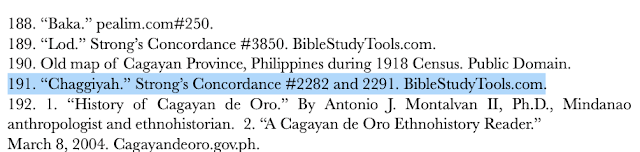
Tim's source for his etymology of Cagayan is numbered 191. 

The Search for King Solomon's Treasure, pg 374

Strong's numbers H2282 and H2291 are listed as his sources but his sourcebook has a completely different word, H2293.

Solomon's Treasure Sourcebook, pg 205

This same blunder is made in his video where one Hebrew word is shown on screen while two others are referenced.


Which is it? Is Cagayan a compound word or is it a single word, the same as the Hebrew name Haggai? That Tim makes this error shows he is simply guessing and is not clear on the Hebrew at all. No wonder since Cagayan is not a Hebrew name but is a native Filipino term meaning river. 

“Spanish documents in 1500s already referred to the area around Himologan as Cagayan. On January 25, 1571, the Spanish government granted this area, including what is now Northern Mindanao, as an encomienda to Juan Griego.” [192]

What is the origin of this name there and also in the other regions? There is a strong possibility, the Spanish did not name either of these areas Cagayan.

“According to Father Miguel Bernad, S.J. of Xavier University, “cagayan” comes from the Malayo-Polynesian word ag, which means “water”. Ag is present in words like agus, agusan, and kagay. Agus means “flowing water”, and agusan “place of flowing water”. Kagay means “river” and kagayan is “place with a river.” [192]

“But according to Dr. Lawrence A Reid, Professor Emeritus, Department of Linguistics, University of Hawai`i, “cagayan” comes from an ancient Philippine word *kaRayan, which means “river”. In an email sent to the Ancient Baybayin Scripts Network of Yahoogroups, Reid explained, “The evidence for the Proto-Philippine word reconstructable for river, kaRayan, comes from the Ilokano karayan, Central Agta kahayan, Itawis kayan, etc... Note that in all the languages that have a reflex of this form, it simply means ‘river’. It is not a morphologically complex form. There is no language that reflects a form kagay. Nor is there any evidence that either the final -an was a suffix, or for that matter that the initial ka- was a prefix ....” [192]

Even archaeology shows a thriving community in Cagayan de Oro in at least 350 A.D. Cagayan Province has a prehistoric history with the oldest bones of humans and animals found there. [192] Cagayan Sulu is mentioned by Pigafetta and also had a community prior to the Spanish. One scholar claims all it takes is the Malay word “ag” to determine an etymology of the word Cagayan. That’s not logic and only a tiny piece of the word. It is not that he may not have a point, it is that he would go public with an opinion of unfinished research which we review consistently from many scholars. What if the Malay word “ag’ actually originates in Cagayan instead as modern science proves that the Philippines populated the other Polynesian Islands and not the other way around. The land bridge theory has also crumbled and with it, many of their antiquated etymologies which need to be updated.

Why is Tim refuting the claim that the Spanish named any area in the Philippines Cagayan? Nobody has made this claim. Father Miguel Bernad says the name originates in the Malayo-Polynesian word "ag" which means water. He then gives several examples of words that contain "ag" and have to do with water.  Tim says that is not logical but gives no reason why except to say "ag" is "only a tiny piece of the word." This is poor reasoning. Disbelief is not proof.

He then says maybe "the Malay word “ag’ actually originates in Cagayan." Well, that would require proof which Tim does not provide. Instead he claims Filipinos "populated the other Polynesian Islands and not the other way around." Ok, but "ag" is a MALAYO-Polynesian word. It seems Tim forgot the Malay part. Ancient Filipinos did not colonize Malaysia. This whole first section is full of unfounded speculation and proves Tim does not understand linguistics as he dismisses Father Bernad's arguments without actually engaging them. Never forget Tim is not a linguist nor does he care to be one.

What about the other Cagayans? Another scholar attempts to connect “karayan,” an Ilocano word, and “Cagayan.” Are they now saying Ilocanos migrated to Visayas and Mindinao prior to the Spanish? There is no history to support that and before positing such a theory would it not be wise to consider such? In other words, it only takes “ayan” to connect the words yet would not “Cag” be a different word from “kar” in any language essentially. Is this really logic? They are guessing and these are not hypotheses as that requires educated reason. Instead, we find that the Hebrew word Chaga or Chag means “feast.”

Having done battle with Father Miguel Bernad Tim now jumps into the fray against Dr. Lawerence A. Reid. Take note that Tim's source is the Cagayn de Oro City website. 

The Search for King Solomon's Treasure Sourcebook, pg. 204

The link given in the sourcebook has been changed and the new page can be found here. But it is the same content as on the old web page. Both pages have a link to more about the History of Cagayan. If Tim had bothered to follow the link he would have eventually found Dr. Reid's full explanation of his etymology of Cagayan.

https://elson.elizaga.net/articles/meaning-of-cagayan.html

There is nothing about Ilocanos migrating to the Visayas and Mindanao in this explanation.

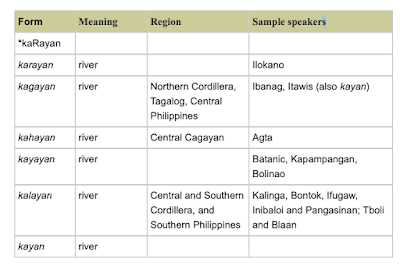
Reid says that the term for ‘river’ as used by the early migrants from Taiwan who became Filipino peoples some 4000 years ago, must have been *kaRayan. Reid states that the asterisk in front of the form is a linguistic symbol and is used to show that the form is a reconstructed word, based on the widely accepted methodology of the science of comparative-historical linguistics. He also comments that the methodology is based on the fact that all languages change from generation to generation, and that sounds change regularly over time. 

What about the letter R in the middle of the word? Reid states that it stands for a sound that must have occurred in the language at that time. This is a sound that occurred in many words, and regularly developed into the sound g in the languages of the Cagayan Valley as well as Tagalog, Cebuano and the other Central Philippine languages. It developed into the sound r in Ilokano, and into y in Kapampangan and the other Central Luzon languages. Reid notes that the symbol R is used because the symbol for the actual sound was not commonly found on typewriters. Linguists suggest that the sound was what they call a velar fricative, or a fricative g, and it is symbolized in the International Phonetics Alphabet by the Greek letter, É£. This is a sound that is not used in most Philippine languages today, but was probably present in the first language spoken by the migrants from Taiwan, since it also occurs in the indigenous languages of Taiwan that are cousins of Philippine languages.

He then shows the following chart.


When Tim asks "yet would not “Cag” be a different word from “kar” in any language essentially" he shows that he is not familiar with Dr. Reid's arguments or with linguistics in general. Never forget Tim is not a linguist and he boasts about that fact. Funny that he calls Dr. Reid's etymology an uneducated guess.

Tim ends by saying "the Hebrew word Chaga or Chag means “feast.”" He will next attempt to prove Cagayan is a compound Hebrew word even though the etymology in The Search for King Solomon's Treasure and the sourcebook show it is one word, the proper noun Haggai. 

If only they were aware of the Hebrew associated through the sons of Eber and the alliance with Israel, many would see this as we. Yah is the name of God and even “yan” is Yah’s Grace (ין). [199].   Some say the connection between these four areas is they each have a river. What rivers are even on Cagayan Sulu? They only have lakes. What about Cagayancillo and the Cagayan Islands? Still no significant rivers. Thus, half of the references already fail to support a meaning for rivers which is a stretched etymology that does not connect from a language not even prevalent in three of the four areas until centuries later.

Incredibly two of Tim's sources for the word "Yan" are baby name dictionaries!

The Search for King Solomon's Treasure Sourcebook, pg 206

This is not the first time he has used a baby name dictionary as a source. He also used one when interpreting the Book of Jubilees. 

https://philippinefails.blogspot.com/2021/04/the-god-culture-timothy-jay-schwab-uses.html

And he has the nerve to call actual linguists uneducated??? 

Tim is insistent in both his videos and books that Cagayan cannot mean rivers because some places are named Cagayan that do not have "significant rivers." There could be a number of reasons why places are named Cagayan that do not have rivers. Has Tim bothered to research when and why these places were named Cagayan? He says they do not have "significant rivers" but does that mean they have no rivers? 

Really the question why a place without rivers is named Cagayan is a red herring Tim is using to distract the reader and listener. Here are some questions for him: Why is there no place called Cagayan in Israel if it is indeed a Hebrew phrase proper for a place name? Why do the two words "Chaga" and "yan" or "yah" never appear together in the scriptures? In his sourcebook Tim links the word "Yan" to Strong's H2605. 

https://www.blueletterbible.org/lexicon/h2605/kjv/wlc/0-1/

But that word is NOT Yan. It's Hanan! In Tim's etymology that would render as Cagahanan which is not  Cagayan. Now, Tim has four different Hebrew words, H2282, H2291, H2293, and H2605, to account for his alleged etymology of Cagayan. He is clearly making things up.

Here is Tim's final proof for Cagayan being a Hebrew word. No surprise it's all pure speculation. 

In fact, in Cagayan Province, the people were already referred to as Cagayanos or Cagayanes when the Spanish arrived. Cagayan appears to us based on this evidence, to be of Hebrew ancestry. This is why the word is all over the archipelago because the Feast of Yah mattered all over. How can one think that the Queen of Sheba brought back nothing from Israel in way of answers of God if nothing else? Did the Wise Men just take some gifts there and visit the Son of God and just take selfies and leave as if they were on a pleasure cruise? It is far more likely they brought texts of scripture and great knowledge upon their return that they would have disseminated to the people all over the land of Ophir, Sheba and Tarshish.

Actually, the three Cagayan’s in Visayas and Mindanao appear to serve a greater purpose as Cagayan de Oro is on the East border of the Garden of Eden. De Oro is said to refer in Spanish to “of gold” and thus Cagayan assumed river. However, Oros is the Greek word for “mountain” and the gold is in the mountains. [193] Cagayan Sulu is on the Southern border of the Garden. The word Sulu in Akkadian (Phoenician, spoken by Hiram, Solomon’s Admiral) is “highway” and the sea was certainly the highway for Solomon’s navy. [194] Cagayancillo is on the Northern border of the Garden. “Cilla” is Spanish for “tithe barn, granary, tithe.” [195] This is a rather odd circumstance rendering the meaning Tithe of the Feast of Yah. We believe Cagayan is Hebrew in origin as it makes far greater sense than the attempt to connect rivers which are not there in half the areas and we see no support to assume an Ilocono origin of the names of three places in Visayas and Mindanao. Cagayan is far better rendered in Hebrew as “Feast of YAH” than contrived etymologies which have no real basis. As the Philippines is the Land of Creation thus the very region of the first Feasts, of all places on earth, Biblical feasts should be observed there and this will be restored

Not only is Cagayan Hebrew but some of the places named Cagayan have other non-Filipino words attached to them. Ancient Filipinos knew Akkadian and Greek. 


As for Cillo meaning tithe, that is all wrong. Cagayancillo means "little Cagayan" as -cillo is a suffix meaning small.

https://spanish.kwiziq.com/revision/grammar/using-the-diminutive-suffix-illo-cillo-ecillo-ececillo

In Spanish we use the suffixes -illo, -cillo or -ecillo after a noun or adjective for two purposes: to qualify it as smaller (diminutive) or to talk about it in an affectionate way.  

Why would the Spanish call these small islands Cagayan Tithe? They wouldn't. That doesn't make any sense whatsoever. It's not some kind of "odd circumstance" that cilla is the Spanish word for "tithe." It's not something to make you go hmmm. It's simply Tim's horrible linguistic and research methods on display as he conflates a word with a suffix. Cilla is not -cillo. He does not give a flip about the truth. 

Tim has not proved a single thing except he is a poor researcher and he is not a linguist. He has not bothered to understand Dr. Reid's etymology of Cagayan and is quick to dismiss him as being uneducated. He has done no actual etymology in this section of his book. Instead he is reaching very far to prove his thesis that the Philippines is The Garden of Eden, Ophir, Tarshish, and Sheba, and that Filipinos are Hebrews by saying it must make sense that there are Hebrew words in the Philippine language. 

The fact is Cagayan is not a Hebrew word meaning "feast of yah." Tim cannot even get his etymology correct as his sourcebook and the main book have different Hebrew word sources! He even uses a baby name dictionary which is not something a real linguist would ever do. That Cagayan is a Hebrew word is simply one more lie being taught about the Philippines by Timothy Jay Schwab who is The God Culture.