Saturday, June 21, 2025

The God Culture: Correcting Tomé Pires in His Own Words and The Bifurcated Island of Luzon

Timothy Jay Schwab has a new series on his blog titled, "The Smoking Quill."


https://thegodculturephilippines.com/the-smoking-quill-series/
EXPLOSIVE NEW SERIES

THE SMOKING QUILL

Torch the Fog. Reclaim the Truth.

Purpose: To systematically document and expose examples of entrenched colonial bias in academic literature, historiography, archaeology, linguistics, theology, and geography. This new series will provide evidence of omission, redirection, or reinterpretation that favors Western paradigms while suppressing alternative, often indigenous or Eastern, understandings. 

In this series Tim proposes to correct alleged colonial biases when it comes to the history of the Philippines As of this writing the vast majority of these articles deal with the Lequios Islands which is a subject I have written about many times. In one of the articles Tim claims to have corrected Tomé Pires' identification of the Lequios Islands.

https://thegodculturephilippines.com/correcting-tom%C3%A9-pires-in-his-own-words-lequios-located-in-the-philippines-not-ryukyu/

Correcting Tomé Pires in His Own Words: Lequios Located in the Philippines, Not Ryukyu

Welcome back to The Smoking Quill Series, where we uncover hidden truths buried beneath centuries of colonial distortion. Today's case study is a landmark: we expose how the 'Islands of the Lequios' were originally understood as part of the Philippines — and how they were later misrepresented as Ryukyu (Okinawa) to suit colonial narratives.

For this installment, let us peruse the maps used as supporting evidence from The Suma Oriental of Tomé Pires [1944 publication by The Hakluyt Society, London].

Imagine when colonial bias reaches its tipping point into outright propaganda — and then chooses to dive headfirst into total immersion, baptizing itself in false narratives so thoroughly that it loses the ability to even read the maps it claims as evidence. Welcome to the mindset behind this historical distortion.

The headline indicates Tim is going to be using Tomé Pires' own words to prove the Lequios Islands are the Philippines. But instead he starts off by analyzing several maps. These maps are dated 1512, 1527, 1535, 1539, 1544, and 1554. However, The Suma Oriental was completed in 1515 and was never published until 1944. The only map that would matter for examining this book is the one from 1512 by Francisco Rodrigues which accompanies the manuscript of The Suma Oriental. 
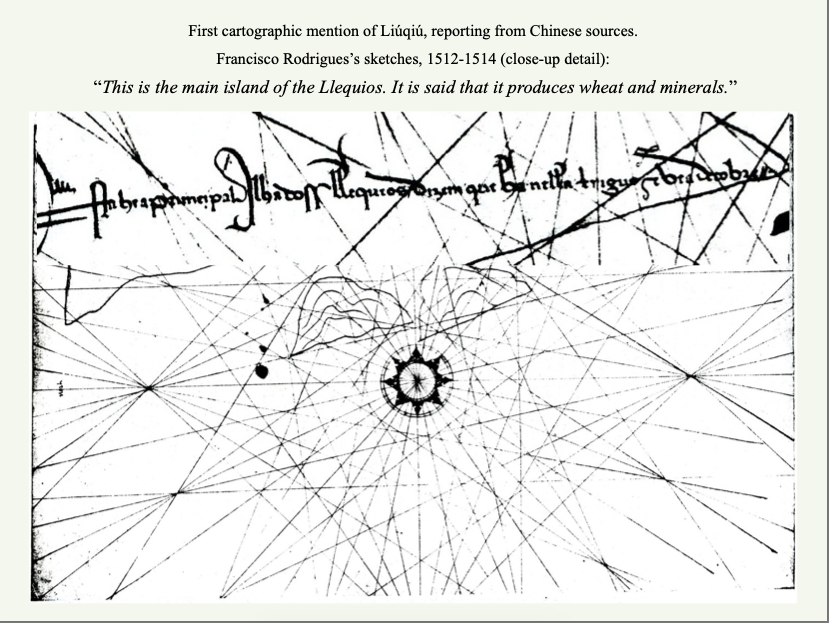
https://hal.science/hal-01964693v1/file/Early%20European%20cartography%20of%20the%20Liuqiu%20Islands%2016th-18th%20c.pdf

1512 Jorge Reinel/Rodriguez Chart (Weimar Version):

NOT Ryukyu!

  • "The Main Island of Lequios" is charted and noted geographically near Luzon, not near Okinawa.

  • The placement is Southeast of China which cannot be Ryukyu.

  • The placement matches the northern Philippines, not the Ryukyu archipelago.

  • Instead of simply reading the map representing what it says, Pires uses etymological flexing in Colonial propaganda, not academic rigor. The problem: the next maps he uses show this same position with the Northern Luzon Islands as Lequios and NOT Ryukyu. This is not a position!

How is this island "charted and noted geographically near Luzon?" Where are the coordinates?  Tim says "Pires uses etymological flexing in Colonial propaganda, not academic rigor." What does any of that nonsense mean? What etymology? What colonial propaganda? It's an incomprehensible gibberish word salad. 

There is also nothing to indicate that Pires used Rodrigues' maps when writing his book. In the introduction to the Suma Oriental we read the following. 

We do not know where the present copy of the Suma Oriental was made, or how it came to be bound together with the Book of Francisco Rodrigues. However, when Rodrigues returned from the first voyage to the Moluccas, in 1512, Pires was already in Malacca. They might have had tastes in common, and perhaps became friends. They might have met in India before Pires left for China, and it is quite possible that Rodrigues obtained a copy of the Suma Oriental', perhaps he had a copy especially made for him. But even if they did not meet in India, they certainly met in Canton. Rodrigues was one of the captains of the fleet of Simao de Andrade which arrived at Tamao in August 1519, and Pires did not leave for Peking till January 1520. It is likely that Pires sent the original of the Suma Oriental to Lisbon before he left Cochin for China, but he certainly kept a second copy or the original draft with him. When the two men met again Pires probably showed Rodrigues the Suma Oriental, which he might have seen before in India or in Malacca, while it was still being written, or Pires may even have handed it to Rodrigues, in view of the difficulties and uncertainties he was anticipating. And if Rodrigues had not a copy already, either one was made while Pires was still in Canton or not much later. The fact that Rodrigues’ Book is from his own hand and the present copy of the Suma Oriental is written on the same kind of paper, strongly suggests that it was made under Rodrigues’ order and was first in his possession.

Suma Oriental, pgs lxix-lxx

Then Tim writes, "the next maps he uses show this same position with the Northern Luzon Islands as Lequios and NOT Ryukyu," which is complete malarkey. The following maps all post-date the writing of The Suma Oriental. Pires didn't use them at all. That's not stopping Tim from concocting a phony cartographic story. 

Of the 1527 Diego Ribera map, Tim writes:

Pires admits this Lequios note is next to Paragua (Palawan) which is no where near Ryukyu! 

That is demonstrably false. The editors of the Suma make that note. 

https://archive.org/details/McGillLibrary-136385-182/page/n257/mode/2up?q=paragua

Ribeiro's maps of 1527 and 1529 have, west of Paragua Island, the inscription: 'These shoals have channels through which the Lequios go to Borneo and other parts.' 

This book was completed in 1515 and somehow Pires is discussing a map from 1527? Absurd!

At no time in this article does Tim cite the actual words of Tomé Pires. He actually attributes invented phrases to the text such as :

  • 👤People Description: "White like Germans" — fits lighter-skinned Batanes/Ivatan people, not Okinawans.

  • The description "white like Germans" does not appear in text of The Suma Oriental. The Lequios are described by Pires as:

    They are white men, well dressed, better than the Chinese, more dignified.

    Why add words to the text? The editors add a note about "white people like Germans."

    https://archive.org/details/McGillLibrary-136385-182/page/n257/mode/2up

    In his letter of 10 Aug. 1518, S. P. Andrade says: ‘There are in the sea [far] from India other lands, which are isles called the Islands of the Lequeos, reaching as far as the Tartars, where there are great gold mines, and all the merchandise that exists in China, off [the coast of] which they lie two hundred leagues away; they are white people like Germans.’

    They are quoting S. P. Andrade. That is not Tomé Pires! Andrade says the Lequios Islands reach as far as the Tartars. That is Russia which is nowhere near the Philippines. 

    Tim says the description of the Lequios people being white fits the Ivatan people of Batanes. Here is a description of the Batanes people written in 1697 by William Dampier. 

    The Natives of these Islands are short squat People; they are generally round visaged, with low Foreheads, and thick Eye-brows; their Eyes of a hazle colour, and small, yet bigger than the Chinese; short low Noses, and their Lip and Mouths middle proportioned. Their Teeth are white; their Hair is black, and thick, and lank, which they wear but short; it will just cover their Ears, and so it is cut round very even. Their Skins are of a very dark copper colour.

    The Philippine Islands, 1493-1803, vol. 39, pg. 99

    Skins "of a very dark copper color" is not white. 

    Tim concludes thusly:

    🔫 The Smoking Quill Verdict:

    🔢Lequios = Northern Philippines (Luzon, Batanes, Babuyan).
    🔴Not Ryukyu (Okinawa).

    Even Tomé Pires' own descriptions undermine the Ryukyu narrative. His words consistently point to Luzon, Batanes, Babuyan, and the Igorot people, a proud highland group with rich gold traditions, lighter complexions, and direct trade with China and Malacca. Ultimately, this entire area was populated even in that age by a people group called "Iloconos". They were likely called Lequios originally and altered by the Spanish to conceal the record. 

    The colonial remapping is exposed for what it is: a post-facto invention ignoring overwhelming primary evidence.

    Another pillar of colonial bias crumbles. The Philippines' ancient role as a major hub in global trade is once again restored to the light.

    It's just all so jaw-droppingly ignorant. Once again it's a conspiracy by the Spanish "to conceal the record." Why would they want to do that? Tim doesn't say. He simply offers the baseless conjecture that it was done. The Portuguese traded with the Lequios Islands and the Japanese while the Spanish discovered and conquered the Philippines. Are we really supposed to believe they didn't know where they were? Are we really supposed to believe that the Portuguese and the Spanish mixed up the names of both places and covered them up for unknown reasons? Is Tim unaware that the Portuguese did not discover the Philippines yet were trading with the Lequios Islands? I guess now we have to rewrite history, say the opposite, and ignore the Treaty of Tordesillas (1494) and especially the Treaty of Zaragoza (1529) which put the Philippines off limits to the Portuguese. According to Tim, the Portuguese actually discovered the Philippines years before Magellan and stayed in that region despite being forbidden from trading in that territory. And only magazine editor and pseudo-historian Timothy Jay Schwab has uncovered this deception 500 years later!? It's unhistoric insanity. 

    Never mind the fact that Ryukyu is the Japanese form of the Chinese Liuqiu which is the Lequios Islands. 

    Indeed, the name "Ryukyu" is simply the Japanese form of LiúqiúEarly modern Chinese sources also specifically called Okinawa (the largest of the Ryukyus) as "Greater Liuqiu" and Taiwan Island as the "Lesser Liuqiu".

    Let's all ignore Chinese history as well and make it up on the go. How brave of Tim to champion ignored "Eastern understanding" and then ignore that same Eastern understanding when it undermines his thesis. Ad hoc argumentation isn't just a logical fallacy, it's the proper way of doing scholarship according to Tim. 

    Here is what Tomé Pires writes about the Lequios and the Luçoes. First the Lequios.

    The Lequeos are called Guores-they are known by either of these names. Lequios is the chief one. The king is a heathen and all the people too. He is a tributary vassal of the king of the Chinese. His island is large and has many people; they have small ships of their own type; they have three or four junks which are continuously buying in China, and they have no more. They trade in China and Malacca, and sometimes in company with the Chinese, sometimes on their own. In China they trade in the port of Foqem which is in the land of China near Canton—a day and a night's sail away. The Malays say to the people of Malacca that there is no difference between Portuguese and Llequjos, except that the Portuguese buy women, which the Lequos do not. 

    The Lequjos have only wheat in their country, and rice and wines after their fashion, meat, and fish in great abundance. They are great draftsmen and armourers. They make gilt coffers, very rich and well-made fans, swords, many arms of all kinds after their fashion. Just as we in our kingdoms speak of Milan, so do the Chinese and all the other races speak of the Lequjos. They are very truthful men. They do not buy slaves, nor would they sell one of their own men for the whole world, and they would die over this. 

    The Lequjos are idolators; if they are sailing and find themselves in danger, they say that if they escape they buy a beautiful maiden to be sacrificed and behead her on the prow of the junk, and other things like these. They are white men, well dressed, better than the Chinese, more dignified. They sail to China and take the merchandise that goes from Malacca to China, and go to Japan, which is an island seven or eight days' sail distant, and take the gold and copper in the said island in exchange for their merchandise. The Leqios are men who sell their merchandise freely for credit, and if they are lied to when they collect payment, they collect it sword in hand.

    The chief is gold, copper, and arms of all kinds, coffers, boxes (caxonjas) with gold leaf veneer, fans, wheat, and their things are well made. They bring a great deal of gold. They are truthful men—more so than the Chinese—and feared. They bring a great store of paper and silk in colours; they bring musk, porcelain, damask; they bring onions and many vegetables. They take the same merchandise as the Chinese take. They leave here in [blank], and one, two or three junks come to Malacca every year, and they take a great deal of Bengal clothing. 

    Among the Lequjos Malacca wine is greatly esteemed. They load large quantities of one kind which is like brandy, with which the Malays make themselves [so drunk as to run] amuck. The Lequjos bring swords worth thirty cruzados each, and many of these. 

    Pires, pg, 128-131

    That is everything Pires has to say about the Lequios. Was Luzon ever a tributary vassal of China? Was there one king of the Ilocanos? Are Filipinos ever recorded as having bought "a beautiful maiden to be sacrificed and behead her on the prow of the junk?" When were Filipinos ever recorded as being "well dressed, better than the Chinese, more dignified?" The trade route of the Lequios is described as being from the Lequios to China and then to Japan. 

    Here is what Pires has to say about the Luçoes. It cannot be stressed enough, this word is pronounced with a soft "C" not a hard "C" as Tim does. There is no connection etymologically or homophonically between Lequios and Luçoes. However, there is a direct connection between Luçoes and Luzon.

    The Lucoes are about ten days' sail beyond Borneo. They are nearly all heathen; they have no king, but they are ruled by groups of elders. They are a robust people, little thought of in Malacca. They have two or three junks, at the most. They take the merchandise to Borneo and from there they come to Malacca.

    The Borneans go to the lands of the Lucoes to buy gold, and foodstuffs as well, and the gold which they bring to Malacca is from the Lucoes and from the surrounding islands which are countless; and they all have more or less trade with one another. And the gold of these islands where they trade is of a low quality —indeed very low quality. 

    The Lucoes have in their country plenty of foodstuffs, and wax and honey; and they take the same merchandise from here as the Borneans take. They are almost one people; and in Malacca there is no division between them. They never used to be in Malacca as they are now; but the Tamaqua whom the Governor of India appointed here was already beginning to gather many of them together, and they were already building many houses and shops. They are a useful people; they are hard-working. 

    Of this family there are now the sons of the Tumunguo and his wife in Malacca, as well as his mother-in-law, and Curia Raja and Tuam Brajy who married the Tumunguo's wife. In Minjam there must be five hundred Lucoes, some of them important men and good merchants, who want to come to Malacca, and the people of Mjjm will not grant them permission, because now they have gone over to the side of the former king of Malacca, not very openly. The people of Mjmjam are Malays.
    Pires, pg. 133-134

    The Luçoes do not have a king but are ruled by groups of elders. Their gold is of a very low quality. They only have two or three junks. They are only 10 days sail from Borneo. How much more clearer could it be that Pires differentiates the Lequios and Luçoes? They are not the same. It's not a conspiratorial cover up. It's actual historic ethnography attested to by the whole of 16th century East Asian explorers and maps. That includes Pigafetta who said the Lequios COME TO Luzon to trade not that they are FROM OR ORIGINATE IN Luzon.

    The only reason Tim brings in conspiracy and post-dated maps rather than examine the words of Tomé Pires is to obfuscate the issue. The title of this article is "Correcting Tomé Pires in His Own Words" yet Pires' words aren't cited even once. Instead Tim is satisfied with placing words in Piresmouth by inventing fake citations. There is no revelation here. There is no uncovering the past. It's more smoke and mirrors to push the unhistorical and untenable false narrative that the Lequios Islands are actually Luzon.  

    Tim's solution to the Lequios/Luçoces problem is both peoples lived on Luzon island with House Lequios occupying the Realm of the North and House Luçoe occupying the Realm of the South. 

    https://thegodculturephilippines.com/the-bifurcated-island-of-luzon-lequios-and-lucoes-rediscovered/

    The Bifurcated Island of Luzon: Lequios and Lucoes Rediscovered

    🔍 Introduction:

    For centuries, the island of Luzon has been spoken of as a singular unit. Yet the earliest European sources, maps, and explorers did not describe Luzon this way. Rather, they documented two distinct peoples occupying the northern and southern halves of the island—known separately as the Lequios and the Lucoes. What we uncover today is not mere geographic labeling but a forgotten cultural fracture, one later blurred by colonial centralization in Manila. 

    To put it bluntly this is more unhistoric, reactionary, ad-hoc balderdash from Tim masquerading as an evolving scholarly position growing out of deep research. He is doing everything he can to justify his claim the Lequios Islands are in the Philippines. In Tim's videos and book The Search For King Solomon's Treasure he conflated these people as being the same.

    This word Lequios or Lucoes became a general term used by many for Luzon Island thus not a mystery to history in the slightest but only to the British it appears as Portugal, France and India certainly knew. 

    The Search For King Solomon's Treasure, pg. 165-166

     3:53 …to which come to trade every year six or eight junks of the people called Lequii, Lequios, Lucoes, same people. It’s there. Pigafetta says they are in Luzon. 

    The Lequios of Luzon: Key to Finding Ophir and Chryse. Clue #52

    Of course seasons change, people change but as we have seen before Tims' mutating position about the Lequios Islands, such as 9N20 now being a range of latitudes rather than a specific location, have been a reaction to the articles I have written about the Lequios Islands. How many years did he spend engaged in research for his book, and yet he did not discover this information until just recently? Since it turns out Luzon was inhabited in the Realm of the North by House Lequios and in the Realm of the South by House Luçoe Tim will have to substantially rewrite his book. What other lost information will Tim "uncover" to make his book The Search For King Solomon's Treasure obsolete? Seeing as Tim continues to alter his thesis perhaps he should close up shop until he is absolutely sure of his position. 

    One would think two people so vastly different as House Lequios and House Luçoe would clash. Pinto describes the Lequios as having "little inclination for bearing arms" while the Luzons (Luçoes) he describes as warriors. With the absence of any notable encounters between these disparate peoples we can safely judge that either they never warred against each other or they did and there has been a cover-up! Perhaps there are records of friendly trade relations between House Lequios and House Luçoes yet to be unearthed. The exact nature of the relationship between these two very different people inhabiting the same island I shall leave for Tim to unveil.

    There is a lot of information in Tim's article justifying the bifurcation of Luzon but I'm only going to look at Tim's rationalization for calling the Northern people of Luzon, House Lequios, and the Southern people of Luzon, House Luçoes.

    2. Pinto and the Northern Islands: The Lequios Archipelago

    Portuguese explorer Fernao Mendes Pinto, in his extensive travels throughout Asia, records shipwreck and maritime encounters in the northern islands of Luzon—clearly identifying these as part of Lequios. These include islands such as those in today’s Batanes and the Babuyan groupPinto's use of Lequios in this context reinforces that the identity was tied not merely to mainland northern Luzon, but to the entire northern maritime corridor. This is clearly marked on maps over centuries that even include elements of Pinto's 5 Islands distinctly including this Spanish-British Map, and those from Venetian, French, and Dutch origin. Europe knew this, but the Colonial propaganda took root.  

    This strengthens the case for Lequios as the indigenous highland and island peoples—distinct from the southern seafarers of Manila.

    4. The Southern Lucoes: Traders, Mercenaries, Diplomats

    By contrast, Barbosa (1516) and Galvão (1555) describe the Lucoes (Luçones) as traders and mercenaries—highly engaged with MalaccaIndia, and the Sultanates. These were the Tagalog and Kapampangan groups of South Luzon, based around ManilaMindoro, and surrounding areas.

    Barbosa even praises the Lucoes as being better merchants than the Chinese, while Galvão highlights their foreign employment in regional politics and warfare. 

    6. The Smoking Quill: Restoring the Divided Luzon

    These converging lines—maps, explorer accounts, language, and geopolitical roles—all point to a Luzon that was historically bifurcated: 

    • Lequios: North Luzon (Cagayan, Ilocos, Zambales, Batanes); highland, autonomous, gold-rich, culturally distinct 

    • Lucoes: South Luzon (Manila, Mindoro); maritime, mercenary, trade-driven, politically entangled in regional powers 

    Over time, colonial mapping and Manila’s administrative dominance buried this duality under a singular label: "Luzon." But the smoking quill still writes in the margins of old maps and forgotten chronicles.

    That is all bunk. Pinto did not shipwreck in the Philippines. He shipwrecked in a land where he had been previously and from where he could see Japan. Everything Pinto says about the Lequios Islands corresponds with them being at a northern latitude. He says they are at 29°N specifically. That is the Ryukyu Islands. Tim seems to have forgotten the Lequios were seafaring traders and relegates them to being "indigenous highland and island peoples." 

    Tomé Pires writes that the Luçoes were governed by elders while the Lequios were ruled by a single heathen king. If House Lequios occupied northern Luzon then who was King in the North? Tim neglects the fact that the Lequios were tributary vassals of China. That would make House Lequios of Northern Luzon under the vassalage of China. Remember when the Spanish fought the armies of the King in the North and the Chinese while they were colonizing the Philippines? Maybe that's been covered up too.

    As for the Luçoes being traders and mercenaries, that is correct. But they were not limited to Southern Luzon. They inhabited the whole island. Where is Tim getting this nonsense that "Manila’s administrative dominance buried this duality under a singular label: "Luzon?" What exactly does this word salad mean? What is his proof for this speculative post-hoc assertion? How does he empirically know this? What is his evidence for this claim? Oh, I know. It was hidden by a conspiracy until magazine editor Timothy Jay Schwab uncovered it centuries later by pouring over and deciphering toponyms on old maps. He's a modern day Maryland Jones.

    In contrast to Tim here is a map showing all the many tribes in Luzon before the Spanish colonized the Philippines. 
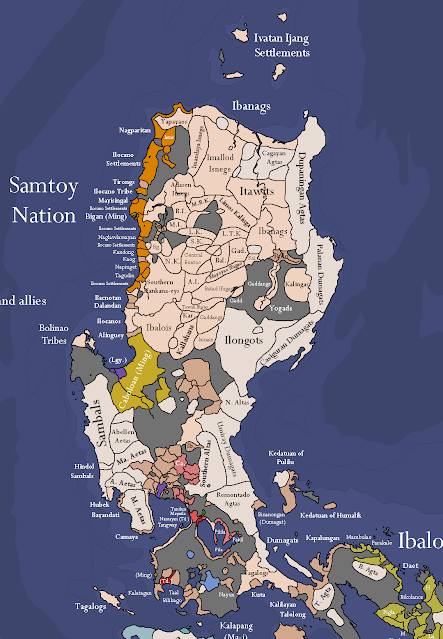
    Filipino Tribes Map

    Whether this map is 100% accurate or not is beside the point. The point is Luzon wasn't bifurcated into two distinct people groups, House Lequios in the Realm of the North and House Luçoe in the Realm of the South. The Lequios were from the Ryukyu Islands while everyone from the island of Luzon North or South, was a Luçoe. That would mean even according to Tim's claim that House Lequios inhabited the Realm of the North, they would also be of House Luçoe. Tim's own slides citing Antonio Galvão confirms this fact.

    https://thegodculturephilippines.com/galv%C3%A3o-s-maritime-flow-the-true-geography-of-ophir-lequios-and-japon%C3%AAs/

    In this yeere 1545 and in the moneth of June, there went a junk from the citie of Borneo, wherein went a Portugall called Peter Fidalgo, and by contrary windes he was driuen towards the north ; where he founde an island standing in 9 or 10 degrees, that stretched it selfe to 22 degrees of latitude, which is called The Isle of the Lucones, because the inhabitants thereof were so named. It may haue some other name and harborowes, which as yet we know not : it runneth from the north vnto the south-west, and standeth betweene Mindanao and China. They say they sailed along by it 250 leagues, where the land was fruitfull1 and well couered,- and they affirmme, that there they will giue two pezos of sold for one of siluer : and yet it standeth not farre from the countrey of China.

    https://archive.org/details/discoveriesofwor00galvrich/page/238/mode/2up

    Galvão says The Isle of the Luçones is called such because that is the demonym of its inhabitants. Then he says it may have some other name as yet unknown but that cannot be Lequios because Galvão mentions the Lequios Islands and Luçon Island together in in the same sentence as separate places several times. Here is one instance Tim has recorded on a slide on his own blog. 


    ...by them and al along the sea; as also the Jauaes, Timores, Celebes, Macafares, Malucos, Borneos, Mindanaos, Luçones, Lequeos, Japones, and other islands being many in number.

    It is clear from the writings of Pires, Galvão, and Pinto that the Lequios Islands and Luçon Island are not the same in any sense. There was no House Lequios inhabiting the Realm of the North of Luzon. Neither was there a House Luçoe inhabiting the Realm of the South of Luzon. All the inhabitants of Luçon Island were referred to as Luçoes. 

    Tim will likely gloat, "YOU DIDN'T REFUTE ALL OF MY POINTS!!" Well, I don't need to. I don't need to examine his speculative etymology or his cherry-picked maps or every single preposterous claim he proposes when his core arguments are entirely fictitious. His thesis is clearly being made up on the spot and contradicts every historical account about the Luçoes and the Lequios which has been passed down through journals, books, and maps. Tim even contradicts himself by previously saying they are the same people but now saying they are two different people inhabiting the same island with one House in the north and the other House in the south. It's imaginative and creative mental gymnastics but that's about it. 

    Friday, June 20, 2025

    Retards in the Government 422

    It's your weekly compendium of foolishness and corruption in the Philippine government.


    https://mb.com.ph/2025/06/13/baguio-lto-official-sacked-for-drunk-driving
    A Land Transportation Office official here was sacked for drunk driving on Tuesday, June 10.
    Police said the official was involved in a vehicular accident with another government official on Legarda Road at around 9:10 p.m. 
    They were invited to discuss the incident at the police station but the LTO official allegedly became arrogant before investigators, prompting lawmen to take him to the hospital for an alcohol breath test which turned out positive. 
    Mayor Benjamin Magalong here criticized the LTO official’s behavior. 
    “I deplore this kind of arrogant behavior. It goes against the principle of good governance. Government officials should lead by example and this official clearly did not subscribe to that guidepost.” 
    Magalong said the incident was unfortunate as the city government is finding solutions to curb the rising trend of vehicle traffic incidents. 
    The LTO official has been relieved from his post.  
    "I commend Transportation Secretary Vince Dizon and Land Transportation Franchising and Regulatory Board Regional Director Glenn Dumlao for their prompt decision to remove the said official and that the said incident is being investigated." 
    The LTO official faces a case for violation of Republic Act 10586 or the Anti-Drunk and Drugged Driving Act of 2013.

    A Land Transportation Office official was sacked for drunk driving

    https://newsinfo.inquirer.net/2070458/fwd-ombudsman-garcia-guilty-of-indirect-contempt-for-not-heeding-suspension

    The Office of the Ombudsman has found Cebu Governor Gwendolyn Garcia guilty of indirect contempt, after she refused to heed the preventive suspension issued against her.

    Documents released by the Office of the Ombudsman on Friday showed Ombudsman Samuel Martires signing the order, which also imposes a fine of P30,000 against Garcia.

    Last April, the Office of the Ombudsman confirmed that an order to suspend Garcia for a maximum of six months preventively was issued, to allow investigators to start their probe of the allegedly anomalous permit she granted to a construction firm that had no environment clearance.

    Despite this, Garcia repeatedly said that she is not stepping down despite the preventive suspension order.  

    According to Garcia, she was not defying the Ombudsman’s order but was following the advice of her lawyers to remain in office since the order was issued during the election period that banned any suspension of officials without approval from the Commission on Elections.

    Martires, however, believes Garcia’s actions “disrupt the orderly administration of justice and infringe upon the constitutionally entrenched powers of the Ombudsman.”

    “Indeed, your contemptuous refusal to comply with the Preventive Suspension Order disrupts the orderly administration of justice and infringes upon the constitutionally entrenched powers of the Ombudsman.  As well, your failure to comply with the Preventive Suspension Order constitutes disrespect and insubordination, plain and simple,” Martires said in the order dated June 10.

    “This behavior undermines not only the integrity of the Office of the Ombudsman, but more grievously, the very rule of law itself.  As the head of the Provincial Government of Cebu, you are expected to lead by example and serve as a role model of accountability and lawful conduct to your constituents,” he added.

    Last May, Garcia — who lost in her reelection bid during the 2025 midterm elections — said that she will be able to complete her term in office up to the end of June, after she secured a temporary restraining order (TRO) that stopped the Office of the Ombudsman from carrying out her six-month preventive suspension.

    A resolution from the Court of Appeals (CA) Special 17th Division in Manila dated May 15  granted a 60-day TRO that would allow Garcia to officially end her term at noon on June 30.

    The Office of the Ombudsman has found Cebu Governor Gwendolyn Garcia guilty of indirect contempt, after she refused to heed the preventive suspension issued against her.


    http://mb.com.ph/2025/06/13/cop-fatally-shoots-neighbor-on-friday-the-13th

    A policeman fatally shot his neighbor during an argument on Friday morning, June 13, in Barangay 6, Tuburan town, Cebu province.

    Police Staff Sgt. Florante Perucho Hoyle, an operative of the Investigation and Detective Management Unit of the Cebu City Police Office, surrendered after the incident.

    Police identified the fatality as Leo Vergel Fin Suico.

    Police Capt. Dun Blane Tabares, information officer of the Cebu Police Provincial Office, said a group of men was having a drinking session when a drunk Hoyle arrived.

    An argument between the policeman and the group broke out. The argument escalated when Hoyle slapped one of the men.

    A melee erupted. As punches were thrown, the policeman drew a gun and fired a warning shot to the ground.

    The group of men ran after hearing the gunshot.

    Police said the suspect gave chase and went to the victim’s house. Once inside the house, Hoyle shot the victim in the head.

    “According to the investigator of the Tuburan police, it looked like a mistaken identity. The suspect may have thought that the victim was one of those whom he got into a fight with,” said Tabares.

    The suspect surrendered to his colleagues who responded to the crime scene. He surrendered a loaded caliber Colt .45.

    The policeman, detained at the Tuburan police station, is facing murder and physical injury charges, police said.

    A policeman fatally shot his neighbor during an argument on Friday morning, June 13, in Barangay 6, Tuburan town, Cebu province.

    MAYOR Ronald Allan Cesante of Dalaguete, along with Vice Mayor William Lagahit, Municipal Councilor Kevin Belandres and nine other officials, have been slapped with a six-month preventive suspension by the Office of the Ombudsman.

    The other officials preventively suspended are Municipal Engineer Expedezitas Lenares, Zoning Officer II Essandre Amprad, Administrative Aide VI Claire Bacala, Local Legislative Staff Officer II Loel Fajardo, Municipal Budget Officer Brenda Vergara, Municipal Government Department Head I Donald Abraham Lara and Administrative Assistant V Cristina Miranda.

    The suspension stems from motions for preventive suspension filed by complainants Jose Rene Moran and Braulio Moran on April 23, 2025. They expressed fear that the respondents might tamper with official documents or influence town hall employees amidst charges of grave abuse of authority, grave misconduct, dishonesty and conduct prejudicial to the best interest of the service.

    The case originated from the unauthorized construction of an “overpriced” warehouse in 2023. The structure was built on a 4,000-square-meter titled lot belonging to the heirs of the late Maria Zambrano family. The construction occurred without the owners’ knowledge or consent, and no deed of conveyance was executed in favor of the Municipality of Dalaguete. There has also been no prior expropriation case involving the lot.

    Ombudsman Samuel Martires, finding “sufficient grounds to grant complainants’ motion,” signed the six-page preventive suspension order on June 2, adding that the order is immediately executory.

    On May 2, the complainants, upon filing their complaint, told reporters their actions were not politically motivated nor backed by any politicians, contrary to the mayor’s accusations that the case filing occurred during the election period. The complainants added that while the actual estimated cost of the allegedly overpriced warehouse was over P3 million, it reached P8 million.

    Before the May 12 midterm election, Cesante and several officials faced multiple complaints from various complainants over alleged violations of anti-corruption laws, filed by the National Bureau of Investigation (NBI) 7 and concerned citizens.

    Cesante and his fellow respondents allegedly implemented an irregular road repair and concreting project worth P9.65 million along ML Quezon St. in Barangay Poblacion. This was the second complaint filed by the NBI 7 on March 28, after they discovered that a private contractor still collected payments despite the Municipal Government having carried out the project itself.

    Cesante expressed frustration over not receiving details of the charge against him, implying “political motivations” ahead of the May elections.

    On Oct. 11, 2024, NBI 7 filed complaints before the Ombudsman Visayas against Cesante and other officials for allegedly allowing government equipment and employees to work under a private contractor, which resulted in the death of one person.

    More than 1,800 senior citizens in Dalaguete also filed a complaint before the Ombudsman Visayas on Nov. 28, 2024, against Cesante and another municipal official for allegedly excluding them from cash assistance earlier that year.

    Cesante sought reelection but lost the mayoral race. His running mate, Vice Mayor Lagahit, however, won.

    SunStar Cebu reached out to Cesante for comment, but to no avail. 

    On Nov. 15, 2015, then-Ombudsman Conchita Carpio-Morales suspended Cesante for nine months for “directly and indirectly having financial and material interest in any transaction that requires the approval of his office.” 

    In 2017, the Ombudsman again suspended Cesante over the sinking of a fishing boat during the onslaught of a typhoon. He was found guilty of simple misconduct and neglect of duty for being directly responsible for the sinking of the boat owned by complainants. 

    MAYOR Ronald Allan Cesante of Dalaguete, along with Vice Mayor William Lagahit, Municipal Councilor Kevin Belandres and nine other officials, have been slapped with a six-month preventive suspension by the Office of the Ombudsman.

    Eight chiefs of police in the National Capital Region were relieved from their posts for failing to comply with the Philippine National Police’s order to respond to emergency calls within five minutes.

    PNP Chief Gen. Nicolas Torre III announced on Monday the relief of the officers, warning that “more” will soon face the same disciplinary action.

    Torre said the affected chiefs of police (COPs) were from Caloocan, Navotas, Valenzuela, Mandaluyong, Marikina, San Juan, Parañaque and Makati. No other details about them were provided.

    “We already relieved eight, and there will be more because I was there in Central Visayas yesterday in Iloilo and we issued caution to the provincial directors,” Torre said in an interview after the flag-raising ceremony at the Quezon City Hall.

    Torre also said more police officers will be relieved and more positions will be open to those who will be qualified to meet the PNP’s standards.

    “We will declare those positions open, so we will give chances to those who are interested and qualified to comply with the standards,” Torre noted.

    Torre explained that the decision to relieve the officials is “not about the radio itself” but “about accomplishing the mission.”

    He added that the five-minute response will not be fulfilled without command from the COPs.

    “I want them to actually command, not only figuratively but literally. They can issue the command over the radio or in a communication that they prefer,” Torre said.

    The PNP has set the emergency response time at five minutes in pilot areas in Metro Manila.

    Torre earlier said that the five-minute response time will be cut to three minutes within the next three months.

    When previously asked about the sanctions police officers will face if they fail to respond to the five-minute target, Torre answered:

    “Their bodies will hurt. I have trained them, and we will make sure that they will comply with it. So drill, drill, drill, and more drills will be the key.” 

    Eight chiefs of police in the National Capital Region were relieved from their posts for failing to comply with the Philippine National Police’s order to respond to emergency calls within five minutes.

    Two officials of the Land Transportation Office (LTO) in Region 2 were sacked for allegedly physically assaulting two individuals at a karaoke lounge in Cagayan, Department of Transport (DOTr) Secretary Vince Dizon said on Monday.

    Dizon named the two LTO officials as Assistant Regional Director of LTO Region 2 Manuel Baricaua and Chief Enforcer Charles Ursulum.

    “These two were immediately relieved from duty. And I wrote to the Office of the President, to Executive Secretary [Lucas] Bersamin, seeking for the permanent removal of the Assistant Regional Director of Region 2,” Dizon, speaking in Filipino, said in a press conference.

    According to a statement from the Police Regional Office 2 (PRO2) on Saturday, the incident occurred on June 4, with victims identified as “Vanessa,” a 20-year-old singer; “Rey,” a 15-year-old individual; and “Topher,” a 20-year-old.

    The PRO2 reported that “Vanessa” was forced to stay beside the regional director, and despite “Vanessa” and her mother’s defiance, she was still ordered to do so. The PRO2 added that the two officials went to “Rey” and “Topher” and slapped them for no reason.

    “I have asked Asec. Vigor Mendoza to reach out to the victims, and to assist in any way in the filing of charges, I would assume, physical assault charges against these two people,” Dizon added.

    Dizon also said that no investigation was needed, as the viral video already showed that the two individuals were physically assaulted.

    According to the PRO2, a formal complaint was submitted to the City’s Prosecutor’s Office last June 13 and will be endorsed to the Office of the Prosecutor on June 16.

    Meanwhile, Dizon expressed gratitude to the citizens who uploaded the incident on social media. One of the viral videos has already garnered over 9,000 reactions, 4,000 comments, and 8,000 shares on Facebook.

    “To our constituents, if you see any problem or abuse related to public transport, upload it immediately,” he said.

    Dizon told netizens that they should not be scared or hesitate to report incidents involving officials of DOTr and its other attached agencies. He also urged them to tag the DOTr and its attached agencies on their videos.

    “You will not be caught up with this. Don’t be afraid. This is a way to protect you,” he added.

    Two officials of the Land Transportation Office in Region 2 were sacked for allegedly physically assaulting two individuals at a karaoke lounge.

    Two female airport personnel were apprehended for allegedly extorting money from a female Chinese national during an entrapment operation at the Ninoy Aquino International Airport (NAIA) Terminal 1.
    Airport Police chief Col. Bing Jose said the two airport personnel were demanding P850,000 from the foreigner in exchange for security from being deported along with her nephew who recently arrived in the country.
    Jose said the airport personnel agreed to reduce the amount to P400,000 but the incident was reported to the airport police by the female Chinese.
    This resulted in the arrest of the two female airport personnel.
    Jose said the they are now readying the charges against the two suspects.

    Two female airport personnel were apprehended for allegedly extorting money from a female Chinese national during an entrapment operation at the Ninoy Aquino International Airport (NAIA) Terminal 1.
    The Quezon City Police District (QCPD) now has a person of interest who could be behind the killing of a 63-year-old official of the House of Representatives during his daughter’s birthday party in Barangay Commonwealth, Quezon City on Sunday, June 15. 
    According to the QCPD, the incident occurred at around 2:55 p.m. when two unidentified suspects entered the party venue and shot the victim at close range. 
    The victim was identified as Mauricio Pulhin, Chief of Technical Staff of the Committee on Ways and Means at the House of Representatives. 
    Pulhin was rushed to the FEU-NRMF Hospital but was declared dead on arrival. 
    The suspects fled the scene on a motorcycle, firing at a subdivision security guard as they escaped.   
    Police officers from Batasan Police Station 6 and members of the Scene of the Crime Operatives (SOCO) responded to the incident.

    “Our victim is an employee of the Chamber. We are currently investigating the motive for this crime. We responded immediately and rushed the victim to the hospital, but he was dead on arrival,” Batasan Police station commander Col. Romil Avenido said.

    “There was a birthday party, around 12 noon this riding-in-tandem entered gate 2 of the subdivision and by 2:55 p.m. the shooting happened, and that's where they exited through gate 1. After they shot our victim, when they exited through gate 1, they shot at the guard house there),” he added. 
    Avenido also said that the suspect surrendered a lost ID of a different person to gain entry into the subdivision.

    “This crime was well-planned. They really studied this place carefully so they used a fake ID and left it behind when they escaped. We immediately identified, located, and put under police custody the owner of the ID that was left there at the guard house, only to find out that his ID had been missing for a long time which is two years ago,” Col. Avenido said.

    He also said that they already have a possible person of interest, but the investigation is still ongoing.

    They are also gathering CCTV footage in the area to help track down the plate number of the getaway vehicle of the suspects.
    Mauricio Pulhin, Chief of Technical Staff of the Committee on Ways and Means at the House of Representatives, was assassinated at his daughter's birthday party.

    https://www.philstar.com/nation/2025/06/15/2450737/no-bail-cops-accused-siargao-slay-spanish-bizman

    A local court has denied bail to three police officers accused of the 2020 killing of Spanish businessman Diego Bello Lafuente.

    In an order dated May 27, the Manila Regional Trial Court (RTC) Branch 1 rejected the bail petitions of Police Captain Wise Vicente Panuelos, Police Staff Sergeant Ronel Pazo and Police Staff Sergeant Nido Boy Cortes.

    The court said the evidence against the accused is strong.

    “All told, the prosecution was able to prove that evidence of guilt against all accused is strong. At this point, the defense that Lafuente fired at the accused in the course of a buy-bust operation and that the latter retaliated to secure their safety remains a mere version of the accused,” the decision read. 

    On March 17, 2022, charges of murder under the Revised Penal Code and planting of evidence under Republic Act No. 10591 were filed against Pazo, Cortes, and Panuelos at the Regional Trial Court of Surigao del Norte, Branch 31.

    The same court received a return of warrant of arrest on February 6, 2023, from the Criminal Investigation and Detection Group, indicating that the three individuals had voluntarily surrendered to their unit.

    Subsequently, during their arraignment on March 1, 2023, all three pleaded not guilty to the charges. The three then filed their respective motions for bail in October 2023, arguing that the evidence of guilt against them was not strong. 

    Contrary to their claim, the court found that the evidence against the three officers was strong. 

    According to the court, all accused admitted in their affidavits that they were present at the crime scene and actively participated in the buy-bust operation against Lafuente, playing specific roles. 

    Also, the police officers’ claim that Lafuente died in an armed encounter was contradicted by the National Bureau of Investigation (NBI).

    “Testimonial and forensic evidence proved that the death of Lafuente did not result from an armed encounter, despite the established fact that Lafuente's hand and .45 caliber that he supposedly fired both tested positive for gunpowder nitrates,” the court’s ruling read. 

    The court gave credence to the NBI's findings, which were based on a collective investigation including the Philippine National Police-SOCO (Scene of the Crime Operatives) and Philippine Drug Enforcement Agency. 

    NBI investigators even re-enacted the incident, considering the accused's narratives. However, when correlated with affidavits from other witnesses and forensic evidence, the court said that there was no shootout scenario.

    “When correlated with the affidavits of other witnesses, particularly Antipasado and Palomar and forensic evidence such as the triangular formation of the three (3) pieces of the .45 caliber pistol together with the six (6) pieces of the fired cartridge from 9mm caliber from the firearms of PCpt. Panuelos and PSSg Cortez, it was concluded that there was no 'firefight' scenario,” the court’s decision read. 

    The court also found strong evidence of conspiracy among the accused, even for Pazo, despite no fired cartridges being recovered from his issued firearm. 

    “The court likewise finds his guilt strong as the prosecution was able to prove "conspiracy" among the accused. PSSg. Pazo was not only in the crime scene, as he himself admitted. His paraffin test likewise yielded positive result,” the court’s ruling read.

    A local court has denied bail to three police officers accused of the 2020 killing of Spanish businessman Diego Bello Lafuente.

    Dismissed policeman and vlogger Francis Steve Fontillas, who criticized President Marcos over the arrest of former president Rodrigo Duterte, was arrested yesterday in Quezon City.

    Fontillas was arrested based on a warrant issued by Quezon City Regional Trial Court Branch 224 Judge Zita Marie Atienza-Fajardo for inciting to sedition in relation to Republic Act 10175, the Cybercrime Prevention Act.

    The court recommended bail of P36,000 for his temporary liberty.

    A complaint for sedition was filed against Fontillas over his Facebook posts about toppling the Marcos administration following the arrest of Duterte on March 11.

    Fontillas has been dismissed from the service for grave misconduct, conduct unbecoming of a police officer and disloyalty to the government.

    Dismissed policeman and vlogger Francis Steve Fontillas, who criticized President Marcos over the arrest of former president Rodrigo Duterte, was arrested in Quezon City.

    https://newsinfo.inquirer.net/2071737/davao-cop-held-in-custody-faces-dismissal-for-firing-gun-at-christening

    A Davao City police officer has been arrested and is facing dismissal for firing a gun at a private christening, according to the Philippine National Police (PNP).

    The incident stemmed from a “misunderstanding” between the police officer and another guest at the occasion, the Davao City Police Office (DCPO) said in a statement on Tuesday.

    “He’s been arrested, and we will not tolerate that. He will be removed from the service, definitely,” PNP chief Gen. Nicolas Torre III said in an interview over DZMM on Wednesday.

    “He is already a dead man walking in terms of service in the PNP,” he stressed.

    The shooting occurred on Sunday evening in Barangay Los Amigos in the Tugbok district, according to the Davao City police.

    “Initial investigation revealed that the officer fired his issued firearm toward the ground following a misunderstanding with another guest, causing panic and distress among the attendees,” the DCPO detailed.

    Davao City police further said it filed criminal charges against the officer for discharging the firearm without authorization, a violation of Articles 155 (alarms and scandal) and 254 (discharge of firearms) of the Revised Penal Code.

    The officer was also relieved from his post and had his service firearm confiscated while the investigation was ongoing, the DCPO added.

    A Davao City police officer has been arrested and is facing dismissal for firing a gun at a private christening.

    A barangay (village) councilor was shot and killed by an unidentified assailant in San Isidro, Abra, on Wednesday morning, police said.

    According to the investigators, the victim, Ronal Javier, 46, of Barangay Pantoc, was driving his tricycle to Poblacion, San Isidro, to pick up a passenger when he was ambushed at 7:40 a.m. in Barangay Dalimag.

    Police said the gunman—wearing a black hoodie and riding a motorcycle—fired three shots at Javier before speeding off toward Pidigan, Abra.

    Responding officers rushed Javier to the Abra Provincial Hospital, where he was declared dead on arrival.

    At the crime scene, investigators recovered several spent shells from a .45 caliber pistol.

    A hot pursuit operation is underway to identify and apprehend the suspect. 

    A barangay (village) councilor was shot and killed by an unidentified assailant in San Isidro, Abra.